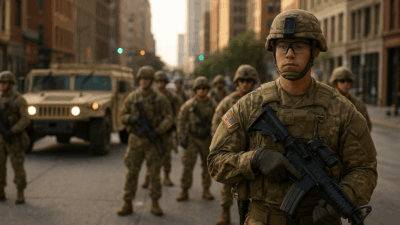
West Virginia Gov. Patrick Morrisey has deployed 300-400 members of West Virginia’s National Guard to Washington, D.C. “to support the President’s initiative to restore cleanliness and safety” to the district.

Violent crime in the district is at a 30-year low.
If the concern is really safety, then the National Guard should have stayed in West Virginia. Both Charleston and Huntington have higher violent crime rates than Washington, D.C.
West Virginia’s two largest cities both have a crime rate of 1.5K per 100,000 people, compared to D.C.’s rate of 931.6, according to 2024 data from the Federal Bureau of Investigation.
Or maybe the guardsmen could have just stayed at home, doing their jobs and being with their families. Because as someone who has lived in Charleston for 12 years, and visits Huntington often — I feel safe in both places. When visiting Washington, D.C., I’ve never felt in danger either.
The American Civil Liberties Union of West Virginia filed a complaint last week over the deployment on behalf of the West Virginia Citizen Action Group, listing Morrisey and Maj. General James Seward, the Adjutant General for the West Virginia National Guard, as defendants.
“This action challenges an unprecedented and unlawful deployment of West Virginia National Guard forces beyond our state’s borders — not to defend against invasion, not to respond to natural disaster, not to assist a sister state’s emergency request — but to serve as political props in a manufactured crisis,” the group says in the complaint. “West Virginia law is clear: The governor may deploy the National Guard outside our borders only for specific, enumerated purposes — none of which exist here.”
Morrisey’s office said that the National Guard was “mobilized at the request of the President under the authority in United States Code, Title 32 502(f).”
Along with West Virginia, five other states — Louisiana, Mississippi, Ohio, Tennessee and South Carolina — have sent troops to the nation’s capital, with about 2,060 patrolling within the 68 square miles of the district. Jackson, Mississippi has the highest murder rate in the nation.
West Virginia — the state with the smallest population of those six — has sent the most troops. The other states sent 150-200 compared to the 300-400 Morrisey said he would send.
Remember in 2023 when former Gov. Jim Justice sent our National Guard to Texas to help Gov. Greg Abbott’s Operation Lone Star initiative?
For one month, 53 members of the West Virginia National Guard were deployed to Texas, costing the state more than $900,000. The governor’s office was sparse in details about what troops actually did during that time.
Reporting from other states shows that troops often didn’t have much to do, and were assigned busy work, like shoveling horse manure and filing paperwork.
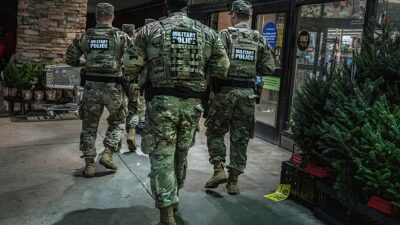
So far, according to the Associated Press, the troops in D.C. don’t really seem to be busy — they’ve been doing some crowd control at national monuments and protecting landmarks like the National Mall and Union Station.
And, well, they’re just being helpful and nice.
“Some troops have fed squirrels,” reported the AP. “One Guard member helped a woman carry her belongings down the stairs in a train station. Others have been seen taking photos with passers-by, standing around chatting and drinking coffee. There have been no overt indications that they have faced threats that would require weapons.”
Last week, Defense Secretary Pete Hegseth ordered National Guard troops to start carrying firearms while patrolling.
Most National Guard members don’t have the right training for this sort of deployment and are being put in a “no-win situation,” Alex Wagner, a former chief of staff to the Army secretary, told the AP. He said asking them to be armed is a “recipe for disaster.”
Troops don’t get the same “extensive training and the nuances that, for example, the police get,” for domestic disturbances and don’t know how to respond to it on a wide scale, Mark Cancian, a retired Marine Corps colonel and a senior adviser with the Center for Strategic and International Studies, told NPR.
Trump has suggested that after this, he may send troops to other cities, like Chicago and New York City and San Francisco — all Democratic-led cities.
“After we do this, we’ll go to another location, and we’ll make it safe also,” Trump has said.
There’s no end date to this current deployment. And with Morrisey’s history, he’ll likely send West Virginia’s National Guard to wherever Trump wants them to go next.
Every time Trump says jump, Morrisey asks how high, and tries to go the highest. It’s time for him to start jumping for West Virginians instead.