Just over a week after the 2016 presidential election, six Black women gathered in a Nashville casual restaurant.

One, Christiane Buggs, was elected to the Metro Nashville Schools Board in August. Another, Tequila Johnson, managed Bugg’s campaign. Charlane Oliver, a marketing director for a suburban chamber of commerce, had volunteered her communications skills. The other three, Aerin Washington, Verlinda Darden and Mariah Cole, worked on the campaign.
In the wake of Buggs’s win and more recently, the election of Donald Trump as president, the group members asked themselves the question often asked in portentous times: What’s next?
“I was angry about Black Lives Matter,” said Oliver, referring to the movement that grew as a response to the 2013 killing of Black teenager Trayvon Martin in Florida and 2014 police killings of Michael Brown in Missouri and Eric Garner in New York. “When Donald Trump got elected, that was the straw that broke the camel’s back.”
They discussed the needs of Nashville’s Black communities, based on their recent work in electoral politics. With each pledging to kick in $250 to launch an organization aimed at educating and mobilizing Black voters, they founded The Equity Alliance on Nov. 18, 2016.
Ten years later, the organization has spun off five other entities, including state and federal political action committees, registered hundreds of thousands of Black Tennesseans to vote — in 2018 alone, The Equity Alliance registered more than 91,000 through the Tennessee Black Voter Project — aided young, Black entrepreneurs in setting up shop and fed thousands through monthly community meals in three cities.
Oliver, who served as the Alliance’s first co-executive director with Johnson before leaving the group in 2022 for a successful state Senate run, said politics was the organization’s first focus.
“We wanted to make sure candidates we were supporting and endorsing at least had a ground group of people who were going to vote for them,” she said. “We wanted people to understand how powerful their vote was and to reach people averse to politics and expand the electorate.”

Red berets of response
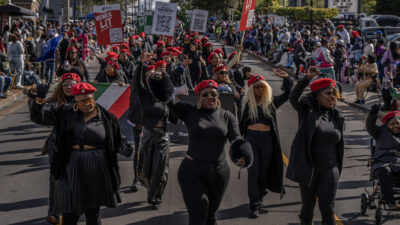
Lipstick-red berets have become the uniform of the Equity Alliance: they are hard to miss and evoke an era when groups like the Black Panthers organized in streets, challenged the political establishment and demanded that a nation live up to its promises.
But the Alliance’s story isn’t about a return to the past. It is about what happens when a new generation of Black women takes the lessons of earlier movements and joins them to politics in the present, in a state where Republican lawmakers have diminished Black voting power by gerrymandering and harsh redistricting, a state in which political power can determine who gets heard, who gets represented and whose neighborhood receives the resources it needs.
It’s not enough to show up and get people physically engaged when their basic needs aren’t being met.
– Tequila Johnson, CEO, The Equity Alliance
Johnson, now CEO, said Alliance leaders realized soon after launching that to achieve success through civic and political means, they needed to help meet the everyday needs of the Black Tennesseans they were trying to reach.
“It’s not enough to show up and get people physically engaged when their basic needs aren’t being met,” said Johnson.
Johnson created a community engagement pyramid based on Maslow’s Hierarchy of Needs, a five-tier psychological theory developed by American psychologist Abraham Maslow. Like Maslow’s structure, the Equity Alliance model seeks to ensure community members have tools for survival and stability before they can be free to grow into higher levels, including leadership and advocacy.
Rapid response following environmental disasters, including a catastrophic Nashville tornado in March 2020 and a January 2026 ice storm that led to power outages in Memphis and Nashville, meet the first level on the pyramid.
“Feed the Block” is another, offering monthly gatherings in Memphis, Nashville and Clarksville neighborhoods,in which local food trucks sponsor and cater community suppers.

The next generation
After 10 years, Alliance leaders are again asking, “what’s next?”
“We are in a place where we need to grow and diversify our leadership,” said Johnson. “We are looking at 20 or 30 years from now. I want to see 20 more ‘mes.” I want to see 20 more young Black leaders.”
She wants a rapid response hub, a community center through which people can get food, generators, and find temporary housing following emergency situations. Johnson sees herself as growing into a national voice for the South, calling attention to the latent political power here and the benefits of investing in civic infrastructure.
Oliver said she once dreamed of raising enough money to hire an executive director; now, the organization has 20 full time staff members and employed 250 in Memphis during the recent election cycle.
“It’s hard to put into words, sitting back, not being attached to the organization,” said Oliver. “I beam when I hear they are adding staff.”
“We planted seeds, we didn’t know how it was going to sprout,” she said. “It had ripple effects. That’s how change happens. You don’t get to control the end result.”
“You do your part and be hopeful the next person catches the baton and carries it forward.”
Tennessee Lookout photojournalist John Partipilo traveled across the state with Equity Alliance staff members and volunteers through summer and fall 2026, documenting political and civic activism in the wake of congressional redistricting, “Feed the Block” meals, strategic planning sessions, parades and rallies.
Bet on Black women


Building political power


Feed the Block


Civic engagement and voter registration