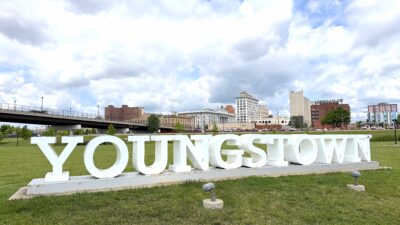
A Postindustrial columnist, consultant, and champion of communities like Youngstown, Ohio, writes about the need for consistent, productive investment in business, housing, and the state’s long-term health.

When it comes to emerging technologies in Ohio, public opinion varies, especially when it comes to data centers.
Public opposition to data centers generates the most headlines, both here and across the country.
However, amid the debate, I think we may be missing the bigger picture: an entire economic ecosystem could grow these investments.
And when it comes to Northeast and Appalachian Ohio, I keep coming back to the same question:
What comes next for regions that have spent decades navigating the decline of steel, coal, and other traditional industries?
I believe an opportunity for growth and change lies ahead, but we won’t realize its full potential if we keep looking at each investment in isolation.
I don’t believe Ohio needs to choose its next big industry. We need to connect the industries, infrastructure, and opportunities already taking shape.
Energy is where much of the reimagining begins
Ohio has an opportunity to turn its energy resources and generation capacity into a competitive economic advantage.
For example, the planned PORTS-Pike Technology Campus in southern Ohio pairs large-scale AI computing with new power generation. Investments of this scale create potential demand for construction, engineering, equipment, and supporting industries. The question is whether we are thinking strategically enough about how these investments can benefit the broader regional economy.
AI and advanced computing are the visible pieces of this puzzle
Data centers have become the headline, but I don’t think the buildings themselves are the most interesting part of the story.
The businesses that build, supply, maintain, and secure these facilities, along with the research and innovation they can support, represent a broader range of opportunities.
Defense and dual-use technology offer another connection
The PORTS-Pike campus has been positioned to support advanced computing and research. At the same time, work with partners like NASA Glenn Research Center demonstrates Ohio’s potential in areas such as drone technology.
Connecting these efforts with our existing manufacturing and engineering capabilities could open new opportunities for research, production, and specialized workforce development.
Manufacturing may be where these connections become especially meaningful for our region
Ohio already has a well-established industrial foundation.
A recent report by renowned consulting firm McKinsey & Company, providing 2026 analysis of the state’s industrial capabilities, points to opportunities in areas such as semiconductor infrastructure, data centers, power generation, and energy storage.
Rather than focusing solely on attracting new industries, let’s help existing businesses enter emerging supply chains and prepare workers to fill the jobs these industries create.
And that brings me to what I believe could become one of the biggest barriers to our success:
Housing!
I don’t see housing as an issue to address after economic development takes off.
I see it as a fundamental part of the strategy.
Major investments increase demand for workers, but those workers need somewhere to live. Communities also need the utilities, transportation, and public services to support growth. Without adequate, affordable housing, employers may struggle to attract talent, while existing residents risk being priced out of their own communities.
I worry we aren’t giving these challenges enough attention early in the development process. Ohio’s affordability pressures, including utility costs, underscore why housing and infrastructure planning must happen alongside economic development—not after major investments are already underway.
When I connect these pieces, I see a much bigger opportunity for Ohio:
Energy generation → AI and advanced computing → Advanced manufacturing and defense technology → Jobs and workforce opportunities → Housing and community growth
Of course, these connections won’t happen automatically. A data center doesn’t guarantee new manufacturing jobs, and a major investment doesn’t automatically translate into prosperity for nearby communities. Realizing that potential requires deliberate coordination: aligning workforce training with industry needs, helping local businesses compete for contracts, and ensuring communities have the infrastructure to accommodate growth.
This is especially important in Appalachian Ohio, where communities have worked for years to diversify their economies and create opportunities for residents. I’m not interested in telling people that data centers alone will create major jobs. Their direct, permanent employment impact is relatively limited compared with the scale of investment. But the broader ecosystem surrounding them could create meaningful opportunities across construction, energy, manufacturing, research, and technology.
The distinction is important, and I don’t think we’re telling that story well enough yet
Too often, economic development conversations focus on individual projects: the investment amount, the facility being built, or the jobs expected.
Those details matter, but we also need to ask what comes next.
Can local businesses join the supply chain?
Are workforce programs preparing people for emerging opportunities?
Do communities have the housing and infrastructure to support growth?
How can we ensure rural and Appalachian communities participate in these opportunities rather than host the projects?
These are the questions I want to see more of our elected officials and economic development leaders asking. They should also shape how we evaluate success—not just by the size of an investment, but by the opportunities it creates for existing businesses, the workers it prepares, and the communities it strengthens.
For me, this is about more than telling a compelling story. It’s about taking a comprehensive approach to economic development—one that recognizes how industries depend on one another and plans accordingly.
Ohio has an opportunity to build on its existing strengths, connect new investments to local assets, and strengthen the foundation for long-term regional prosperity.
AI may be the visible tip of the spear, with energy providing the spark and manufacturing, defense, and research extending the potential impact.
But our success will depend on whether we can connect those investments to the people, businesses, housing, and infrastructure that make communities thrive.
We need to stop asking only what a new investment will bring to a community and start asking what a community needs to gain from it
That means planning for the entire ecosystem from the beginning, preparing local businesses and workers to participate, and ensuring housing and infrastructure keep pace with growth.
For those of us working in economic development, that is the challenge—and the opportunity. We have to connect the dots before we can expect our communities to see the full picture.
Ohio’s future won’t be defined simply by what we build. It will be defined by what we’re prepared to build around it—and who benefits.