Battery Storage Projects Stall in Maryland, Undermining Clean Energy Momentum.

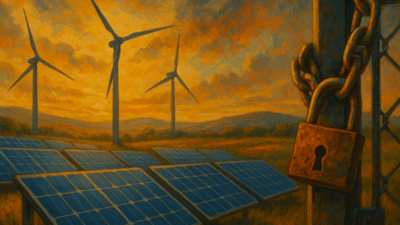
Maryland’s quest to transition toward clean energy is hitting a critical impasse as battery storage projects, vital in integrating renewable power, are being delayed or canceled.
PJM Interconnection, the regional grid operator, faces criticism from state officials, including Governor Wes Moore, for delaying critical transmission upgrades needed to replace aging coal-fired infrastructure, such as the Brandon Shores plant near Baltimore.
The stagnation threatens state climate ambitions and risks prolonging reliance on fossil fuel infrastructure in the Baltimore region and beyond.
State lawmakers recently wrapped their 2025 legislative session with new energy mandates, including requirements for utilities to deploy at least 150 megawatts of grid-scale battery storage under the Next Generation Energy Act.
A companion law mandates a total of 800 megawatts of storage procurement by Oct. 2026. Yet, despite the legislative push, industry insiders report major setbacks in financing and implementing battery projects across the state.
Compounding the issue, a national review by Clean Energy Associates revealed that over 20 gigawatt-hours of planned battery cell capacity, sufficient to power tens of thousands of homes, was canceled in 2025 alone.
The downturn reflects investor reluctance amid shifting federal policies, evolving tariffs, and uncertain demand forecasts, according to PV Magazine.
At the local level, experts warn that a backlog of clean-energy projects awaiting grid interconnection is obstructing Maryland’s transition.
Though the plant’s planned retirement was set for June 2025, reliability concerns have extended operations into 2029 under an expensive must‑run agreement with grid operators.
Maryland has set ambitious emission reduction goals, aiming to cut greenhouse gases by 60% by 2031 and achieve net-zero emissions by 2045.
Yet progress has faltered.
Renewables, particularly solar and battery projects, are lagging as ratepayer protections and operational costs collide with environmental targets.
Although state climate legislation includes clean-energy commitments, multiple projects have been delayed, and the legislature is still considering parallel language designed to protect ratepayers amid rising utility costs.
Environmental advocates say the slowdown reveals a deeper structural issue: Despite firm state policy, meaningful deployment depends on interwoven infrastructure, private-sector certainty, and predictable federal incentives.
The rollback of federal clean energy subsidies and tightened financing rules under the current administration have rattled project backers nationwide, curtailing expansions from major renewable developers and battery producers, Reuters reports.
While Maryland’s new laws afford clearer pathways for solar and storage development, oversight groups emphasize that regulatory frameworks must be paired with accelerated grid investments.
Without expanded transmission, slated projects will remain idle in queue systems, potentially clogging PJM projects for five to six years, which could stall clean power that could replace coal plants and mitigate climate risks.
The growing misalignment between legislation and implementation has prompted local clean-energy advocates to call for immediate action. They demand faster siting approvals, federal coordination to restore lost incentives, and a firm commitment to grid modernization to uphold Maryland’s stated climate priorities.
Why It Matters
- Clean-energy stagnation: Despite policy mandates, most battery projects in Maryland remain unbuilt due to permitting, financial uncertainty, and grid constraints.
- Grid reliability: Without prompt storage and transmission upgrades, aging coal plants will remain online longer under expensive contracts ($215 million/year for plants like Brandon Shores).
- Fiscal and climate risks: Delays could increase utility costs, jeopardize emissions reductions, and erode public confidence in the state’s energy transformation.
The announcement follows the recent Pennsylvania Energy and Innovation Summit at Carnegie Mellon University, where President Trump and corporate leaders announced more than $90 billion in new private-sector investment in the state.
The full speaker lineup will be announced in early August.