Born in Pennsylvania and living in Tennessee, a new Postindustrial contributor and author shares an essay on what inspired her novel, “Borough of Blooms.”

One: Everyone was hungry.
After growing up in Dale Borough, an un-annexed sliver of land inside the City of Johnstown, and moving away at 17, I knew from the many visits back home about the decline of the neighborhood.
I knew that most of the kids were on free or reduced-price lunch programs, and that the first drive-by shooting had happened at Punky’s Pizza Parlor at the corner of Von Lunen and David Streets— the dividing line between us and “the city.” Where all the crime used to happen.
Just across the road, we lived in a bubble of Old-World (mostly German) immigrant life, front porch culture, and community. In the days when I grew up there in the 70s and 80s, our fridge was full of sirloin and salmon, and the yard buzzed with games of badminton.
In the summer of 2005, inspired by this place in my own poems, I went back to Dale to work with the children in a grant-funded poetry and art program, hoping to explore the “beauty and the blight.” We set up shop in a sweltering, no AC, carriage house above a garage in the alley, graciously lent by a childhood friend. To reach the rooms, you climbed creaky wooden stairs and were greeted with a bleach-white clawfoot tub at the door that was supposed to be removed but never was. Eventually, we planted petunias in it.
To say it was a grassroots effort is an understatement, but I had made pre-visits and the kids signed up and seemed excited to start. However, after setting up the pens and notebooks at 9:00 am, absolutely no children showed. All the bikes, decorated with streamers and normally left strewn around the sidewalks, had seemingly vanished.
Perplexed, I set off through the alleys to try to find the kids. As I jogged through the apocalyptic scene, I met a girl perched up against one of the abandoned garages, her nose bleeding. I handed her a tissue and asked,
“Where are all the kids?”
“They’re at the Fire Hall eating breakfast,” she said as though everyone in the borough would know about the federally funded breakfast and lunch.
“Ah, got it.”
From that day on, I learned about the hunger. We’d bought multiple 24-packs of fruit bars and juice packs. It wasn’t enough. We went back to the Dollar Store repeatedly. And if I had to admit it, many came because of the sugar, then stayed for the art. That was OK with me and my partner, an artist from Upstate New York. We were happy to see faces gathered around a table that never seemed to level on the tilted floors, in one of the most unlikely places for creating works that would eventually become an exhibit.
But even with all the hunger and decay around us, the second thing that shocked me was:
It was still Mayberry.
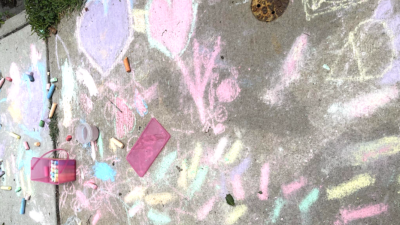
At least in a Northern Industrial kind of way. The streets of my childhood had always seemed magically imbued with color — all of us outside all day drawing hopscotch diagrams on the sidewalks with chalk, trusting neighbors to band-aid our cuts, and living in the dug-outs of the playgrounds where summer leaders had us making papier-mâché creations.
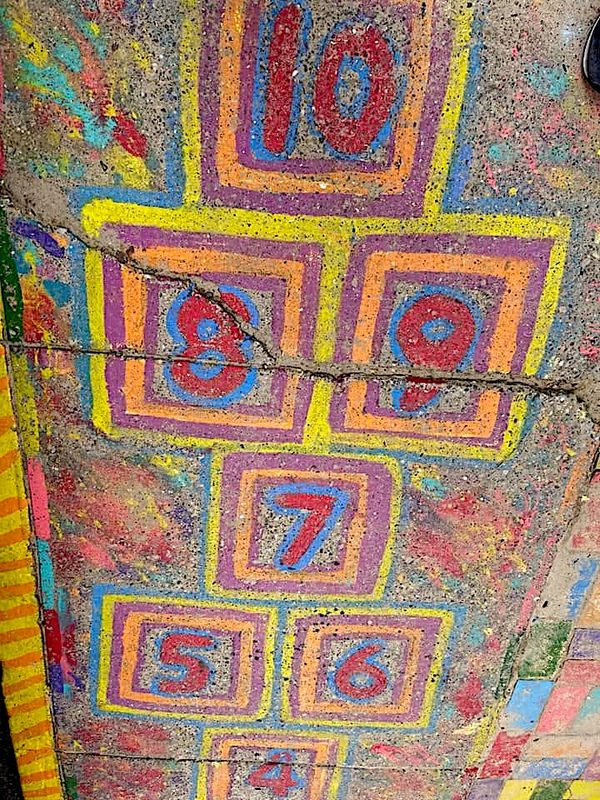
Image courtesy of Sandee Gertz
The Beulah United Methodist Church, with its Grecian green dome, still loomed large over the borough and took in the children for Wednesday night suppers and Vacation Bible School. The girls and boys still trudged down the aisles with candelabra and memorized bible verses. And then it dawned on me: I had been looking at the borough through an adult lens.
Sure, many in Dale are unemployed or “over-employed” with too many jobs, each not paying enough. But through the children’s eyes, I saw much of what never changed: one of the first things was the decorated bikes. In the past, it had been an art to weave the colored streamers through the handlebars, and I noticed older teens still guided the hands of the younger. And when the kids weren’t riding, they were bouncing in and out of the backyard makeshift pools: inflatable and prone to questionable green algae by mid-summer. I discovered the girls lived in their bathing suits, swimming in a heady freedom of unscheduled play; and what struck me most was that they all wore the same bejeweled flip-flops for every activity, no matter how impractical, which glittered in the noonday sun. If one girl tripped on our site walks on the Dollar Store soles, another picked them up.
And this is where the inspiration began for me. In the sparkle of the sandals, the way the “The Glitter Girls” (as I call them in my novel) lived as if there was no better place to be than in the valley bowl of Dale on David Street. And as I watched them, I knew I had to write about it: the way they were composed beyond their years, often locked out of their homes without complaint, yet genuinely innocent. Many responsible for themselves at 9 or 10, and their even younger siblings they always had in tow.
“I had to bring him,” one girl said as her 5-year-old brother plopped down at the table. “He will tell me what to write, and I’ll write it for him.”
Over that summer, the dry-erase board wedged into the splintered windows, the 1930’s icebox “on the blink,” the tub that greeted everyone into the carriage house rooms that used to house a family, became so much more than their bedraggled parts and developed into a community center that seemed lost in time. I almost felt the presence of a turn of the century “Housedress Woman” in the kitchen at the apron sink or bending to the mopping of the porch.
And this is where my novel, currently out on submission, found its core: grounded in gritty reality, but with magical realism to allow the Glitter Girls to take flight and fly back to past, more abundant versions of the borough, when the soil was that of an orchard and the steel mills were just beginning to boom.
Walled off between the Conemaugh Gap on one side and the formerly impenetrable Allegheny Front on the other, I continue to be struck by the contrasts of my Urban Appalachian home. One part dense city, one part untouched and sheltered. In all my travels, I don’t know a place quite like it.
“Borough of Blooms” hopes to shed light on a place that may be forgotten and currently covered in a sepia filter, but one I am obsessed with peeling back to reveal the lush colors underneath.