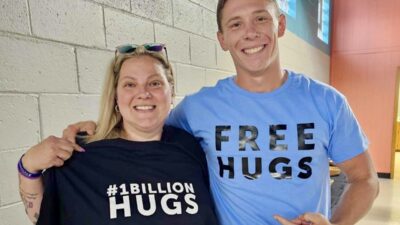
Parkersburg, West Virginia native, Reed Byers, believes that a small gesture, offered at the right moment, can cut through the kind of loneliness many people carry but often struggle to name.

In West Virginia, where isolation is common and connection frequently feels like something one must earn, he learned early what it meant to grow up without the safety nets other places take for granted. So when a stranger wrapped him in a hug one morning at a Tudor’s Biscuit World in Huntington — no questions, no judgment — it landed with a force he couldn’t shake.
That moment didn’t solve anything outright, but it reframed something for Byers. After years of addiction, loss and rebuilding, he’d been carrying the quiet weight familiar to so many Americans, and particularly Appalachians, who navigate their hardest days alone. The simple act of someone pulling him in — just long enough to feel seen — became the seed of an idea he couldn’t ignore.
Today, that idea has taken shape as #1BillionHugs, a community-rooted effort built around human contact, mental health and the kind of everyday grace that rarely makes headlines. What started as a T-shirt with a catchy slogan has begun to spread across the state and beyond, carried by people who understand the power of a gesture that asks for nothing in return. And in a region where the struggle can be both connection and the chance to build a life that feels possible, Byers is betting that something as small and unguarded as a hug might change the way people feel about themselves, their neighbors, and the place they call home.Full circles being what they are, Byers’ life didn’t follow a straight line. Born in Marietta, Ohio, he spent his early childhood in Parkersburg, where his father worked at a plant and his mother earned a nursing degree.
“Before 13, I had a pretty decent childhood,” he said. “Yes, there was domestic violence and drug use, but when they were present, when they weren’t consumed with that, they were pretty good parents. I was involved in rec sports and extracurriculars and academic stuff, and I had clothes on my back.”
Everything shifted when the family broke apart. A volatile divorce sent him to North Carolina for several years — deepening the instability. His mother left the family for a drug dealer, falling deeper into addiction, and his father didn’t know how to cope.
“Next thing you know, my brother’s 17 and catching a felony for trafficking weed. And here I am, watching all this happen at 13.”
Byers was the last in his immediate family to start using drugs — at 13.
“It was sort of part of our family culture,” he said.
He returned to West Virginia during high school, moving to St. Marys with his father. They smoked marijuana together until Byers realized he needed something different.
“I wanted to go to college. I was in youth leadership programs. I was on an academic team, a science bowl team. I really wanted to make a difference — pursue academic endeavors — but my lifestyle, family life, wasn’t really conducive to that.”
So Byers staged his own intervention — moving out, living with an aunt and finally landing in a small community outreach apartment where staff let him stay if he promised to attend school.
“Which I did,” he said. “I was the first immediate sibling to graduate high school.”
After graduation, he tried to cling to the few positive influences in his life, working briefly at Camp Horseshoe, where he’d seen a glimpse of structure and purpose.
College came next — West Virginia Wesleyan — though it didn’t last. Dropping out left him adrift.
“I fell into the bar scene, eventually getting diagnosed with a mental illness, ending up homeless,” he said. “This pattern continued over the next four years in my early 20s — homelessness, mental illness, onset drug use.”
The spiral deepened until, at 24, he was arrested in Ohio.
“You go from smoking weed at 13 to trafficking meth at 24”
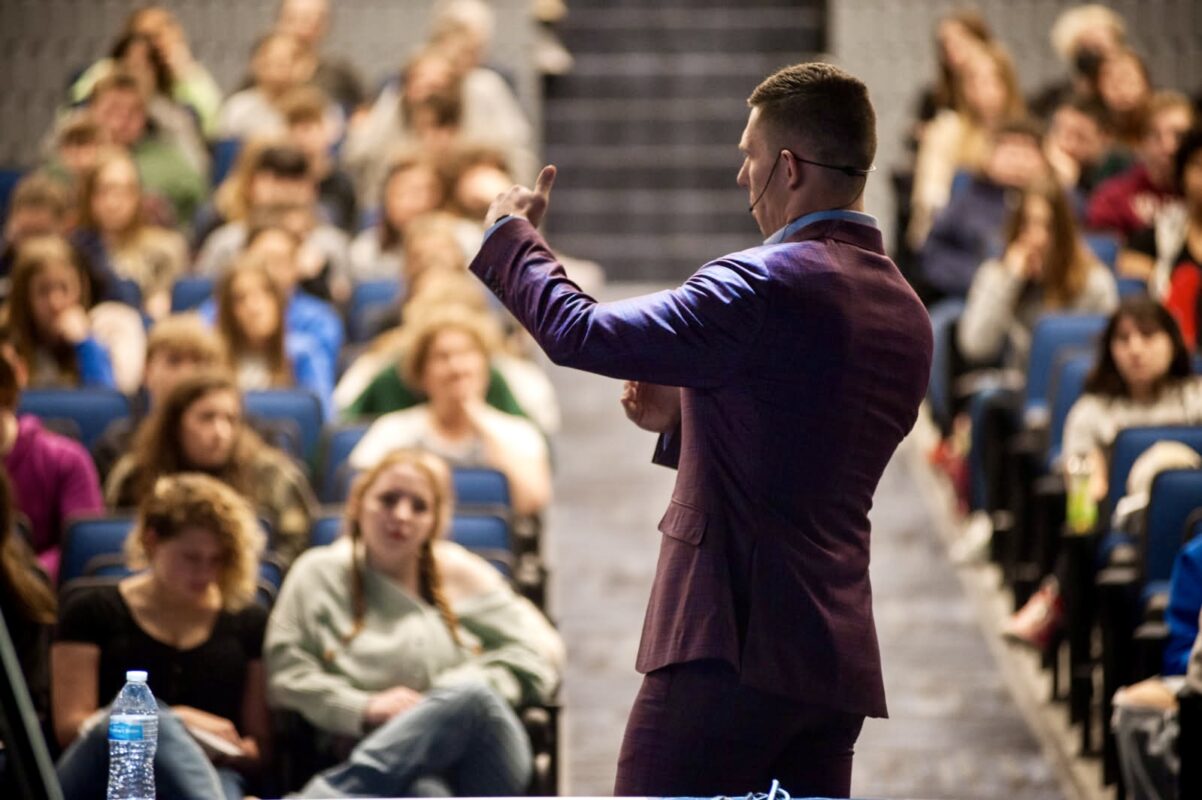
Byers uses his story to help audiences rethink what resilience can look like — and how community can carry people through their hardest seasons. (Courtesy photo)
Called to create
Prison became the hard stop he never saw coming. And yet, even there, someone showed up for him.
“The only person that came and visited me at Noble Correctional Institution was my mentor, David King — the director of Camp Horseshoe in the Youth Leadership Association,” Byers said — noting that King had believed in him long before he believed in himself. “He used to drop off canned goods and books on the porch of the boarding house when I was in high school. This guy genuinely believed in me, saw potential in me. He came to my graduation and gave me “The Purpose Driven Life.”
In prison, King pushed Byers to see possibility.
“He saw something in me that I didn’t see. He said, no, you’ve got a purpose. You see what’s not working. You’ve witnessed people around you lose their lives, take their lives, give it away and you’ve chosen your health instead.”
Together, they sketched out the framework that would anchor Byers’ return to the world: a four-page plan of action: mind, spirit, body, relationships.
Upon returning home in 2020, Byers felt something unfamiliar — clarity.
“I thought, I’ve really put my health together. I’d lost 60 pounds. I’d started working out and running. What do I want to do with my life?” The answer arrived quickly. “I wanted to be helpful. That was the answer.”
Byers took a job as a youth peer supporter at Westbrook Health Services — the same agency where he’d once been a patient. However, while the work was meaningful, he discovered the system wasn’t built for someone like him.
“Organizationally, the systems that exist that we’ve created are not meeting all of the needs in the communities,” he said. “You hired me to make a difference because of my lived experience, but now my lived experience is becoming a barrier.”
Byers wasn’t allowed into high schools or the Boys & Girls Club because of his background.
“These kids are often the ones going home to the harshest environments — sometimes wanting to take their own lives. We were receiving grant money from the state to solve these problems, but you’re telling me no.”
And so he left, determined to build something outside the limits of existing structures. He created a youth recovery initiative called How to Save a Life, developed programming, built an advisory team, raised funds, and was close to a $50,000 pilot. But still, something felt misaligned.
“Even working underneath an existing nonprofit wasn’t the best fit because I’m called to go and build my own thing. I can work well with people. I just think I’m called to create and not necessarily fit inside of a container.”
Byers pivoted again — this time into a new identity.
“I ended up opening a business as a motivational speaker,” he said. “I’ve been operating that for over three years now — it’s been very successful.”
He’s spoken to mental health organizations, high school assemblies, civic groups, health departments, universities and tens of thousands online. His message is simple and relentless: Recovery is possible. Yes, you can do it. Take care of your mind, spirit, body. And we are all responsible in our community for affecting the change that we believe in. Nobody’s coming to save us.
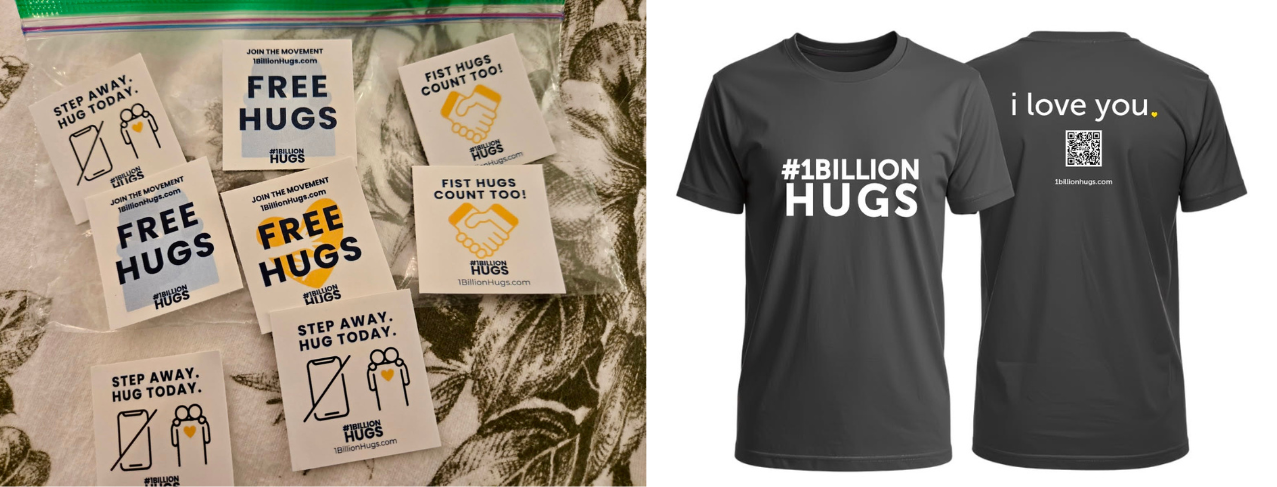
(Left) #1BillionHugs stickers carry the movement’s core message: step toward one another, even if just for a moment. (Right) At the heart of the endeavor, Byers considers each #1BillionHugs T-shirt a wearable signal of hope, carried into the world one person at a time. (Courtesy photos)
More than a brand
At this point in his life, two things stand out most for Byers when thinking about West Virginia: the depth of its people and the limits of opportunity.
“It doesn’t seem like there’s ever enough resources,” he said.
In his attempts to crack the code, Byers has served on nonprofit boards, built volunteer movements, run for office, and eventually held a seat on the Cabell County Board of Education.
“Our budget was $150 million and we still couldn’t pay our teachers enough to not want go to Ohio or Kentucky or Virginia,” he indicated. “To me, that’s unacceptable.”
So he asked himself what most people in his position eventually ask: What can I do that actually changes anything? He was already speaking professionally, consulting with nonprofits, and stepping into places where lived experience and clarity carried weight. But he wanted something bigger than speeches and incremental change.
“What if I started a business and found a real way to drive revenue that we could then invest in our region to solve the same social challenges I’ve been trying to solve for five years?” he said. “Mental health, suicide, addiction, recovery, lack of economic opportunity, poor health metrics, obesity, et cetera. How do we solve this holistic slew of social challenges in a simple and focused way through a business?”
The answer came in a way he didn’t expect.
“God put it on my heart that we could do that through essentially selling ‘Free Hugs’ T-shirts,” he said. “But the movement is so much bigger than that.”
What emerged was #1BillionHugs — not an apparel line, but a human-scale intervention.
“The endeavor came to mind as a way to promote this wearable symbol of hope,” Byers said. “To catalyze connection with individuals and, in that connected moment, to be a reason that people want to stay on this planet.”
He knows exactly what that moment can do.
“I was wearing a Free Hugs T-shirt years ago, and I had wanted to take my life. I showed up at a Tudor’s Biscuit World to kind of self-medicate with food. And a woman behind the counter was jumping up and down pointing at her chest, and I realized she was motioning at the front of my shirt. So I said, ‘Come on out here.’ And she gave me a big-old hug. She said, ‘You don’t know how bad I needed that.’ And I told her I needed it too.”
He sat down afterward, still shaken, and another couple approached him.
“They said, ‘We really appreciate you wearing that shirt.’ And I knew in that moment it was more than just a shirt. I was showing up imperfect, hadn’t shaved, hadn’t showered, had been in bed for a couple days — I knew that I was good enough to make a difference. And in that moment of connection, I didn’t want to take my life anymore.”
For Byers, that was the blueprint.
“This isn’t like building an apparel brand,” he said. “This is a movement to get a billion people hugging more — to create a billion reasons to stay on this planet. Because if a billion people are engaged in connection, you’re going to have less suicide, improved mental health, improved psyche and rapport in your communities. You’re going to take better care of your physical health, have increased economic opportunities, increased collaboration.”
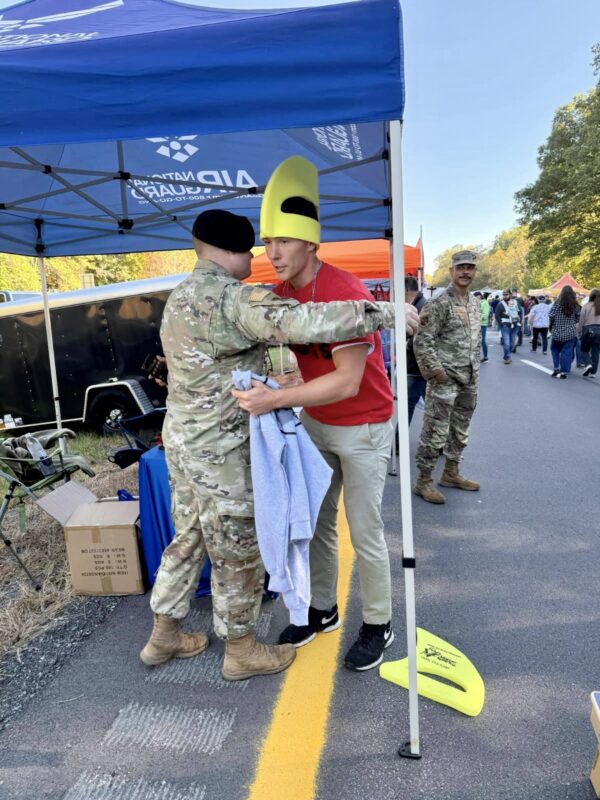
Whether at festivals, community centers, or chance encounters on the street, Byers uses one simple gesture to remind people they’re seen, valued, and not alone. (Courtesy photo)
Further proof
When Byers first imagined #1BillionHugs as an actual brand, the vision arrived all at once.
“I thought, wow, you can count hugs essentially by people using the hashtag,” he said. “Which made me think about scale. What does that mean, a billion hugs? What would it take to get there? Maybe you have a hug counter. Maybe selling a billion shirts will also help you get there.”
His own willingness to learn became the driving force.
“I also had to ask myself if I was willing to commit my life to it,” he said. “Was I willing to keep going until we get to a billion and this becomes my life’s work?”
Ultimately, an injury forced him to slow down — and build.
“I blew my knee out and I had to sit down,” he said. “Thankfully, having surgery allowed me to get to work on the website.”
A collection of different designers finally got the logo to his liking. The first shirt design emerged.
“I was consulting with people in my network for six months.”
The first pre-order was printed through Mountain Mindful at Coalfield Development, but Byers quickly realized he needed a different long-term partner. A chance meeting with a local pastor introduced him to a young Marshall student running his own print shop.
Soon after, the website launched in August. And the response was immediate.
“We did 117 units in our four-week pre-order,” he added. “We had so much response from the press — a TV commercial, a segment on WSAZ, a couple different press publications. I spoke on a global mental wellness summit. Boys & Girls Club published our release. I got to speak at the West Virginia Goes Purple Fest. We’ve had so many hug ambassadors and people supporting the movement, and we’re not even three months in.”
Further proof, for Byers, that the need is real.
“People are hungry for connection. People want to support organizations like the Boys & Girls Club and the Youth Leadership Association — where 10% of our proceeds go to.”
All the while, he knows that pace is the lesson.
“Rome wasn’t built in a day. Nike did $6,000 in their first year. Twenty thousand in their second. I’m confident we’re going to do better than both of those numbers. But we don’t expect a billion in a year. I’ve learned to move at a sustainable pace versus all-or-nothing.”
Operationally, #1BillionHugs is obviously quite young, but the movement has already spread farther than Byers expected. “That first four-week pre-order went all over the nation,” he said.
Most of the early response has come through online marketing and the Shopify store that feeds directly into the website. There, supporters can track their own hugs on the site’s counters, join a Facebook group where people share photos and stories, and contribute to a business page that is approaching its first thousand followers.
Byers has also assembled what he calls “hug hustlers” — brand ambassadors who help sell shirts, give hugs and spread the message.
“We do accept applications for new hug hustlers,” he said. “We do want to engage with volunteers. We’re working on how that can be more formal and streamlined, because it’s mostly just me right now in terms of managing the operations.”
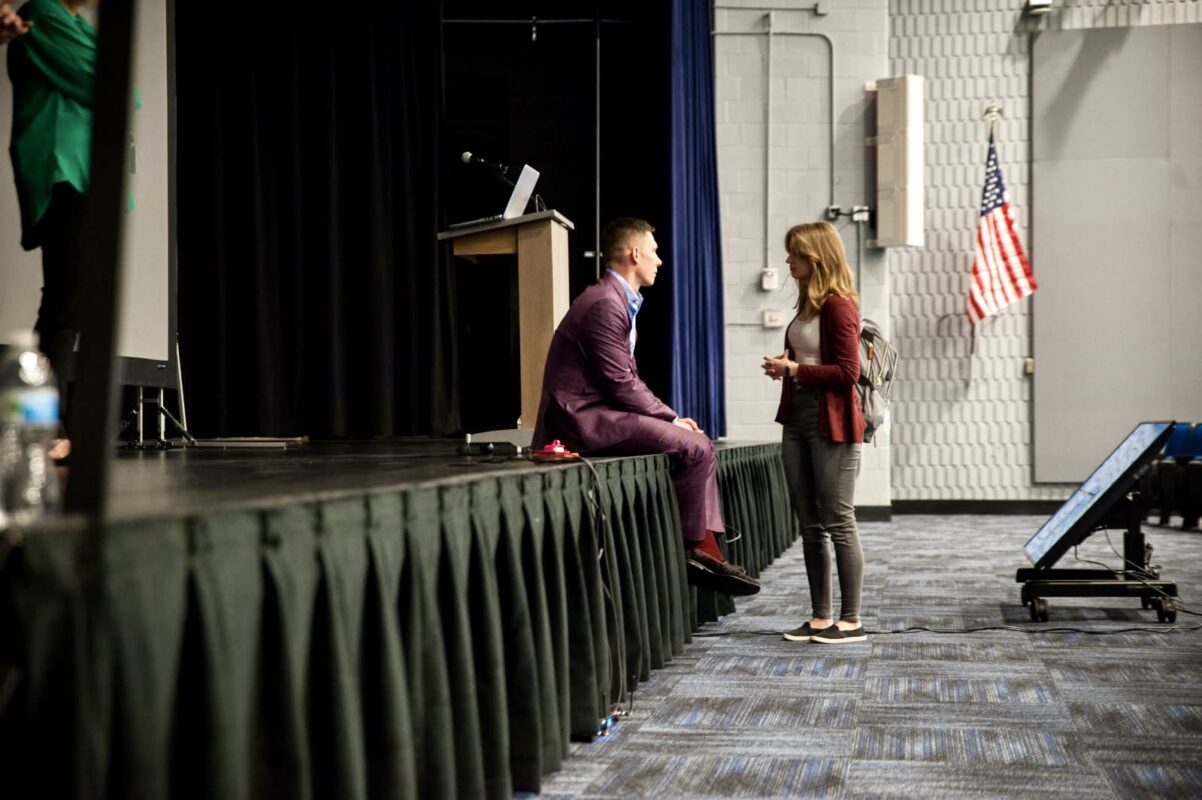
Byers speaks to students about mental health, recovery, and the power of showing up for one another—messages he once needed himself. (Courtesy photo)
A new story
Byers is building the kind of partnerships he believes will ground the movement in communities.
“I’ve met with nine pastors — trying to figure out how the message fits with churches,” he said — while simultaneously thinking carefully about how to involve schools in the future. “I’ve been hesitant to introduce it directly into schools so far, just because of the physical consent piece. You don’t want to spark anything that’s inappropriate, but you do want the kids to know that they’re loved, welcomed, and valued.”
The project donates 10% of its proceeds to charity partners — the Boys & Girls Club and the Youth Leadership Association — and Byers sent each a check recently.
“It’s $150 to each of those organizations — so $300 total we’ve donated just from August. It’s not a ton of money, but for me, as a person who came from tough circumstances, from the streets, no shoes, it means a lot. It shows me the vehicle that I was led to create, that people invested in, is producing fruit.”
As for explaining how #1BillionHugs fits into Appalachia, Byers doesn’t hesitate.
“This state, region, all of it — we have our different social challenges, but there is a massive amount of social capital. Kindness.”
He’s seen it everywhere he goes. “It’s challenging for me to go anywhere in the state and not see somebody that I know,” he said — admitting that wearing the shirt opens new connections instantly — sometimes with people he didn’t realize he already shared community with.
“Like the day I hugged a stranger who turned out to be the new director of the West Virginia Community Development Hub.”
Ultimately, Byers affirmed, Appalachia is where the idea emerged, and where the need feels most urgent.
“My family has been plagued by mental illness and addiction,” he said. “I’ve lost a number of people who are very close to me — my brother, my mother, my best friend. Several of my classmates in high school to suicide and addiction. This place is where the idea met me and where its biggest and greatest impact will be carried out.”
Accordingly, he finds proof of concept wherever he goes.
“People will share their stories, their personal connection to addiction, their personal connection to mental illness — to suicide,” he said. “I’m continuously amazed by what comes up when I just wear these shirts and live out the mission.”
Among his greatest challenges at this point is a lack of personnel.
“I’m extroverted by nature — and not having a fortified enough internal team or system to brainstorm and hash these ideas out has been tough,” he said. “And I can admit an occasional lack of emotional or mental fortitude in terms of being able to live out this dream optimally. But the greater point is that I continue showing up.”
For Byers, the future depends on him showing up. And when he pictures success five or 10 years down the road, it’s not about a number on a hug counter.
“It goes beyond that,” he said. “I see the young people that look like I once did — on the west side of Charleston, or Parkersburg, or up in the hills of Preston County. The ones who need loving, caring, supportive adults. And because they might not have access to that, they’re ending up on the wrong path.”
Success, to him, is both simple and sophisticated. “It’s about being a presence in those areas and many more like them — seeing how all of the young people are supported and cared for. So they don’t have to go down the same path I did, which led to incarceration. So they don’t end up lonely, isolated or taking their lives like so many of my friends have.”
Byers describes #1BillionHugs as the front end of a comprehensive effort.
“We get people hugging, we sell the merchandise, we create the revenue, and we invest that back into Appalachia,” he said. “If it works, the region becomes something people haven’t seen in generations. Appalachia becomes a beacon of hope. Where people want to move, want to stay, where people aren’t in despair, and where people are healing and healed and sharing that healing with others.”
To see that happen, to help build it, Byers said, “… is how I would define success.”