For decades, the standard Democratic campaign strategy in rural and factory towns has disappointed and disconnected voters. Here are some ways to fix that.

Two leading community organizations, The Rural Urban Bridge Initiative (RUBI) and Rust Belt Rising, teamed up to offer purple- and red-district rural and factory-town candidates a toolkit packed with campaign tactics and communications guidance.
Until now, most candidates leaned on national narratives, abstract debates about democracy, and a focus on college-educated voters.
As we approach the 2026 election, their toolkit challenges this status quo and offers a new way to run, built on one tenet: to win in the heart of America, candidates must stop sounding like politicians and start behaving like neighbors.
“We teamed up with Rust Belt Rising, an organization that reconnects the Democratic Party to its working-class base, and came up with original research to build this toolkit,” said Maggie Walsh, RUBI’s director of communications.
“This toolkit is a one-of-a-kind reference guide for all progressive candidates in rural and factory towns to win back trust and elevate working people’s priorities.”
A Shift in Focus
At the core of this new guide is a radical yet straightforward premise: abandon the fixation on national narratives and concentrate on the kitchen-table issues that keep voters awake at night.
In districts dominated by working-class voters, the gap between national party platforms and local realities has widened significantly.
Recent data show that only 31% of high school graduates intended to vote for Democrats in the most recent midterms, suggesting the current approach is not just ineffective—it’s alienating the very voters whose support is crucial to success.
The “neighbor” strategy
The toolkit advises candidates to avoid activist and academic jargon. Terms like “lived experience” or “BIPOC” do not resonate in local diners or factory floors.
Instead, candidates are encouraged to “talk like a neighbor” and focus on universal concerns such as the cost of groceries, gas prices, reliable internet service, and fears of online scams.
Moreover, voters are weary of being told to fear the opposition. While critiquing opponents is essential, it is insufficient when constituents feel their lives are spiraling out of control.
Candidates should instead prioritize their own agendas, presenting themselves as credible alternatives who understand that the system is rigged in favor of corporations and elites and who have concrete plans to rectify this.
Policy as a “hand-up”
When discussing policies, the toolkit promotes a “hand-up” approach rather than offering mere “handouts.” Voters in these regions take pride in their work and their ability to support their families.
They seek policies that empower them to help themselves, such as reshoring manufacturing, dismantling corporate monopolies that stifle small businesses, and investing in local infrastructure.
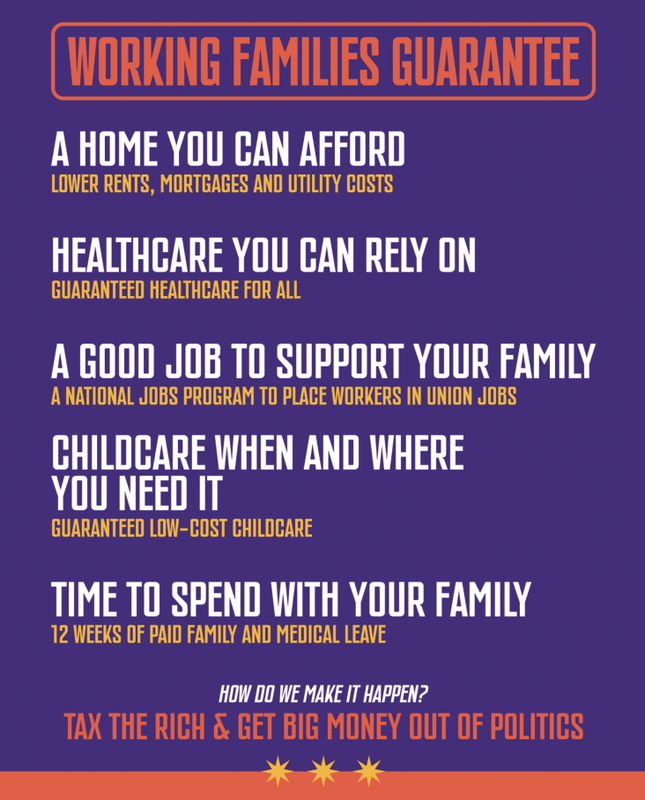
The “Working Families Guarantee” exemplifies this mindset, advocating for affordable housing, reliable healthcare, union jobs, and paid family leave. These policies are framed in universal terms, presented not as special interests but as basic rights for all working families.
By concentrating on these shared economic struggles, candidates can forge coalitions that transcend traditional cultural divides.
Engaging beyond the digital realm
One of the toolkit’s most actionable recommendations is to “get offline.” High-budget commercials and digital ads often feel like corporate noise.
The guide promotes a “Bedrock Approach” to social media, advocating authentic, DIY videos that feel like something a friend would share.
These videos should focus on community members, not the candidate. By showcasing local businesses, youth programs, or community success stories, candidates can express genuine affection for the places they wish to represent.
The toolkit also emphasizes the importance of constituent services, even before candidates are elected. By helping people navigate government bureaucracy or solve local problems, candidates can build trust long before Election Day. This strategy shows you are a problem-solver, not just another politician.
The importance of presence
Ultimately, the toolkit encourages candidates to show up everywhere: at gun shows, church picnics, Rotary club meetings, and high school football games. It suggests holding “upside-down” town halls, where candidates spend more time listening than speaking.
While it might be tempting to avoid contentious issues like immigration or gun control, the document offers strategies for addressing them: stay calm, acknowledge that reasonable people can disagree, and steer the conversation back to shared values.
“There are loads of useful nuts and bolts campaign training materials out there. What we’ve added to the mix are tips specifically for candidates running in places where non-Republican candidates face an uphill battle,” said Erica Etelson, RUBI cofounder and author of Beyond Contempt: How Liberals Can Communicate Across the Great Divide.
“The dynamics of these races call for depolarizing campaign strategies that appeal to Republicans, independents, and disaffected Democrats.”
For candidates in purple and red districts, victory lies not in shifting further left or right but in moving closer to the people.
By adopting a populist, community-centered approach that prioritizes economic dignity and local pride, candidates can bridge the divide.