A Postindustrial columnist, farmer, and state senate candidate in Michigan writes that the United States is at a tipping point in its ability to competitively grow fruits and vegetables, and that this is a national security risk.

The United States is at a tipping point in its ability to grow fruits and vegetables competitively.
This is no longer just an agricultural issue; it is a critical national security risk.
U.S. agriculture is rapidly getting priced out of the fresh produce market. This economic reality explains why local farmers are plowing under fruit trees and replacing them with row crops like corn. Row crops rely heavily on mechanized farming. In rural Michigan, you can always find a worker to drive a tractor.
What you cannot find is an American to pick fruits and vegetables. The country has reached a dangerous cliff where we will no longer be able to grow the fruits and vegetables we eat.
And the United States is transitioning to growing the row crops it can sell.
For example, just 5% of Michigan’s agricultural land now goes to fruits and vegetables.
Our reliance on foreign-sourced food is accelerating, and we now import 59% of our fresh fruit and 35% of our fresh vegetables.
This has now become a national security risk.
Food security is national security, and while the United States falls behind, China surges ahead.
“One pound of food taken from the enemy is equivalent to twenty pounds you provide by yourself.” Sun Tzu, The Art of War, 5th Century B.C.
During World War II, the United States launched the Bracero program with Mexico to address the acute labor shortages caused by the war by allowing Mexican workers to be employed in the U.S. agricultural sector.
That program, which was riddled with problems, began at $5.85/hour in 1942 and ended at $10.30/hour when the program ended in 1964.
Western growers used most Bracero labor. It included substandard housing and was rife with abuse. Many Braceros lived in barrack-style housing in squalor with contaminated water, overflowing pit toilets, and disease.
To prevent the risk that Braceros would overstay their welcome, a portion of their pay was deposited with the Mexican government’s Banco de Crédito Agrícola. Millions of those dollars were promptly stolen.
Because of these abuses, the Bracero program was terminated.
While there was an existing H-2 program, farmers by and large didn’t use it due to complexity, cost, and the availability of unauthorized migrants willing to work.
I grew up with an outhouse and a hand pump for water. My neighbor’s house was worse, with a dirt floor – the literal origin of the term “dirt poor.” But these difficult “substandard” conditions were not anywhere near the oppressive conditions the Braceros lived in.
To address the issue of unauthorized farm workers, Congress split the H-2 visa into the H-2A for seasonal agriculture and the H-2B for seasonal non-agricultural workers.
The H-2A visa formally launched in 1987 and had strict mandates for free housing and transportation. Congress addressed the fear that cheap foreign labor could take away American jobs by including the Adverse Effect Wage Rate (AEWR).
The AEWR requires farmers to pay the highest of various rates, including the minimum wage.
Current proposals to go to a $25/hour minimum wage are ignoring the impact that will have on U.S. fruit and vegetable production.
We will not be able to compete with foreign food absent very stiff tariffs.
And Americans don’t like paying tariffs.
The competitive disadvantage the United States has is becoming extreme
The following chart illustrates the problem. I have also used very conservative numbers – most farmers would argue that the differential is much greater than in the chart below. All numbers are in 2026 dollars:
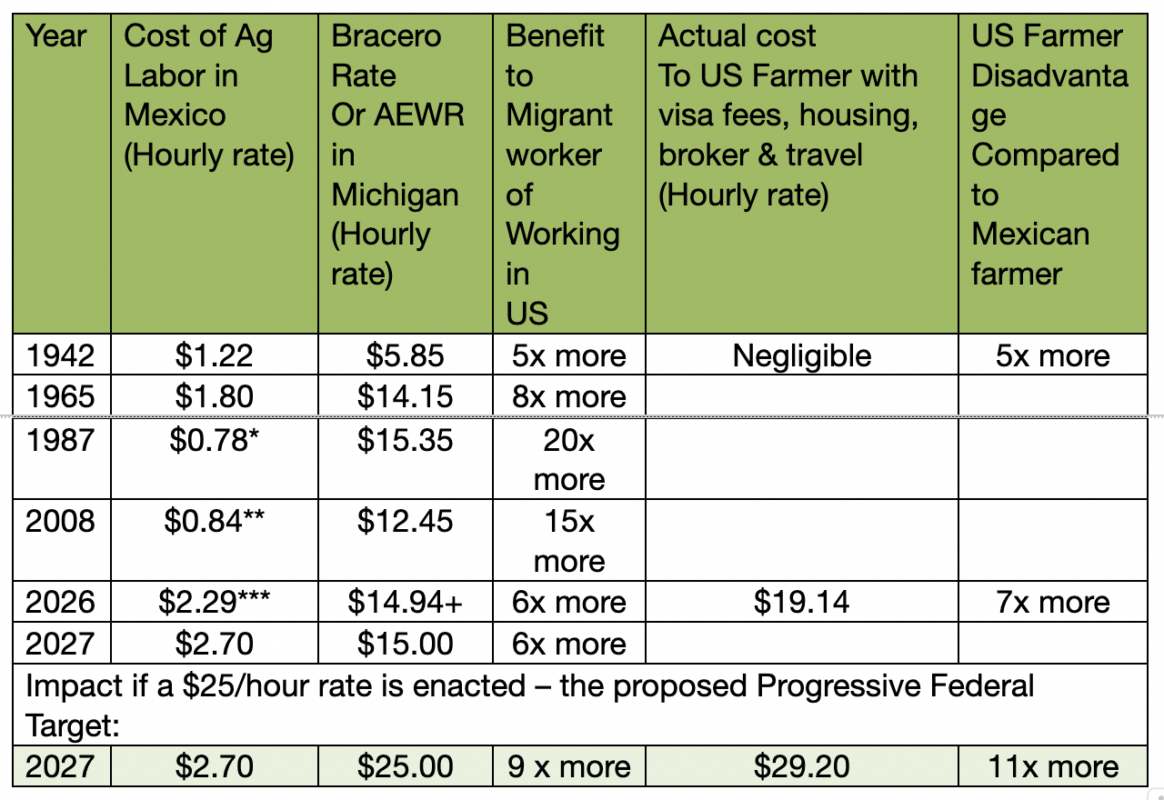
* Mexico was suffering from extreme hyperinflation and debt crises.
** NAFTA structural changes kept rural farm pay very low.
*** The Mexican government has implemented historic, aggressive minimum wage hikes.
+ This number reflects the new Skill Level I & II breakdown by using a blended rate of the two numbers. In 2026 the binding rate in Michigan was $13.73 for Skill Level I and $16.15 for Skill level II. I am using a simple average of the two numbers here for simplicity and clarity.
The Solution: Decouple the AEWR from domestic minimum wage hikes
We cannot let our agricultural base disappear. The United States will need to decouple the AEWR from standard domestic minimum wage increases.
If Washington plans to accelerate minimum wage increases in domestic sectors, it must exempt seasonal agriculture. This is no longer a debate about “taking away American jobs.”
The reality is that domestic workers are unwilling to do this hand-harvest work at any price.
Instead of linking the AEWR to local minimum-wage spikes, the United States should peg guest-worker pay to a multiple of what those workers would earn in their home countries.
A 6x multiple might be a fair, stable benchmark that protects the migrant worker’s financial upside while keeping domestic farms viable.
While advanced robotics and field mechanization might solve this labor crisis, the technology is not ready today. In the interim, we must protect our ability to grow the food we eat.
It is incredibly easy to stop growing specialty crops, but it is exceptionally difficult and capital-intensive to reverse that decline later.
Anyone talking about a $25/hour minimum wage needs to be addressing this labor wage issue.
National food security must remain a pillar of American border defense.