It’s been almost 50 years since the Midwest’s fast-growing city has had passenger rail service. It’s time to bring it back.

When I was in sixth grade, I used to ride the COTA bus across town to meet a friend near Fifth Avenue. From there, we’d continue downtown to City Center Mall to buy the latest CDs. It felt like an adventure.
Looking back, I’m still surprised my parents were comfortable letting us do that—but it taught me something important: public transit can mean freedom, even before you’re old enough to drive.
Today, Columbus is very different. According to World Population Review, it is now the 15th largest city in the United States. Yet despite its growth, Columbus remains one of the largest metropolitan areas in America without a rail transit system.
That reality becomes obvious every weekday morning. Picture the thousands of workers sitting in traffic on I-270, I-70, I-71, Route 33, and other major corridors. Columbus residents love their cars, but few people enjoy driving them through congestion, construction zones, and endless orange barrels.
There is another option.
Modern elevated rail systems—like those in Chicago, Honolulu, Seattle, and Vancouver—run above existing roads on raised tracks.
These systems allow trains to move efficiently through cities without taking lanes away from drivers or causing major disruptions during construction.
For a fast-growing city like Columbus, Ohio, that kind of system could transform how people move.
Columbus already offers a great quality of life: strong schools, safe neighborhoods, and a growing job market. But transportation options have not kept up with that growth. For most residents, the only alternative to driving is the bus. While the Central Ohio Transit Authority provides an important service, rail would add the speed, reliability, and regional connectivity that large cities depend on.
The environmental benefits alone would be significant. If even 66,000 commuters—about a quarter of current drivers—shifted from cars to rail each day, Columbus could reduce carbon emissions by roughly 132,000 tons annually. That is equivalent to removing tens of thousands of cars from the road and avoiding hundreds of millions of miles of driving every year.
Cleaner air and fewer cars are only part of the story.
Rail reduces congestion for everyone, including drivers. It encourages walkable neighborhoods and shorter trips. It connects people to jobs, entertainment, and cultural districts without the stress of parking or the cost of ride-shares.
Imagine taking a quick train ride to dinner in the Short North, to a show downtown, or directly to John Glenn Columbus International Airport.
And rail would not replace buses or ride-share drivers—it would strengthen them. Local buses could focus on short neighborhood routes feeding into rail stations, while ride-share services would see increased demand for trips to and from those hubs.
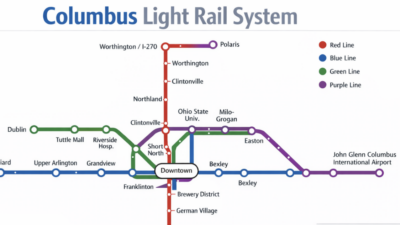
A rail network in Columbus could follow the corridors where people already live and work. Areas like Northland, the Northwest Dublin corridor, the Hilltop, the University District near The Ohio State University, and the growing retail and employment centers around Easton already contain dense populations and major job clusters.
A four-line system connecting Worthington, Dublin, Hilliard, Reynoldsburg, Grove City, Polaris, Easton, downtown, and the airport could place more than 50 stations across the region.
With efficient routing, travel times could be competitive with driving:
- Dublin to downtown in about 22 minutes
- Worthington to downtown in roughly 15 minutes
- Easton to downtown in about 12 minutes
For many commuters, that would mean leaving traffic behind.
But the real reason Columbus needs rail is not just transportation. It is time.
Time spent stuck on highways is time lost with family. It is missed dinners, missed games, missed moments. A modern rail system would give thousands of people that time back—allowing them to read, work, relax, or simply enjoy the ride instead of gripping a steering wheel in gridlock.
Columbus has grown into one of America’s largest and most dynamic cities. Our transportation system should reflect that reality.
Rail would not replace the way we move around this city. It would expand our choices.
And for a city built on growth, opportunity, and forward thinking, that is exactly the kind of investment Columbus deserves.
A Columbus native, Dave Eastburn is a retired Army Lt. Col., formerly of New York, NY, Washington DC, and Honolulu, Hawaii. He has a Master’s degree from the George Washington University Graduate School of Political Management, a Bachelor’s degree in Journalism and Communications from Campbell University, and he’s a 1994 graduate of Upper Arlington High School.