A new Postindustrial columnist from West Virginia writes about his affinity for the late, great writer and the community ties that bind us.

My neighborhood isn’t much different than your neighborhood, I imagine.
It’s filled with people who rarely leave their houses, and when they do, speak little more than the most basic pleasantries when they pass.
We’re not unfriendly – far from it.
We’ve just forgotten that sharing a zip code is not the same as being a community, and that being a community is not the same as being a neighbor.
I care a lot about being a good neighbor these days, but that hasn’t always been the case.
For the last 20-odd years of adulthood, I don’t believe I’ve been a rude neighbor, but I couldn’t tell you the names of half the people on my street either.
And none of that seemed odd to me until I fell in love with the work of Kentucky-born writer, farmer, and advocate Wendell Berry a few years ago.
His work completely changed the way I viewed my hometown in Postindustrial Appalachia.
It changed me as a storyteller and a neighbor. And that’s why I was particularly devastated when I read about Berry’s recent passing.
So many writers over the years have helped guide me through different seasons.
Ralph Waldo Emerson grabbed my attention in my teens.
Jack Kerouac gave me permission to feel the freedom of my twenties.
Leonard Cohen’s poetry fed me the gritty reality of romantic adulthood in my thirties.
But it was Berry in my forties that taught me that you can collect all the experiences and stories in the world, but none of it matters until it’s tied to a specific place and people—your place and people.
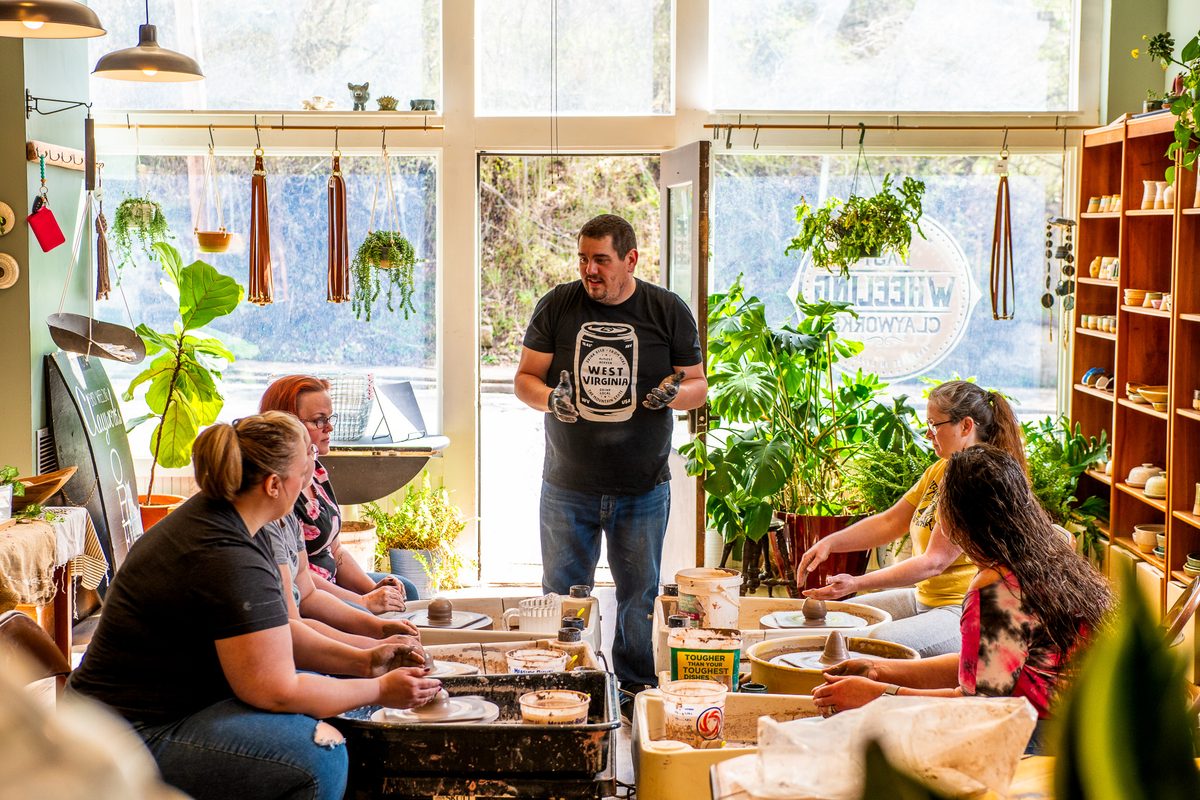
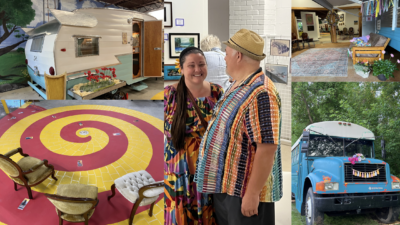
Adam Bedway (center) and his wife own East Wheeling Clayworks and have run their business in a way that makes their story a part of Wheeling’s narrative by rehabbing old properties, holding pottery classes, and being an active voice in community problem-solving. (Image courtesy of Daniel Finsley)
It wasn’t too long ago that I read a quote by Berry:
When a community loses its memory, its members no longer know one another. How can they know one another if they have forgotten or have never learned one another’s stories? If they do not know one another’s stories, how can they know whether or not to trust one another? People who do not trust one another do not help each other, and moreover, they fear one another. And this is our predicament now.
I know it’s a long quote, and modern best practices tell me I should make it shorter because none of us have the attention span for depth anymore—not for quotes, not for conversations, and not for stories- but that is the root of the problem, and at least part of what I think Berry was getting at.
The problem is the best stories we tell ourselves about ourselves aren’t efficient or particularly effective in an economy of curated images and calls to action. The best stories tie us to a place and that place back to us.
And that takes time, courage, and repetition.
I tell stories for a living, and I grieve as a storyteller because when we have to curate a story for a predetermined outcome, it loses the part of itself that is useful—the truth of the people and places that make it unique.
Curated stories don’t take time to chew. There’s nothing real to digest. And if the stories we tell aren’t what happened in a specific place to specific people, they can’t teach us or remind us of our common experience or collective understanding of who we are.
What Berry taught me is that our shared stories, when they’re honest, can help us to remember who we are and that we belong to a place together—that when we retell the stories of our past, our people, and our place often enough, we’re not just recalling the events. We’re rejoining them into the larger fabric of the neighborhood and the community. We “re-member” them.
But if our stories are going to do that kind of heavy lifting, they must do three things well: they must be knowable, they must tell on themselves, and they must be told whole.
The stories that Berry would ask us to tell aren’t seeded by our politics, our theology, or even our views on moral or cultural issues. Those things are too abstract to matter to him, and are best dealt with in the kind of essays he was famous for.
There’s a reason our grandparents were raised not to talk about religion and politics. And even though those things need to be discussed, I think Berry would tell us those aren’t the conversations that should dictate who we’re willing to call a neighbor.
Because when the creeks rise, and the newest developer wants to come in and take more than they give, what you really need is someone you know well, the good and the bad, working and fighting next to you for the dignity of the same neighborhood and community.
The stories we tell in our communities shouldn’t be pretty, because most of the time, we aren’t pretty. We get things wrong. We hurt each other. Neighborhoods fall apart and need to find ways to put themselves back together. But the stories need to stay true, even when they’re as messy as we are, especially when they’re as messy as we are.
Community storytelling is about making our neighborhoods stronger. It’s about re-membering our neighbors. It’s about looking at life as it really is and having the courage to recount it that way.
Berry lamented and grieved for the loss of small, rural communities, but we miss the point if we let that become a romantic pull back into an agrarian way of life that may or may not be possible today.
The real pull of his work is what those communities represented—a group of people tied to a common place, regardless of their differing opinions on an endless ledger of problems, issues, and ideas.
And that, I believe, is still possible if we choose to start listening to the stories we’re trying to tell each other.
It’s possible if we are brave enough to tell our own story without the curated edits. It’s possible if we make the places we’re from the protagonist instead of ourselves.
That’s not as easy as it sounds, but it’s not as hard as it sounds either.
At least not in the way Wendell Berry talked about it.