Postindustrial’s West Virginia columnist writes about how frequent, devastating flooding in the Mountain State prompts communities to pull together and help neighbors when state and federal agencies fall short.

Thunder on the horizon feels different in West Virginia.
In a lot of places, thunder and lightning and the rain behind them are a spectacle you watch from the porch with wonder and awe.
However, in these hills, thunder is a warning.
We listen to it and worry whether the next flash will illuminate a wall of mud and debris coming down what used to be a quiet stream, washing out the road to town.
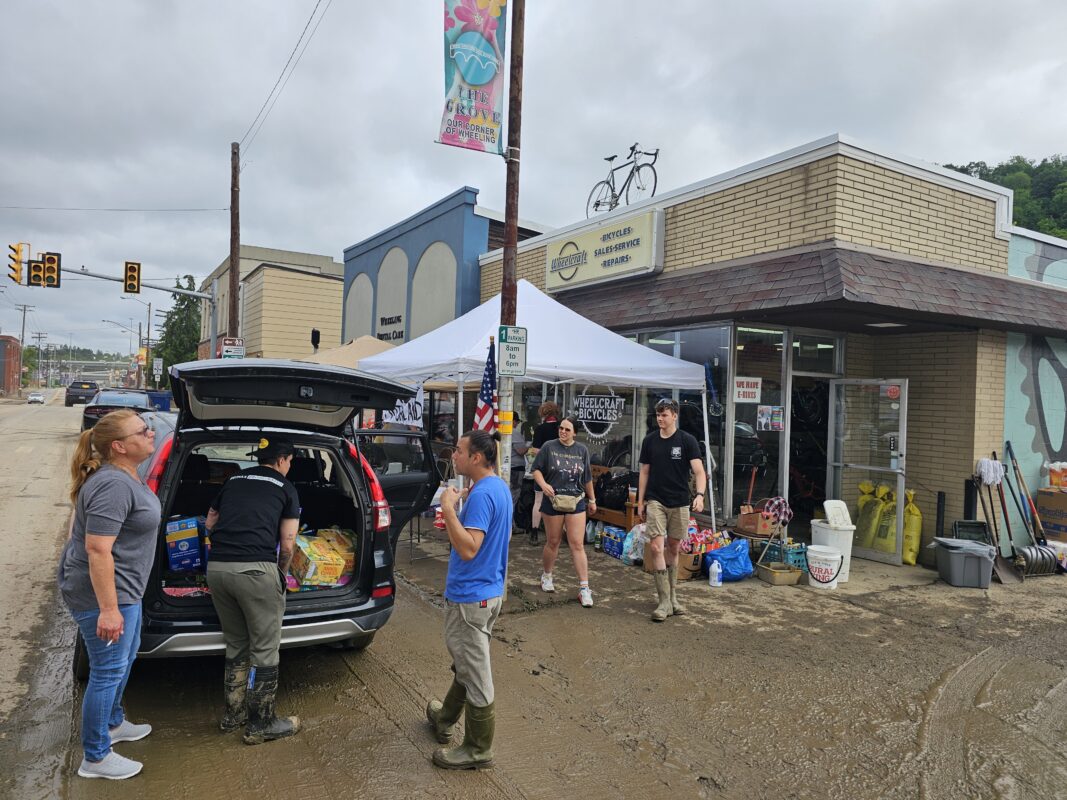
Volunteers came out to help neighbors and buisnesses in need after deadly flood waters covered much of the Wheeling, West Virginia area. (Photo by Matt Welsch.)
The water came for Weston, West Virginia, on a Tuesday last month, and I watched it from a couple of hours up the road the way you’d watch a house fire two doors down.
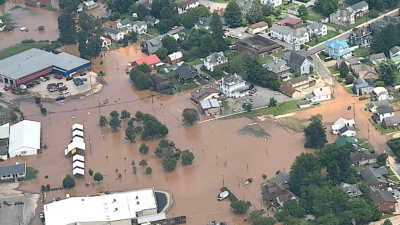
Stonecoal Creek and the West Fork came up over their banks in the dark, and by morning the water had signed its name seven feet up the sides of the buildings. People spent the night upstairs, waiting on water they couldn’t see to recede.
I knew what the pictures would look like before they loaded on my phone. I did not have to be told.
A little more than a year ago, the water came for us in the Wheeling area.
June 14, 2025. The Saturday before Father’s Day. Three inches of rain fell in about an hour, and Little Wheeling Creek did what a creek does when you hand it more than it can carry.
Flood waters went up National Road, into basements and first floors and out the far side, and it carried off cars.
And homes.
And people.
Nine of our neighbors did not come home that night. Valley Grove Park, where the kids played ball, was gone. The creek was full of what it took, and the roads sat in the mud.
Two very different things followed.
First, the official response. A state of emergency was declared. The National Guard rolled in. There was a podium, and there was a word.
“Devastation.”
It was spoken into cameras by men in clean boots, and then, the way it always goes, the trucks packed up and drove back toward the interstate, tires barely muddied.
What they filmed was true, and it was the easy part. The water had already gone down by the time the cameras came.
The hard part was still being done, and it was a lot harder than saying a few 10-cent words or taking a picture on a camera that costs as much as my truck.
The second thing was us.
As the humidity set in that Father’s Day, people moved fast.
A group called Ohio Valley Mutual Aid set up in front of a local bicycle store, collecting supplies and sending out teams with shovels, dehumidifiers, and bleach.
They shoveled, they sanitized, they hauled the ruined remains of someone’s upended life to the curb. They worked in a stranger’s basement, four inches of river silt gone to paste, and a smell like nothing you’d believe, the kind that does not come out of your clothes no matter how many times you run them through the wash.
They also put around $30,000 in cash into people’s hands.
No forms, no strings.
Most of the folks giving it didn’t have much to give, and they gave it anyway. They gave all they could when others couldn’t be bothered to give at all.
My first day on the front lines, I felt useless. A lot of us did, in the face of such loss and, yes, devastation. I showed up in muck boots ready to do whatever needed doing, and quickly saw the work went best when everybody did the thing they knew how to do best. What I could do was cook. Like some heavily tattooed, bearded Nonna, I wanted to feed my hurting neighbors.
My boxing coach, Johnny Haught, was one of the folks knee deep in mud. He was out there for weeks. Not a day here and a fundraiser there. Weeks of the kind of physical labor most people couldn’t keep up for an hour.
When I say the community showed up, I mean people like Johnny showed up, and they kept showing up long after the initial call.
Even so, they could only stay so long. Folks from all over the Valley did everything they could.
At first there was a lot of help, and then there was less. People had to get back to whatever lives they had, to jobs and family, even if the work wasn’t done. You can only ask so much, and even when people give all they can, it is only so much.
I’d seen it when I went down to Jenkins, Kentucky, to help with the same situation a few years ago.
I wanted to do something to help my community get to the other side of this. So, with a lot of help, we planned a party. A day to create some good memories to overwrite some of the painful ones.
We put every idea we had in one pot and called it Come Hell and High Water. Neighbors in Valley Grove drove it, and I got out of the way.
The culinary students at West Virginia Northern helped cook and serve. One end at the church was set up for the kids, with inflatables and backpacks full of school supplies, and live music.
A mile or so up the road, we set up more food and music at the B&B Sports Bar for the grown-ups, giving them a drink and somewhere to laugh next to a neighbor.
We got donations for door prizes, gift certificates to local businesses, tools, and toys. Anything to help replenish a little of what was taken. We got the food donated, cooked it, and gave it away. Nobody got handed a needs assessment at the door. We just fed them.
Then there was the bridge.
Up in the Springer Addition neighborhood in Triadelphia, a small community near Wheeling, six families lived across a creek from the rest of the world, and the flood took their bridge, the only tie to the road.
For months they parked on the far bank and walked in, parents carrying their kids across the water to catch the school bus. The government was “going to get to it.”
When it became plain that getting to it was a long way off, a friend of the fire chief said he could fix it; he’d built bridges before. An ironworker pitched in, and the neighbors did the rest by hand.
A recovery fund covered materials, some of it their own FEMA money pooled together. They finished this spring, the better part of a year after the water came, and the kids can finally ride to their own front doors again.
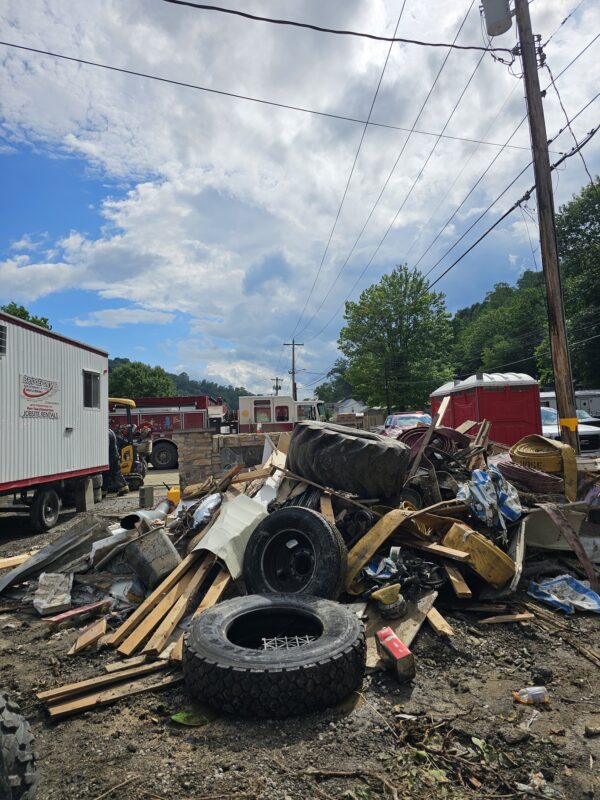
Piles of debris and what were once belongings following last year’s flooding in and around Wheeling, West Virginia (Image by Matt Welsch.)
Around here, this is just what you do. You don’t sit and wait on rescue, because rescue has a habit of not coming, or coming late.
We are proud of that. We ought to be. There is something in these river towns the rest of the country misplaced somewhere, the plain understanding that your neighbor’s flooded basement is your problem too.
Our pride is a convenient thing for the people who are supposed to answer to us. Every time we prop each other up, we hand them one more reason not to. FEMA approved money for Triadelphia and then sat on it.
The sewer that failed a year ago still backs raw waste into people’s basements when the rain comes hard, and the town does not have the millions it would take to fix what the state won’t help pay for.
The bridge stands because a retired man and his friends built it, not because anybody we voted for made it happen.
And now, Weston is under seven feet of flood water.
Same emergency, same cameras, same word. The Guard will leave. The cameras will leave. A year from now, some cook and some ironworker and a church basement full of volunteers in Lewis County will still be doing the job the people with titles were hired to do.
We have done this before. We are doing it again. We will do it again after that, because the storms are not going to stop coming. It is a matter of when. Not if.
The question that has sat in my chest since our water came and won’t move now that it’s come for them. We took care of our own. We always do.
Why is it we always have to do this?
The high-water marks will fade off the Weston brick the way they faded off ours.
Give it a few summers, and you’ll have to know where to look.
We’ll know. We always know.
That is the point, and that is the problem.