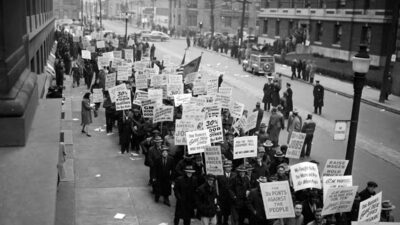
Union autoworkers are facing numerous challenges these days, including Trump’s chaotic economic policy and a less-than-graceful transition to electric vehicle production.

Decades ago, I was a nonunion journalist whose standard of living depended heavily on the bargaining prowess of the United Auto Workers union.
I worked for a group of Michigan daily newspapers located in a few cities where General Motors was the top employer or among the top three. My wages, cost of living increases and benefits were closely linked to financial packages won by the UAW for its then hundreds of thousands of factory workers at what was called the Big Three automakers.
Michigan economists and policymakers closely watched national UAW contract negotiations, typically held every three or four years, to assess how those contracts would impact the state’s economy. So went the UAW and the automakers, so went Michigan in those days.
A record 26% percent of Michigan workers belonged to a labor union in 1989. Today it’s just over half that at 13.4% The UAW and the rest of organized labor no longer have the power they once did to boost the state’s overall prosperity.
The UAW celebrated its 90th birthday on Aug. 26, appropriately just a few days before Labor Day. It was an event largely devoid of media coverage, an indicator of the shrunken role the union plays in steering the state and national economy.
UAW membership has fallen from a peak of 1.7 million in 1979 to about 375,000 last year, according to its annual report filed with the Labor Department. That largely reflects a similar decline in the number of factory jobs at domestic automakers, which are now known as the Detroit Three, no longer the Big Three.
Only about 150,000 UAW members work at GM, Ford and Stellantis. Most are employed at universities, hospitals, state governments and nonprofits.
A battle-hardened nonagenarian, the UAW faces existential threats from a variety of forces. They include increased factory automation, Trump’s chaotic trade policies, the auto industry’s choppy transition to electric vehicles, the growth of nonunion automakers in the South and discord at Solidarity House, the UAW’s headquarters in Detroit.
The past couple of years gave hope of a turnaround for the union’s prospects. Fiery UAW President Shawn Fain negotiated record labor contracts with the Detroit Three in 2023. President Joe Biden, promising to be the most pro-labor president in U.S. history, walked a picket line with striking UAW workers at GM, something no other U.S. president had done.
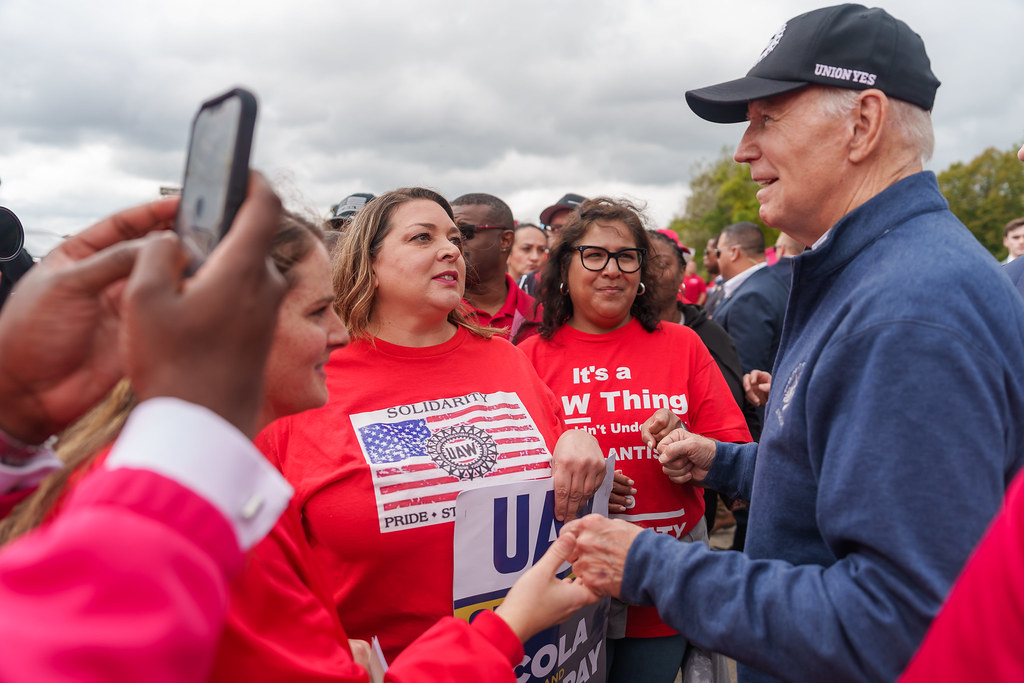
President Joe Biden walks along the UAW picket line and engages with union members at the GM Willow Run Distribution Center, Tuesday, September 26, 2023, in Belleville, Michigan. (Official White House Photo by Adam Schultz)
Then came Trump. The new president quickly slapped punishing tariffs on cars, steel and aluminum coming from Canada, Mexico and other countries in attempt to drive more auto production to the U.S.
It was a move that Fain, who harbored a simmering anger about free trade with Canada and Mexico, supported. But the UAW has since become miffed about Trump’s trade agreement with Japan, which lowered auto tariffs from an initial 25% assessed by the president to 15%.
The UAW said it was “deeply angered” by the deal, which it claimed could give imported cars and trucks from nonunion Japanese automakers a cost advantage over U.S.-built vehicles by the Detroit Three.
What’s more, Trump’s tariffs are costing U.S. automakers billions of dollars, likely taking a big chunk out of this year’s profit-sharing checks for UAW workers.
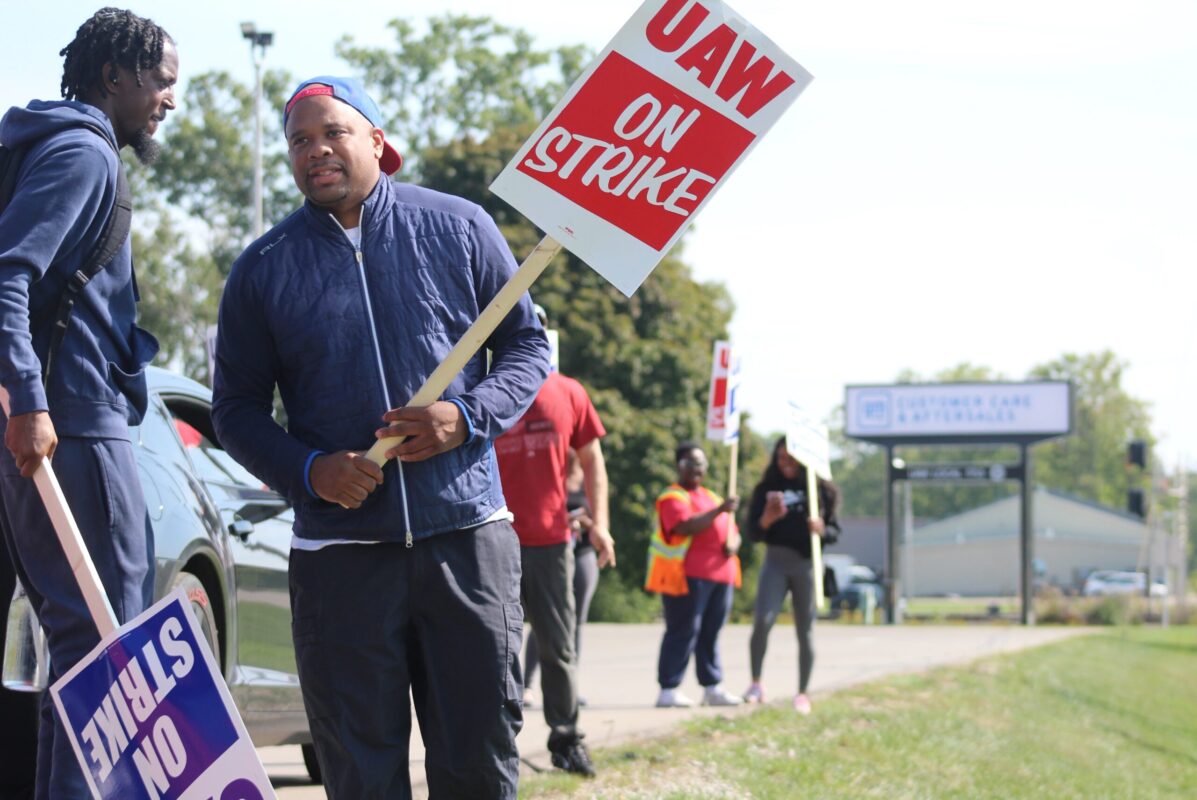
Employees join the picket line at General Motor’s Lansing Redistribution Center as the location was called to strike on September 22, 2023. (Photo: Anna Liz Nichols)
And so far, the tariffs haven’t led to any new auto manufacturing jobs. Instead, there were 10,600 fewer motor vehicle and parts jobs in July than there were last December.
The UAW also is fighting to unionize workers at Detroit Three electric vehicle battery plants, some of which are being built with foreign joint-venture partners.
It appears to have won an organizing drive this month at the BlueOval SK battery plant, a joint-venture between Ford and South Korea-based SK On in Kentucky. But the company is challenging 41 ballots that could change the outcome.
The loss of a union election at the plant—co-owned by Ford, no less—would be a staggering blow to the UAW’s Southern organizing strategy.
Meanwhile, Fain is trying to hang on to his job. A court-appointed monitor in June found the UAW leader engaged in Trump-like retaliatory tactics against the union’s secretary-treasurer. A few union locals are seeking an internal trial for Fain on alleged financial and other misconduct.
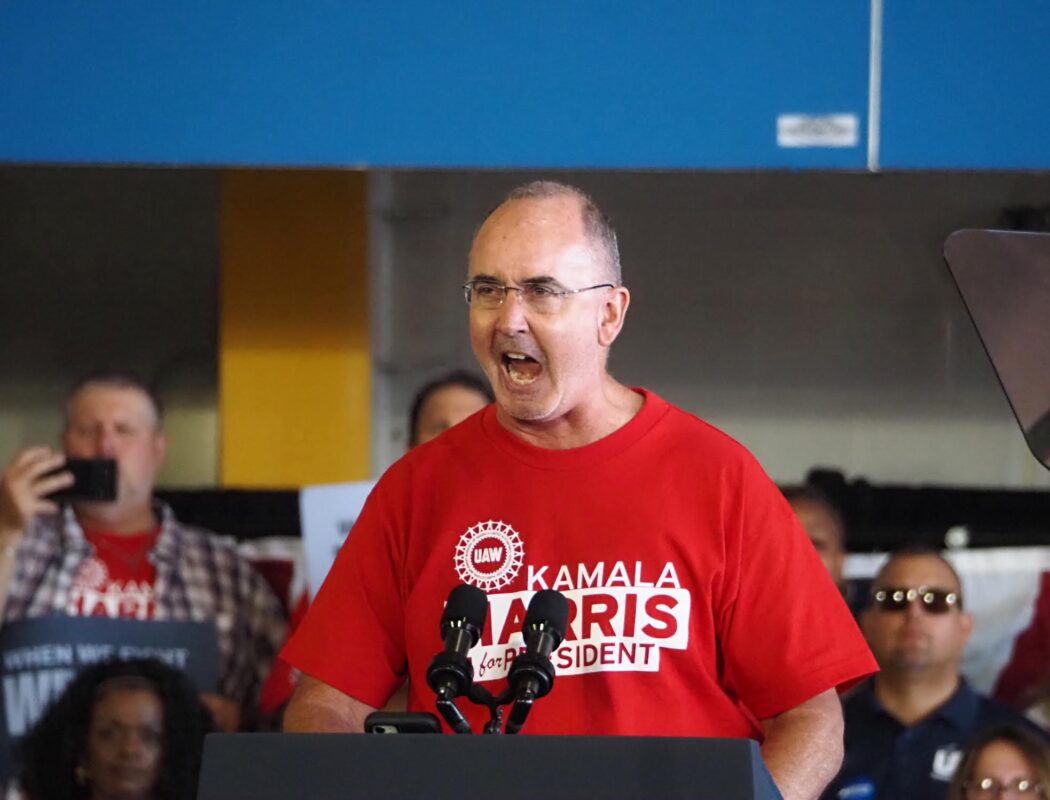
UAW President Shawn Fain speaks to a crowd in Detroit at a rally for Vice President Kamala Harris’ campaign for president on Aug. 7, 2024. | Anna Liz Nichols
But for all the talk of auto jobs moving to Mexico and China, a boom in factory automation could be the biggest threat to the UAW becoming a centenarian.
Hyundai’s new nonunion, highly automated assembly plant in Georgia features robot dogs that work with humans in building vehicles. The robots aren’t paid, don’t get benefits or go on strike.
The South Korean automaker has about two human workers for every robot in the plant. The industry average is seven workers per robot, according to the Wall Street Journal, so there is a lot of room for automakers to robotize their factories.
But existential threats are nothing new for the UAW. For its 90th birthday, the UAW released a highlight video showcasing its hard-won accomplishments that included organizing Detroit automakers, creating the middle class and advancing civil rights.
The fight continues.