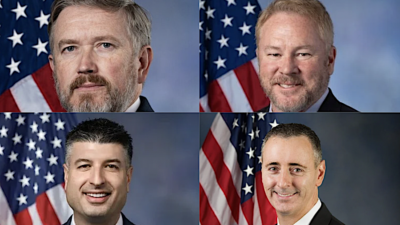
Four House Republicans from our community crossed party lines by voting to limit Trump’s power to continue spearheading military action in Iran without congressional authorization, delivering a rebuke of the war and illustrating their influence on the country and world.

Though they hail from different factions in the party, the four GOP leaders all expressed a firm belief that Congress, not just the president, must weigh in on the scope and objectives of the war.
And, as stated above, perhaps most notably, all four hail from our community, further illustrating the incredible impact our lawmakers have.
Let’s take a look at those representing us who defied the president and their party, shall we?
Michigan Rep. Tom Barrett is a first-term Republican and former Army helicopter pilot who faces a tough re-election race in his competitive Lansing-area district.
Earlier this spring, he introduced legislation that would authorize military action against Iran for a limited period while imposing a firm deadline for winding down the conflict and barring the use of U.S. ground troops.
But a short time later, Barrett changed his tune and sided with Democrats.
“My support of this resolution tonight is consistent with my belief that it is time for Congress to decide the scope of the mission and the appropriate limits on the use of force in Iran,” he said in a statement.
Pennsylvania Rep. Brian Fitzpatrick is considered one of the most centrist Republicans in the House. The former F.B.I. agent has frequently broken with his party on a range of foreign policy and national security issues.
Fitzpatrick, who hails from the politically competitive and coveted Philadelphia suburbs, also initially voted with Republicans against war powers measures, but flipped his position last month, arguing that the legal window for the president to act without authorization from Congress had expired and that lawmakers could no longer defer to the executive branch.
Ohio Rep. Warren Davidson is a libertarian and conservative who has long asserted that Congress, not the president, should decide whether the United States enters military conflicts.
He has been a frequent Trump ally when it comes to domestic matters, but the Iran War has seemingly fractured his faith in the president’s decision-making ability and designs for the country.
Kentucky Rep. Thomas Massie has long opposed American military intervention abroad. His opposition to Trump waging the Iran War without congressional approval came as no surprise.
His vote against the war follows his recent loss in the Republican primary to Trump’s handpicked challenger.
But Massie still has another six-plus months in office and is clearly intent on using them to curtail Trump’s war-waging abilities any way he can.
So, there you have it – yet more proof that Postindustrial America wields an enormous amount of influence over national and global politics.