A renowned West Virginia chef and Postindustrial columnist recounts how the hardships of growing up in Appalachia later served him well as he explored the world.

There is a pot that has lived in my family’s kitchen for as long as I can remember.
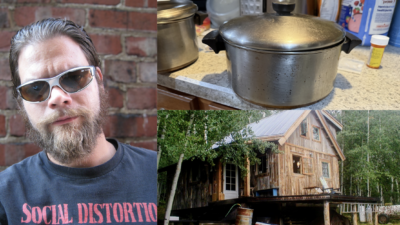
Stainless steel, domed lid, black bakelite handles worn smooth from decades of use. Scratched and scorched, copper bottom wearing thin, but still fit for cookin’.
Mom used it on a yellow stove in the farmhouse we lived in when I was growing up. A house my father lovingly called “the shack.”
Every Fall he wrapped it in plastic sheeting, not just the windows, the whole damned house. Fighting a losing battle every year against the cold and ever-present gusts of wind that found their way in anyway. ‘Cause man hasn’t yet made anything stronger than the cold touch of winter that rips up out of the hollers.
I can still see the light coming through those plastic-covered windows. Diffused and pale, filtered through the grey winter clouds, filtering through the translucent plastic wrapping the house like the clinging hug of an elderly, seldom-seen aunt.
The sun did its best, but didn’t quite make it. I can still feel the draft that moved through the rooms, no matter what we did.
And over all of it, cutting through the chill like a warm hand on your shoulder about to pull you in for a hug, I can still smell the beans bubbling. Ham and onion with something deeper underneath: the slow, smoky exhale of a ham hock giving everything it had to that pot.
We ate them with fried potatoes and ketchup. That was supper. It was enough. It was more than enough.
I didn’t understand what those beans were actually teaching me until much later. A cookbook of a life from which many would pull recipes of scarcity, poverty, or want.
We didn’t want. We were happy. We worked hard. And maybe we lived hard, but we lived well.
The logic of soup beans is elegant in the way that only true Appalachian cooking can be. You start with next to nothing: dried beans, onions, water, a ham hock that’s mostly bone and rind.
With time and gentle heat, the beans, patient and porous, pull every ounce of flavor and more from the ham hock—the fat renders. The collagen softens. The broth thickens. The smoke from the cured meat permeates the broth. We sat down as a family to eat this mountain alchemy. What was almost nothing now fills a cold house and hungry mouths.
Also by Matt Welsch: Dreams don’t go anywhere without commitment to your passion
The mountains work the same way. They simmer you for years on low heat, and you don’t notice what they’ve drawn out until you’re somewhere else entirely and you reach for something, somehow knowing it was there.
Those times have come back to me in many moments over the years and miles. Once, standing on a street in Eugene, Oregon.
I had left Columbus two weeks earlier on a Greyhound bus, with everything in an army-surplus duffel bag. The bus had misrouted my bag to San Francisco, and I was wearing clothes I’d bought at a thrift store somewhere in Idaho, where I’d spent 10 days helping build an off-grid cabin outside a small town called Felt.
Felt is the kind of place where you work with your hands all day, shower in a rainstorm, sleep hard, and wake up hungry for more.
From there, a friend and I had barreled through the midnight scrub desert of Oregon, the high desert dark and enormous on both sides, stars overhead glittering almost as bright as our headlights, the only other light in the pitch darkness. We’d rolled into Eugene in the small hours, and slept on a loading dock.
Now it was morning. I hadn’t showered in days. I was tired and sore and hungry, and I smelled like someone who’d been living outside. The town was beginning to wake up, shops still gated, a few people moving with the particular efficiency of people who had somewhere to be.
Glancing my way, they nervously ignored me. I had nowhere to be—only a vague destination. I had no luggage, no plan, no clean clothes, and no breakfast.
I was thrilled to be alive.
Not despite all of it. Because of it. I had been built for exactly this and raised to understand that discomfort is a condition, not a catastrophe. So I let it go and looked around.
The pine scent of the West Coast. The town slowly waking. The struggles shrugged off because beyond them there was life: raw and unfiltered.
Tired, sore, reeking, hungry, but so very, profoundly alive. I felt it in my body the way you only get when you’re in motion. The streets of Eugene were beautiful and strange. I was free in a way that required nothing more.
Except maybe for one of those shops to open, so I could use the bathroom.
I had felt this before. In a drafty shack in rural West Virginia, watching pale light filter through plastic sheeting, listening to beans burble on a yellow stove.
That’s what the mountains drew out of me, like a hamhock in a pot of beans. Not comfort but capacity. The ability to be fully present inside discomfort without mistaking it for catastrophe. To make something from almost nothing, not because you’re gifted, but because you learned to cook when almost nothing is enough.
Mom never called it a philosophy. She called it supper.
The ham hock doesn’t leave the pot. It stays in the water, releasing its treasure, until the beans are done. By then, the broth is the point. The flavor lives in the liquid, in the beans that absorbed it, in the people who ate it and carried it forward into the day.
I have slept on loading docks and picnic tables. I have ridden a motorcycle across 13,000 miles of this country. I have eaten from convenience stores in countries where I didn’t speak the language and navigated cities where I didn’t know a soul. I have always known, somewhere below thinking, how to find the flavor in what’s at hand. How to let a little go a long way.
The mountains taught me that. They taught me young, through thin walls and pale winter light and a pot of beans that bubbled all day and made the cold house smell like something worth remembering forever.
Mom still makes beans in that pot.