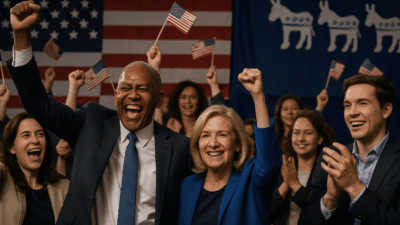
Democratic candidates scored significant wins in Virginia, New York City, and elsewhere. But the challenges they face in the upcoming midterms include party infighting and gerrymandering.

Democratic candidates and their party faithful are celebrating some critical electoral victories.
Virginia elected a Democratic governor to replace its Republican leader. And New York City’s 34-year-old Mayor-Elect Zohran Mamdani shook up the political world by defeating the state’s former governor and political legacy, Andrew Cuomo.
Meanwhile, down-ballot state races also saw notable victories for Democrats.
Three Democratic Pennsylvania justices won retention for 10-year terms on the state Supreme Court.
That election drew the attention of both a Republican billionaire political donor intent on flipping the Democratic majority court, as well as Trump, who understands the potential value of having state-level judges on his side when he declares the 2026 midterms or 2028 presidential elections “rigged.”
So the wins for Democrats in both high-profile races and those at the state and local levels could give a party in desperate need of some momentum a boost heading into next year’s races.
That is, if Dems can finally get out of their own way.
The party has been reeling and rudderless since Kamala Harris’ loss, partly due to its inability to rally its political campaign apparatus around the vice president in time following Biden’s decision not to seek another term just 107 days before the November election. However, that should have been more than enough time.
But that wasn’t the only reason the presidency, as well as the House and Senate, went to the GOP.
Democrats seemingly can’t build a coalition to save their political lives because too many of their leaders and voters harbor an “all-or-nothing” mentality when it comes to their wants, creating unreasonable litmus tests for what is a “progressive” and are unwilling to compromise in the face of the existential crisis that is Trump and MAGA.
If you don’t support trans rights the exact way in which activists and voters see fit, you can’t get elected.
The same goes for the Palestinians, or when it comes to immigrants.
Failing to be the “perfect” candidate results in too many Democratic voters sitting out the election or voting for third-party spoiler candidates in protest (e.g., Jill Stein in 2016).
Democrats continue to curse themselves to the sidelines because they demand perfection from their candidates now, rather than seeing them for what they are: yet another step towards the pursuit of a “more perfect union.”
Meanwhile, Republicans, despite some recent infighting over the federal government shutdown, primarily work in lockstep toward their goals, like gerrymandering congressional districts to increase their chances of retaining the House in 2026.
If Democrats want to effect real change in the long run and return to power on the federal level, they need to heed the age-old aphorism that “perfect is the enemy of good” and that not getting everything you want when you want it is not defeat or acquiescence, but compromise and a step in the right direction.