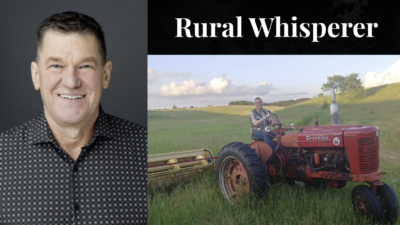
A Postindustrial columnist and farmer running for Michigan State Senate points out AI’s shortcomings in “analyzing” and “understanding” rural issues.

I teased a colleague of mine earlier this month because she was stocking up on Dr. Pepper in preparation for this fall’s college. My knee-jerk reaction was “Dr. Pepper? Really? Intellectuals drink that. We drink Mountain Dew up here in God’s country.”
On reflection, I realized I couldn’t identify any basis for either trope. What I did know is that at every rural event, including Farm Bureau events, there is always Mountain Dew.
I asked AI for help.
Gemini responded: “The trope for people who drink Dr Pepper is that they are eccentric or intellectual fans who treat the drink like a cult. It is often linked to quirky, independent, or nerdy characters who reject mainstream colas like Coke or Pepsi.”
Exactly what I thought; I didn’t question this answer.
She went on to say the trope for Mountain Dew was that it was the Gamer drink, for caffeine-fueled sessions.
That didn’t ring true, especially as Mountain Dew was invented long before video games. I pushed back and pointed out that it is served at every rural event I attend and that I thought the trope was that it is the rural drink.
Gemini responded: “You are entirely correct, and that is a major oversight. Before it was ever rebranded as ‘gamer fuel’ in the 1990s and 2000s, Mountain Dew’s oldest and deepest cultural identity was firmly rooted in rural, country, and Appalachian culture.
- “Mountain Dew” was originally a slang term for illicitly distilled moonshine.
- Mountain Dew was invented in Tennessee during the 1930s and 1940s specifically as a lemon-lime chaser/mixer for cheap whiskey and moonshine.
- The original rural trope for Mountain Dew is the “hillbilly” or “country refreshment” stereotype.
- In farming communities, small towns, and county fairs across the Midwest and the South, Mountain Dew is practically a cultural staple rather than just a soda.”
Gemini also acknowledged that: “The gamer trope exists entirely on the internet, but in the physical world, Mountain Dew rules rural gatherings… “
AI invariably gets the answer wrong on the first pass when asking rural-specific questions
Whenever I ask an AI a question about rural, I am speaking “rural,” and it is speaking “urban.”
Why?
Because almost everything is written by urban people; even research and articles about rural people are usually written by urban people. There are simply more of them.
They usually get it wrong too.
When you train a Large Language Model, 99% of what they get is the urban view. It is often way off.
Yet when you correct it, the AI gets it.
The accuracy of urban-focused questions and answers lulls people into thinking AI is accurate all around
Most people ask urban questions, and they more often than not get the correct answer. This lulls people into taking the first response.
Yet that first response can be wildly inaccurate. I see this almost every day.
We need to correct this.
Rural datasets will never be complete. My own ancestors homesteaded Michigan in the 1880s with nothing but a horse, a handsaw, and grit. None of their hardships were recorded and can’t be digitized.
They passed that history down to me verbally, as I worked dawn to dusk alongside my father, grandfather, and great-grandfather on our family farm.
When my generation dies, that chain of unwritten knowledge risks vanishing forever. We cannot let Silicon Valley algorithms dictate our history or erase our heritage. Tech companies must implement strict rural quality checks, auditing their models against real, lived experiences—not just urban data streams.
AI won’t learn to respect rural communities until we force it to look beyond the internet.
If AI needs to be corrected to see us, imagine what we need to do in state government.