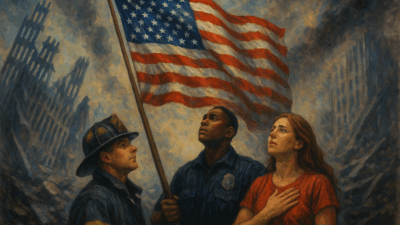
It’s been 24 years since the terror attacks that briefly united the country. However, since then, the divide among us has grown broader and more violent, leading to this fraught and dangerous time.

I was a young journalist working in Washington, DC, on Sept. 11, 2001.
Before the attacks, the nation’s capital and the rest of the country were fiercely divided over the Bush presidency, which was preceded by a drawn-out, contested election that left many Americans bitter and resentful of the Republican leadership.
However, after planes struck the Twin Towers and Pentagon, the nation, albeit far too briefly, lowered its guard, forgot about our divisions, and united as one.
I recall how the mood shifted dramatically in DC. The partisan divide that defined the first 9 months of the George W. Bush presidency was gone.
Democratic and Republican lawmakers quit their bickering, and residents of the district came together, united in their grief and resolve to stand tall at our darkest hour.
It was a solemn, yet inspiring time, and its duration was far too short.
In the ensuing years, Americans returned to their respective political corners, fighting over the direction of the War on Terror, mainly the invasion of Iraq, which began under false pretenses and led to more than a million senseless deaths.
We squabbled about government overreach, the economy, and every other issue that rankles a multicultural democracy.
But we did so peacefully, relative to the political violence that has become our horrifying norm.
Yes, there were protests over the war that occasionally turned cantankerous, though nothing like the killings we’re dealing with these days.
Charlie Kirk was just the latest victim of the partisan violence that has gripped our nation.
Not long ago, two Minnesota Democrats were shot, one of them killed, by a man with a list of other Democratic leaders he planned to murder.
The Pennsylvania governor’s mansion was burned by a man who hated Democratic Gov Josh Shapiro.
A gunman shot Republican Rep. Steve Scalise and others.
And the list goes on.
In the 25 years since that fateful Sept. 11, we’ve gone from a nation that put aside its differences to mourn and rally as one, to a country seemingly intent on tearing itself apart for our own amusement.
I could point the finger at many culprits, including leaders who trade in hateful rhetoric, social media sparking the collapse of real communities in favor of virtual ones that feed our fear and hate, and COVID.
We know we’re divided, and that our differences have been weaponized.
What do we do to remedy America’s most divisive era since the fight over Civil Rights, a time when protests, killings, and even church bombings tested our mettle and made us question our character as a nation?
Because this is the time when we should be asking ourselves tough questions:
Is this who we are?
Do we want to be a nation where we settle political differences with violence?
I can answer the latter questions with ease. As someone who spent years covering the War on Terror and bouts of political unrest the world over, I can assure you we do not. The fallout from a society that has collapsed into violence can be best described as hell on earth.
The former question – is this who we are – is harder to answer. Not because we lack sufficient evidence to draw a conclusion, but rather, it’s because the evidence is all around us, and the answer is difficult to admit.
This is who we are, at this moment.
Whether we can work together to rein ourselves in will decide if we will remain this way, until there is no “we” left to save.