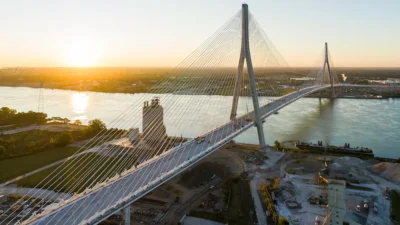
Trump escalated his ongoing diplomatic standoff with Canada by threatening to block the opening of the Gordie Howe International Bridge between Detroit and Windsor, Ontario, unless Canadian officials addressed what he described as a long list of grievances.

The warning marks a sharp deterioration in relations between the two longtime partners amid an ongoing trade dispute.
The bridge — a major cross-border link whose construction was funded by Canada and is now in final testing — was scheduled to open early this year, according to The New York Times.
Trump said he would “not allow” the crossing to open “until the United States is fully compensated for everything we have given them, and also, importantly, Canada treats the United States with the Fairness and Respect that we deserve,” posting his remarks on social media.
How the president would physically block the opening was not immediately clear. Canada paid for the Gordie Howe project, and a public-private agreement gives Michigan partial ownership and joint operational control with Canadian authorities. Legal avenues for unilateral U.S. action appear limited.
One potential mechanism cited by officials and legal experts would be the invocation of emergency powers that allow U.S. Customs and Border Protection to close a port of entry “when necessary to respond to a specific threat to human life or national interests.”
Trump has previously used such statutes to expand executive authority in other disputes. However, the threshold for such a move is high and would likely draw legal challenge and political backlash.
The president also floated alternative measures, suggesting the United States might seek to acquire “at least one half” of the new bridge and demand a share of its toll revenue. Those proposals would require complex negotiations and potentially congressional or legal approval.
The Canadian Chamber of Commerce condemned the threat, warning that “blocking or barricading bridges is a self-defeating move” whether the threat is carried out or merely used to sow uncertainty.
Canadian officials declined immediate comment. Stacey LaRouche, a spokeswoman for Michigan Gov. Gretchen Whitmer, said the governor expected the bridge “to open one way or another” and looked forward to attending a ribbon-cutting.
Local officials in Windsor reacted with alarm.
Mayor Drew Dilkens called the president’s remarks “crazy stuff,” saying he was stunned but not surprised. The Gordie Howe International Bridge Authority, which is managing construction and operations, said construction is largely complete, and engineers have been conducting months of testing; it did not respond to requests for comment.
The president’s threat comes amid widening bilateral tensions, including tariffs, trade sanctions, and inflammatory rhetoric.
Trump has previously threatened to annex Canada as the “51st state,” and last month appeared to suggest grounding Canadian-built aircraft — a remark regulators later clarified would apply only to new aircraft certifications. His aggressive posture has provoked frustration in Canada, prompted some Canadians to boycott U.S. goods and travel, and raised concerns among businesses that rely on seamless cross-border trade.
The Gordie Howe bridge, named for the hockey legend who played for the Detroit Red Wings, is expected to provide a new route for the $300 million in daily trade that crosses the Ambassador Bridge, a privately owned and long-dominant crossing controlled by the Moroun family. The owners of that bridge had opposed the Gordie Howe project, which would introduce fresh competition.
Analysts say the president may use the threat as leverage in broader negotiations with Ottawa and could ultimately back away to avoid the severe economic fallout of disrupting a critical trade artery.
But for now, the warning has heightened uncertainty for industries and communities on both sides of the border that depend on the smooth flow of goods and people.