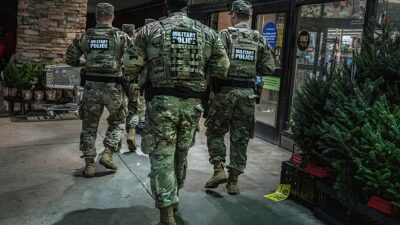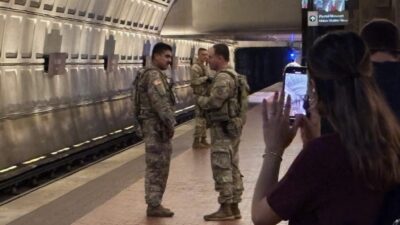
Los Angeles, Washington, D.C., and now Memphis, Tennessee, have been subject to Trump’s orders deploying National Guard troops to their streets.

Until his announcement last week that he’d send in troops and federal law enforcement agents to Memphis with the support of that state’s Republican Gov. Bill Lee, Trump’s focus had been on Democratic strongholds.
The White House shelved plans to send the guard to Chicago over the objections of Illinois Gov. J.B. Pritzker and Mayor Brandon Johnson, after advisors warned it would draw legal challenges. But that didn’t end speculation that other large Democratic-run cities, such as Philadelphia, could be in line for what Trump calls an effort to “restore law and order.”
“It’s very important because of the crime that’s going on, not only in Memphis, in many cities,” Trump said in the Oval Office when he signed an order to send forces to Tennessee.
Gov. Josh Shapiro and Philadelphia District Attorney Larry Krasner, both Democrats, have said they plan to fight back with the tools their respective offices provide if the president turns his attention to the commonwealth.
“It is my hope that it will not get to that here in Pennsylvania,” Shapiro told reporters Wednesday. “I can tell you that we are preparing aggressively on that front.”
Krasner said in a series of town hall meetings around the city that he would prosecute federal officials for civil rights violations and encouraged Philadelphians to record any incidents they witness.
The National Guard is unlike other military services in the United States. It exists under dual sovereignty, meaning it is commanded both by the president and the governors of the states where National Guard units are based.
Governors have the authority to deploy their states’ National Guard on missions anywhere in the country for disaster relief, as Shapiro did last winter when heavy snow stranded people in Erie. Guard units under state control can also support civil law enforcement, as in the National Guard’s ongoing mission at the United States-Mexico border.
“I’ve deployed our Guard to the southern border of the United States. I’ve deployed our guard to Germany, where they’ve trained Ukrainian soldiers in trying to push back on Russian aggression,” Shapiro said.
In that context, the National Guard is functionally a state militia, according to Beau Tremitiere, an attorney with Protect Democracy, a nonpartisan nonprofit dedicated to preserving America’s form of government.
National Guard troops can also be deployed with a governor’s consent under Title 32 of the United States Code, to carry out a federal government mission as in Tennessee.
Without a state governor’s cooperation, the president can federalize National Guard troops under Title 10, which governs the Armed Forces, but their missions are limited to repelling an invasion, putting down rebellion and enforcing federal law.
“I think that it is dangerous when a commander in chief of the United States tries to usurp the power from the commander in chief of the state, it sets up a conflict,” Shapiro added. “And we’ve seen that conflict play out on the streets of Los Angeles as just an example. We are prepared, should the president of the United States seek to try and commandeer our guard and deploy them on the streets of Philadelphia or anywhere in the commonwealth of Pennsylvania.”
National Guard soldiers have been used to enforce federal laws in the past – notably when Presidents Dwight Eisenhower and John F. Kennedy used troops to enforce desegregation laws. But Lindsay Cohn, a political scientist who studies civilian-military relations, said it is a seldom-exercised power of the presidency.
“That means there’s very little jurisprudence around it,” Cohn said. “There isn’t really a clear legal path to sending troops into other states for state-level law enforcement.”
If the Trump administration were to call on Republican governors to send guard soldiers to cities like Chicago or Philadelphia, it would be on a highly-dubious legal footing and would violate core constitutional principles, Tremitiere said.
“One state cannot lawfully invade another,” Tremitiere said. “There might be cases when the president could lawfully federalize the guard, even though it’s a bad and dangerous idea. It’s critically different when you’re talking about one state sending forces into another state and actively policing its streets. That’s never OK.”
The Posse Comitatus Act, which stems from the Reconstruction period after the Civil War, forbids federal troops from enforcing state or local laws.
“For the first time in peacetime, in U.S. history, you had a lot of federal personnel, military personnel, being used to try and just manage civilian affairs,” Tremitiere said, adding Congress passed the Posse Comitatus Act in 1878 to reinforce the nation’s founding principle that military involvement in civilian government is an inherent threat to liberty.
Under the Insurrection Act, however, the president can temporarily suspend the act. The law’s intent is to allow the federal government to address internal rebellion using the regular Army and National Guard. But critics warn that it’s too vague and leaves too many details to the president’s discretion.
While the Trump administration has reportedly considered using the Insurrection Act, it’s considered an extraordinary measure, Tremitiere said.
“It’s long been recognized as a red line,” he said. “Either facts on the ground are so awful that we have to resort to this extraordinary remedy, or if the glass is broken short of an actual rebellion, it means that there is a clear abuse of power.”
Trump employed Title 10 to federalize California National Guard troops over Gov. Gavin Newsom’s objection in response to protests over immigration raids in June. A federal judge in San Francisco ruled earlier this month that the deployment was illegal.
U.S. District Judge Charles Breyer said the civilian police force was able to enforce the law and the use of armed troops to conduct traffic blockades and crowd control violated the Posse Comitatus Act.
Taken with Trump’s and Defense Secretary Peter Hegseth’s statements they intend to send National Guard troops into other cities, it raises concern the administration was “creating a national police force with the president as its chief,” Breyer’s decision said. The administration is appealing.
In the District of Columbia, Trump initially mobilized the district’s own National Guard in August to respond to what he characterized as a city “overtaken by violent gangs and bloodthirsty criminals,” notwithstanding federal Justice Department data showing crime in the city is at a 30-year low.
Six Republican governors have since agreed to use their Title 32 authority to send their National Guard soldiers to the nation’s capital. Because those troops are technically under state control, the Posse Comitatus Act doesn’t restrict them from law enforcement duties.
In a challenge to Trump’s actions, D.C. leaders have argued the deployment violates the autonomy Congress vested in the city to police itself and determine when to request National Guard aid from other states. They also allege it violates the Posse Comitatus Act because the district’s National Guard reports directly to the president and is always under federal control.
D.C. Mayor Muriel Bowser has credited the presence of federal law enforcement — including the U.S. Drug Enforcement Administration, Bureau of Alcohol, Tobacco, Firearms and Explosives and the FBI — and their partnership with the Metropolitan Police Department with lowering crime in the city.
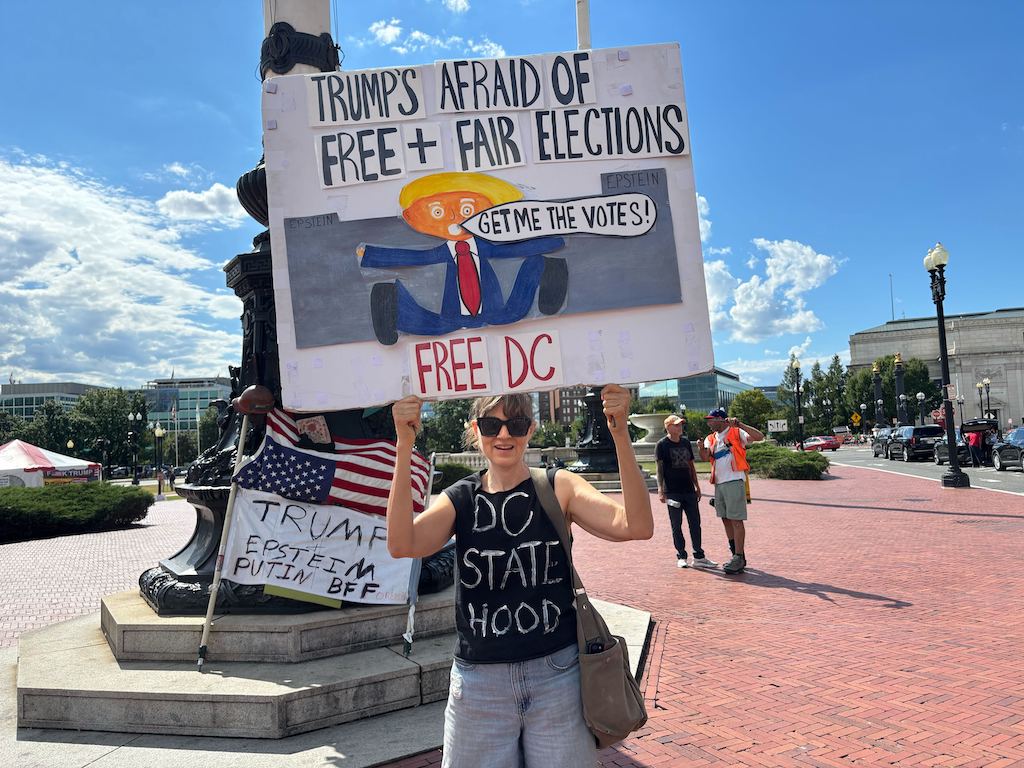
Robin Galbraith of Bethesda, Md., holds a sign outside Union Station in Washington, D.C., in protest of President Donald Trump’s deployment of the National Guard in the district. (Photo by Jonathan Shorman/Stateline)
At the same time she said the presence of Immigration and Customs Enforcement agents and National Guard troops “is not working,” citing a break in trust between police and the community. “We know having masked ICE agents in the community has not worked, and National Guards from other states has not been an efficient use of those resources,” she said.
Louisiana Gov. Jeff Landry has endorsed Trump’s suggestion to use the national guard to combat crime in New Orleans, although he has not asked Trump to do it or used his own authority to mobilize the state’s guard.
If the Trump administration were to employ the same tactic in states with Democratic governors, like Pennsylvania, they would have a right to challenge it directly in the U.S. Supreme Court, Jane Bentrott, also an attorney with the Protect Democracy Project, said.
But Tremitiere said Illinois Governor Pritzker and Chicago Mayor Johnson were effective by standing firmly by their convictions that sending troops is unnecessary, unlawful and would not be tolerated.
“Their courage created a real political cost,” Tremitiere said. “All signs suggest their bold stance led to the administration backing down on what appeared to be a pretty clear intention to move forward promptly in Chicago.”
Bentrott said Shapiro has shown similar resolve without picking a fight with Trump.
“So far that seems to be working,” she said. “Not drawing fire while still holding firm that he would oppose the National Guard coming in here.”
More conventional political forces may also shape the Trump administration’s plans as the midterm elections draw closer, Cohn, the political scientist, said.
“The evidence that we have indicates that the public is not extremely comfortable with militarized law enforcement,” she said. “That is something that at least some of his advisors are going to take into account and worry about.”