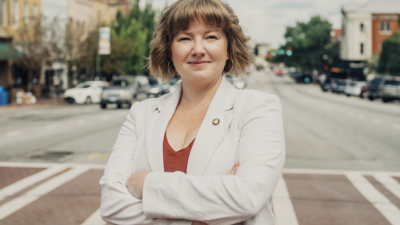
Alexandra “Lexy” Doherty is vying to fill the seat in Georgia’s 10th congressional district being vacated by Republican Mike Collins, who is running for the Senate, and hopes to become the first Democrat to win there in 30 years.

The 33-year-old Doherty, who lost to Collins in 2024 by a sizable margin, is leading all Democrats in the polls ahead of next week’s primary.
And while she still has a tough row to hoe, the candidate is counting on the growing discontent with the MAGA status quo in her district, which includes farmland parts of the Atlanta suburbs and Athens, to help her flip the district blue.
Leading up to the midterms, Georgia Democrats have scored significant wins in recent special elections, including flipping a state House seat in the district she hopes to win in November.
Doherty told Postindustrial that she thinks her platform, focusing on improving rural health care and bolstering economic development, will appeal to the farmers in the 10th, as will her stance on protecting the environment and clean energy solutions.
She’s also an ardent advocate for women’s reproductive rights, which stands in stark contrast to Collins’ anti-abortion stance and those of her Republican opponents were she to win the primary.
We spoke to Doherty about these and other issues.
Postindustrial: You ran in 2024 and lost to Mike Collins. And this district has been in Republican hands since 1996. What makes you think that you can win?
Doherty: Demographically, we (Georgia’s 10th congressional district) are slowly shifting to the left.
Our population is continuing to grow. I was looking at this district thinking, “sooner or later, this district is going to flip.” And so, I decided to get to work even though everybody told me I didn’t have a shot.
So now, looking in 2026, I think between that slow shift in the demographics and the political environment that we’ve seen so many races swinging, I really do think that if we’re going to be able to flip this seat, this is the year that we’re going to be able to do it for sure.
Postindustrial: In 2024, you won handily in parts of the Atlanta suburbs and in Athens, home of the University of Georgia. But in the more rural parts of the district, you lost to Collins by a wide margin, which helped secure his win. How do you expect that to change this time around?
Doherty: I think this is where my background is going to be really helpful. I’m from the rural south. I grew up in South Carolina. I’ve worked on farms my whole life. So I do have a really solid understanding of rural conservative voters’ values, even if we disagree on some things. I know how to talk about issues in a way that lets us connect, even if we may not 100% agree on everything.
Actually, I was pretty surprised after the last cycle (the 2024 race against Mike Collins, which she lost). A gentleman who I consider pretty MAGA reached out to me after the election and said, “I just want you to know you’re the only Democrat I voted for.”
We had gone back and forth on social media about a bunch of stuff over the campaign. And one of the things he said was, “I just know that even though we don’t agree on a lot of things, I know you’re doing this for the right reasons and I know you’re looking out for the people.”
And so I think that speaks to probably how a lot of people would view me, even if they’re kind of conservative, that maybe we don’t agree on everything all of the time, but that I see what they need as a community. I’m going to fight for that, even if it might look a little different than they expect.
Postindustrial: Rural health care accessibility has been plummeting throughout the Postindustrial Community. What’s the health care situation like now in the rural parts of the 10th, and how can it be improved?
Doherty: We’ve struggled with health care access in this district for a long time. Georgia is one of 10 states that still have not expanded Medicaid. And now with the expanded ACA subsidies getting rolled back, people are just struggling.
People’s health care costs have doubled, sometimes tripled. All of our rural hospitals, especially, rely on Medicaid. One of the things we’ve already seen since the big bill last year is that a labor and delivery ward in a hospital in Leavonia, in the very northern part of my district, is going to be closed.
Women in that area will have to drive an hour and a half in any direction to reach the closest labor and delivery ward. So, in an area that has long struggled with inadequate health care access, it’s just getting worse.
And unless things change dramatically, this is the path we’ll continue to head down. From my perspective, the way that we fix this is universal public health care.
We already pay for it. We pay more per capita for health care than any other country in the world. We have the resources to make sure that people have adequate health care access instead of it going to these for-profit insurance companies.
I think long-term, that is the real solution. But we don’t have the votes for that. If we allow people to buy into the programs that already exist, I think that would go a long way to giving some additional funding to some of our rural hospitals.
Postindustrial: Another issue affecting rural communities, even more so now than the last time you ran in 2024, is data centers. Is this already an issue residents in Georgia’s 10th are facing? If so, how is it being handled?
Doherty: It’s actually pretty horrifying. A lot of farmland gets bought up for development, whether that’s subdivisions or these data centers.
Georgia is one of the states where data center growth is happening the fastest. Georgia Power, our for-profit utility, is courting data centers because they make their money when they build more energy infrastructure.
For me, step one is that there needs to be transparency if a data center is going to come into a community. I don’t think our utilities should be able to OK it without even announcing it, without giving our local officials information, because they’re using our water. You know, if they’re going to be taking advantage of our local infrastructure, then our local governments absolutely need to be aware.
I also think people should have a say, and there are many communities that don’t want these data centers because they’re loud, and often they have diesel generator backups. So it’s reducing air quality.
There are just so many negative effects, and they’re not really creating jobs long term.
So, step one is just transparency, but step two, I think, is that we need better local say.
Postindustrial: You’ve mentioned that you are a proponent of “green manufacturing” and protecting the district’s natural resources. What do you consider green manufacturing?
Doherty: I think [green manufacturing] is about how we use natural resources.
One of the things people get pushback for regarding green manufacturing and renewable energy is that it does require heavy-metal mining [the extraction of dense metallic elements such as copper, lead, zinc, and gold].
I studied geology, specifically economic geology, so heavy metals were my focus. I think it’s really important for people to realize we live in a world where technology is ubiquitous. So the way I see it, we can either do this in a way that’s harmful to the environment, or we can do it in a way that is thoughtful and has as many safety guardrails as possible.
It [green manufacturing] has to take into account how much water we are using and how we are using electricity. All of these things. How we are taking worker safety into account.
It’s really important that we’re not just saying that “all manufacturing is good, all mining is good.”
We have to make sure we are doing those things in ways that aren’t hurting the environment or our people, because we can definitely go all in on manufacturing in a way that is just harmful, and that’s not what I want.