Megan Jean Klay, an evocative and dynamic musician, has captured the hearts of many with her unique sound and insightful, deeply personal lyrics.

In a wide-ranging conversation with Postindustrial, Megan Jean provided an intimate glimpse into her musical influences, personal experiences, and the evolution of her artistry.
Musical Influences and Early Inspirations
Her musical journey began in the Pacific Northwest during the height of the grunge movement. Although she grew up surrounded by the sounds of iconic bands, she felt like an outsider, arriving at the scene just as it was winding down.
“I totally missed it,” she reflected, “By the time it was 1994, I was still a kid, and it felt like an incredible moment passed me by.”
Yet, this absence of feeling like part of a movement fueled her desire to make music.
“I grew up in a very different musical landscape,” Megan Jean explained. “My biggest influences are necessity, injury, and jazz.”
The folk scenes of New York City, featuring legendary songwriters such as Bob Dylan and Odetta, greatly influenced her artistic development.
She gravitated toward lyric-driven music, finding inspiration in artists who craft thoughtful, complex narratives—a rarity in a music industry that often prioritizes commercial appeal over lyrical depth.
The intersection of emotion and artistry
Megan Jean’s songwriting is profoundly influenced by her personal experiences and the challenges faced by women in music.
Reflecting on her early inspirations, she reminisced about the riot grrrl punk movement and artists like L7 and Bikini Kill, who used their platforms to express anger and frustration.
The tragic murder of Mia Zapata, lead singer of the Gits, left a lasting impression on Megan Jean, shaping her resolve to continue making music in a world where women are often minimized or overlooked.
“I think about that a lot,” she said. “Mia Zapata didn’t get to continue, but I’m here. I’m also angry, and I’m going to take my place. It’s important that women don’t just disappear from music scenes as they age.”
This perspective resonates deeply in Megan Jean’s music, where she continues to challenge societal norms and expectations, inviting listeners to confront their own emotions.

Journey from the Pacific Northwest to Frostburg, Maryland
Megan Jean’s journey took her from the vibrant music scenes of Seattle and New York City to the quieter, more intimate setting of Frostburg, a former coal town.
She described her initial move to New York as a necessary step in her life and career.
“I ran afoul of a bog witch at birth, and I just stay away till she vacates the realm.” This colorful metaphor speaks to her tumultuous upbringing and the desire to escape difficult family dynamics.
After studying at the Tisch School of the Arts at NYU, Megan Jean dove headfirst into the music scene, performing at iconic venues like CBGB’s and Bitter End.
However, the relentless grind of big-city living eventually drained her spirit.
“I was managing a high-end antique shop when I realized this wasn’t the life for me anymore,” she recalled. “So, my husband and I decided to sell everything and book a tour through small towns across the country.”
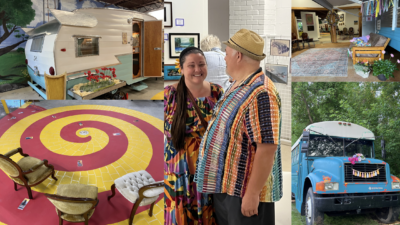
After leaving New York, Megan Jean and her husband, guitarist and vocalist Byrne Klay, hit the road and lived in tour vans for several years before setting up shop in Charleston, South Carolina.
But after a few years, they pulled up stakes again, this time for an even longer stint, playing thousands of shows along the way.
[Check out Megan Jean Klay’s tour schedule to see her live!]
When the pandemic hit, the couple realized that their way of life was over.” It was a mercy killing of a career I didn’t want anymore,” Megan Jean said.
Her arrival in Frostburg in 2020 was met with a mix of warmth and suspicion. In a community where “outsiders” are sometimes greeted with what she calls “Edward Scissorhandsing”—a phenomenon where people are celebrated for their uniqueness until they become intimidating—Megan Jean found that the only way to navigate the torch mobs was to lean into her songwriting.
“The worst thing you can do to a songwriter is give them another song,” she laughs.
Instead of fighting rumors, she turned them into lyrics, transforming isolation into a defiant anthem of roots and resilience.
Navigating personal challenges and the industry
Throughout the conversation, Megan Jean candidly shared her struggles with body image and health, revealing that she had recently lost 100 pounds and was finally ready to resume extensive touring.
“The pandemic forced me to re-evaluate everything,” she admitted. “Living on the road became untenable, and I had to focus on my health. Now, I’m ready to hit the road like I used to.”
Megan Jean emphasized the importance of balancing her personal life and artistic ambition. “The reality is not going to change for me; I have to change the way I move through it,” she explained. This philosophy illustrates her resilient spirit and commitment to her artistry.
Art as a reflection of society
Megan Jean believes that art serves as a mirror for society, reflecting its complexities and struggles.
During the conversation, she expressed frustration with the widespread use of artificial intelligence in creative fields, asserting that it detracts from the authenticity and emotional depth of human artistry.
Art created through AI, she argued, lacks the nuance and personal experience that make music meaningful.
“It takes a lifetime of experiences to write a song that resonates, and we can’t let that be distilled into a quick hit,” she stated passionately.
“For me, the process of creation is what makes art valuable.”

The philosophy of the pattern breaker
Megan Jean’s music is deeply philosophical, informed by her Buddhist practice and a profound engagement with history—both personal and collective.
She speaks of her grandmother, a survivor of fascist Spain, and the epigenetic shadows cast by trauma. She views the world through a lens where science and mysticism converge.
“If you don’t think that science is a miracle, I don’t understand the disconnect. We’re just figuring out how God speaks, and it’s science.”