Somewhere in my brain, personal narrative mixes with fairytales, historical events intertwine with the imagined, and a veil of nostalgia blurs the border between fact and fiction.

[Editor’s Note: An exhibit of Patricia Bellan-Gillen’s work begins on Sept. 13 at the Zynka Gallery in Pittsburgh.]
Sacred imagery moves about in the temporal lobe with iconic characters from children’s stories and recent news flashes picked from the Internet join the legends of black and white television.
With colored pencils and paint, I try to make sense of these insistent and entangled images and render a personal tale of an individual trying to understand this world.
The White Rabbit, Pinocchio, Jack Pumpkinhead, and Humpty Dumpty are characters that appear most frequently in my head and in my drawings. Like many characters from fairytales and folklore, the passage of time has enshrined them as easily identifiable symbols.
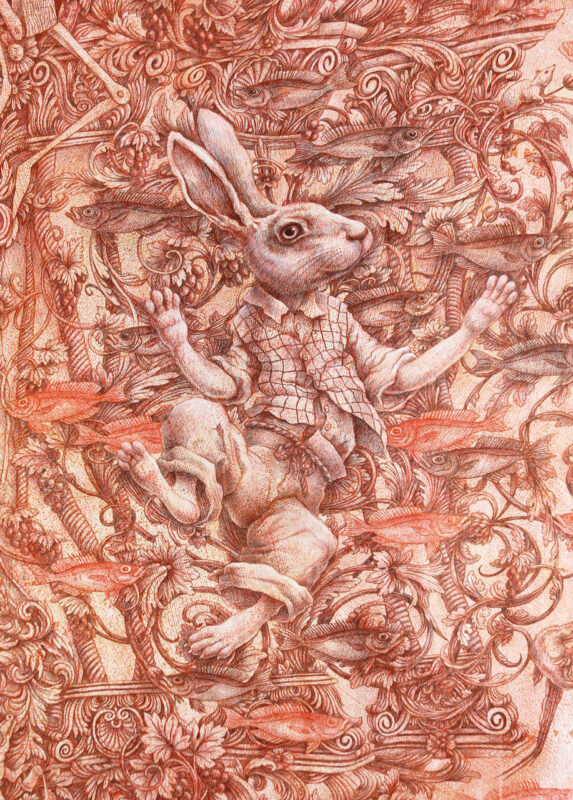
Still, the stories and characters hold much deeper meanings than a single interpretation and carry lessons and warnings that are relevant to life in 2025.
Pinocchio, with his elongated nose, gives us the liar, but reclaimed from the soft brush of Disney, the richly layered text of Carlo Collodi’s The Story of a Puppet (Pinocchio), 1893, is a dark commentary on the extreme disparity of wealth in mid-19th-century Italy and a rallying cry for universal education.
The Wonderful Wizard of Oz and its marvelous illustrations have been studied by scholars since their release in 1900. L. Frank Baum and the original illustrator, W. W. Denslow, were political activists, so the story has been interpreted as an allegory for the political, economic, and social climate of the United States in the 1890s.
Others have read the original story as the heroine’s journey. My favorite character from the sequel, The Marvelous Land of Oz (1904), Jack Pumpkinhead, embodies the figure of a creation story and the need to construct a God in our image.
Although Lewis Carroll denied any political or transcendent interpretations of Alice’s Adventures in Wonderland, many scholars see direct references to the politicians and royal family of Victorian England.
John Tenniel’s iconic rendering of Humpty Dumpty and his brusque dialogue in Through the Looking Glass: ” Words mean exactly what I say they mean, no more, no less,” are mirrored in the language of politics today.
Humpty Dumpty is a much more thought-provoking character when we know that in the original nursery rhyme, Humpty Dumpty was a mocking nickname for a large cannon used in the English Civil War in 1648. The fat cannon crumpled to shards as it fell off a castle wall.
And the White Rabbit? In his anxiety-driven state, he asks us to pursue, hold, and value the sense of wonder in a time-centric modern world.
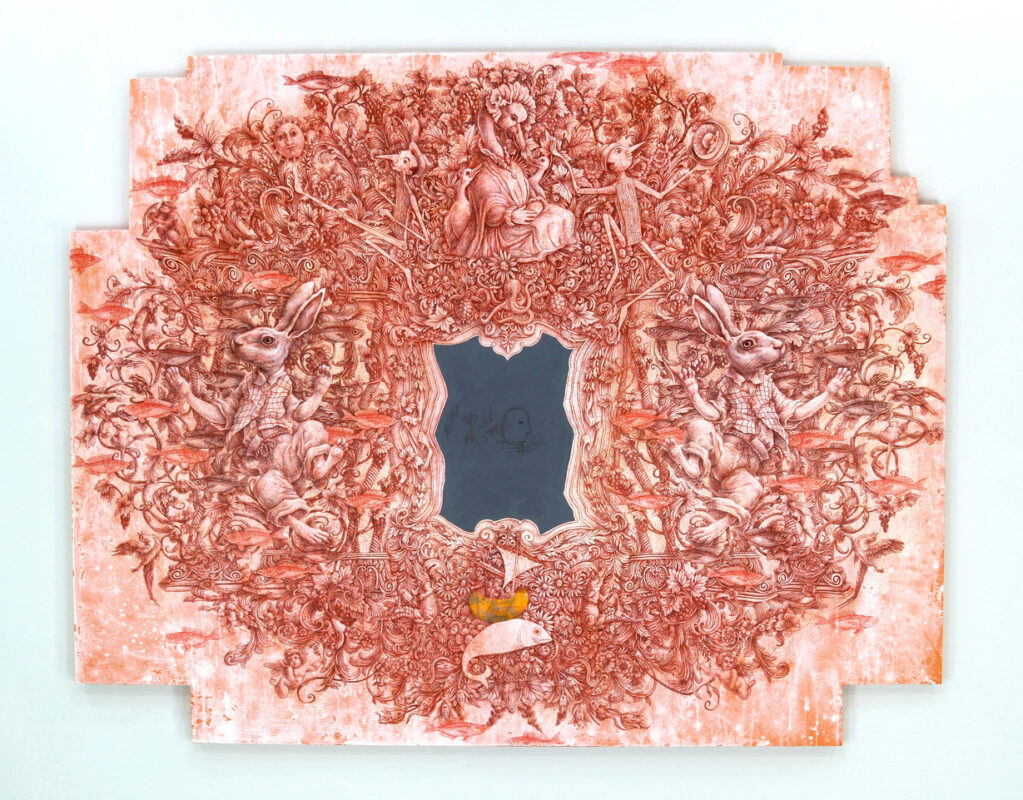
My drawings, staged with these familiar actors, cultural icons, cartoon characters, mythical beasts, and contemporary monsters and mysterious personae on botanical fields, attempt to reconcile the past with the present, suggest a narrative, and engage the viewer’s associative responses.
Keeping formal qualities of abstraction in mind, the drawings employ contrasting elements, precisely rendered passages with loose fluid textures, delicate shading with rough cartoon-like figures, and place polished areas alongside raw, unfinished sketch marks.
I would like my work to confront the viewer simultaneously with beauty and awkwardness, and to mediate elegance with humor.
With everything said, in the end, the work is a celebration of the act of drawing.