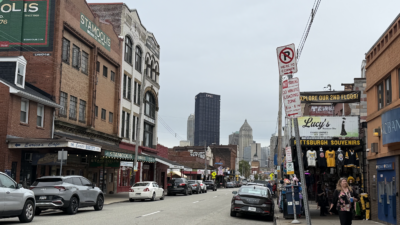
Over the years, Pittsburgh has been known for its industrial past and reimagining as a center for computer science, medicine, and more. But one constant across these eras has been poetry.

If you live in the United States but have never visited the Smithsonian Institution, there is still a chance you have encountered its collections on the road.
Based in Washington, D.C., the Smithsonian—“the world’s largest museum, education, and research complex”—partners with more than 200 affiliate museums and organizations nationwide to share resources and circulate exhibits through programs like the Smithsonian Institution Traveling Exhibition Service.
Pittsburgh’s local affiliate, the Senator John Heinz History Center, has showcased Smithsonian artifacts in exhibitions spanning Destination Moon: The Apollo 11 Mission to the locally inspired Portraits of Pittsburgh.
All this is well-documented. The Heinz History Center has been voted best museum in the country three years running, and the Smithsonian-Heinz relationship is a detail most Pittsburghers have in their back pocket to share with tourists from the capital.
Less well known is the fact that during the 1980s, the relationship was reversed.
For a time, the Smithsonian imported its poetry programs from Pittsburgh.
From 1984 until 1990, the Smithsonian hosted collaborative public programming with the Pittsburgh-based International Poetry Forum, a 60-year-old nonprofit organization that I now direct.
The International Poetry Forum was founded in 1966 by Samuel Hazo, Pennsylvania’s first poet laureate. As one of several dozen poetry programs, reading series, and workshops in Pittsburgh, the Forum has hosted public readings and educational programs featuring hundreds of poets and performers, including W.H. Auden, Mary Oliver, Gwendolyn Brooks, Gregory Peck, and James Earl Jones.
In the decades after Hazo founded the Forum, Pittsburgh’s poetry scene began to receive serious international attention. Pittsburgh’s circle of local writers boomed; publishers like the University of Pittsburgh Press and Carnegie Mellon University Press began to feature works by Nobel- and Pulitzer-winning poets.

An award from the Smithsonian Institution given to the International Poetry Forum in 1990 ( (Image courtesy of the International Poetry Forum)
In 1978, Grace Kelly made her first professional appearance in the United States after becoming Princess Grace of Monaco in 1956. Her destination was, of all places, Pittsburgh—not to act, but to give a poetry reading. One 1982 article in The Washington Post described Pittsburgh’s poetry programs with a kind of awed surprise, noting that the city’s outsized calendar of literary events was in fact “based in Pittsburgh, not in the East Village.”
By 1984, the Smithsonian took note. After a run of events at The Barns of Wolf Trap, the Pittsburgh-based International Poetry Forum was invited to host a series of duplicate events at the Smithsonian.
This arrangement usually involved a Sunday repeat at the Hirshhorn Museum in Washington, D.C., of a Wednesday event at Pittsburgh’s Carnegie Lecture Hall or Carnegie Music Hall.
The Smithsonian-International Poetry Forum collaboration kicked off Oct. 7, 1984, with a reading at the Hirshhorn by future Nobel laureate Derek Walcott. Music was provided by Pittsburgh saxophone legend Nathan Davis and his band Tomorrow.
Other poets and performers to participate in the joint series included figures like Czesław Miłosz, Seamus Heaney, Ellen Burstyn (for a reading of D.H. Lawrence), Tammy Grimes (for a reading of Edgar Lee Masters), James Laughlin (for a reading of William Carlos Williams), Jill Balcon (for a reading of T.S. Eliot), Jason Miller (for a reading of Robinson Jeffers), John Ciardi, Yevgeny Yevtushenko, Marilyn Nelson, Edward Braithwaite, and more.
The series also hosted a special reading in honor of William Butler Yeats featuring Michael and Gráinne Yeats, his son and daughter-in-law, in 1986.
The Pittsburgh-D.C. relationship continued until 1990, when the International Poetry Forum was awarded the Smithsonian’s James Smithson Bicentennial Medal and the institutions parted ways to focus on their respective local programming.
One curious aspect of the joint programming is that the newspaper record of the Pittsburgh events is far more extensive than the record of the D.C. events. This is not entirely surprising: Pittsburgh—as past U.S. Poet Laureate Mona Van Duyn once noted, and which I have discussed elsewhere—is arguably the only city in the country that has ever sustained a consistent practice of reviewing poetry readings in the way that most major cities review musical and theatrical performances.
From the record that remains, the D.C. programs appear to have been well received. Attendance at the Pittsburgh events was formidable: one review from the now-defunct Pittsburgh Press in 1984 expressed disappointment that only 400 people showed up at one of the Pittsburgh readings.
As Postindustrial reported back in 2024, the International Poetry Forum’s reading series recently relaunched after a long hiatus. The Forum will soon announce events for the upcoming 60th anniversary season, which are all set to take place in Pittsburgh. Whether the Pittsburgh poetry scene ever establishes another foothold in the capital is unclear. What is clear is that the country’s interest in Pittsburgh poetry—and Midwest and Appalachian poetry generally—remains strong.
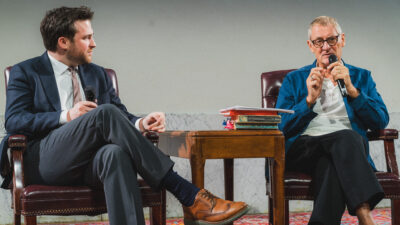
The Forum is now working to help spread Pittsburgh’s literary history to a broader audience on Instagram and other social media platforms, which have unexpectedly accrued over 25 million views since launching last spring. Over the past two years, Pittsburgh’s poetry programs have drawn audiences from out of state—and even out of the country—for events like the world premiere of Simon Armitage’s new Gilgamesh translation.
For all the challenges facing the arts, I have faith in the future of poetry in Pittsburgh. Its past reflects its strength.
As Jerzy Koziński said during his 1986 visit to the International Poetry Forum: Who would have thought poetry would outlast steel?