A Western Pennsylvania artist and author shares an excerpt from her new book Ruins State of Mind: Building a Cathedral to Coal about preserving and celebrating her and others’ industrial heritage.

I was born into the ruins of America.
It just took me most of my life to realize it.
I had internalized the alligator, the Blue Ice, the promise of FantasyLand.
I believed in the fairytale of possibility.
My parents taught me to see magic in furnace grates and strength in leverites. They taught me that Fayette County, Pennsylvania, was special, that coal miners built the world, that we were lucky to be from here.
I believed them.
It took my entrance into the art world to wake me up to how the rest of the country saw my home.
Appalachia was a punchline. Coal country a cautionary tale. My people reduced to statistics in books about what’s broken in working-class America.
The cognitive dissonance nearly split me in half. I was desperately in love with a place the world had already written off as ruined.
That gulf between what I knew and what the world assumed became the exact energy I needed to see possibility in an architectural wasteland.
Because I had grown up believing in impossible things. And now I had something to prove. The collision between my love for this place and the world’s disdain prepared me to give
The Ruins form and shape. Seeing the alligator isn’t enough.
Imagination needs structure to hold. That first winter, I sat down to write about the beginning and arrived at three simple rules. I still look back at them in wonder. They’re not clever. They just work.
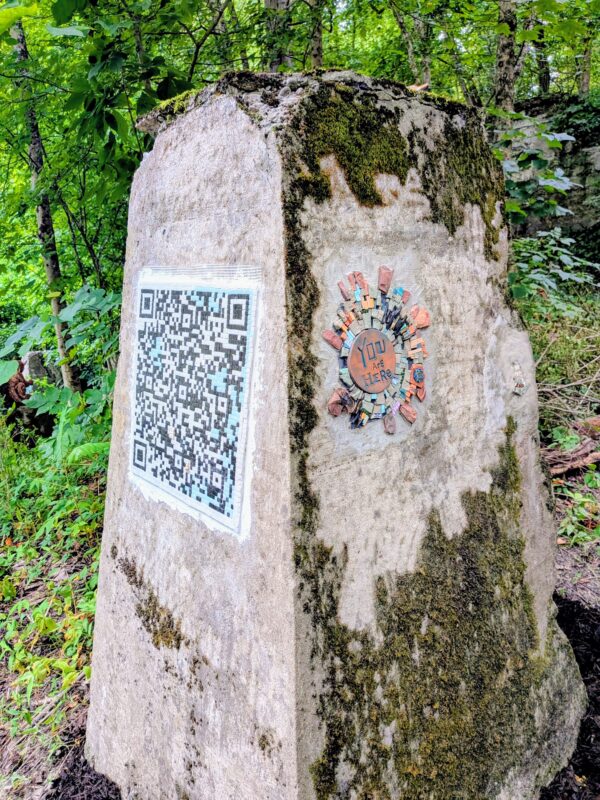
The three rules that keep The Ruins Project – an abandoned coal mine turned into a mosaic museum – from spinning away into something it was not meant for:
- Honor what was
- Build relationships with raw material
- Walk the line
Their simplicity hides an inner strength. Over the years, they have proved their worth as we interpret them into building blocks that also give us limits.
A mosaic museum built onto the bones of an abandoned coal mine operation hits the novelty receptors in the brain. But it takes more than novelty to build an always-in-progress pilgrimage site that attracts coal miners’ granddaughters and working artists.
The people who work here and visit here come from wildly different narratives, and one of my jobs is to find common ground between them.
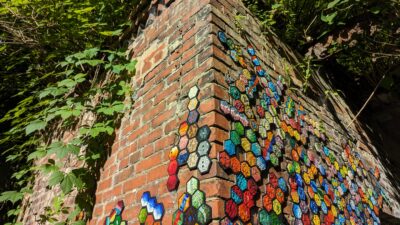
Hundreds of mosaicists from six continents, dozens of countries, and all over the U.S. have contributed their work to the concrete walls of The Ruins.
Some participate via open calls that welcome all levels; others are professionals whose ambitious portraits, maps, and native Pennsylvania fauna arrive by invitation.
This summer, our newest mosaic portrait was built and installed in one week by nine artists.
The Contemporary Miner, based on the profile of a real man working a coal mine in Greene County, asks the visitor to see that coal is still here in Pennsylvania.
Its hyper-modern design was planned to look unfinished, like the man who travels over an hour underground to get to the work site and loves his job. He is his own work in progress.
Most of the stories we tell during the guided tours of The Ruins reach back into the past. Details that round out real people beyond the caricatures of dirty faces.
Our tours are more than a list of facts; they are a kind of ephemeral art, alive in the moments they last and with the people who come.
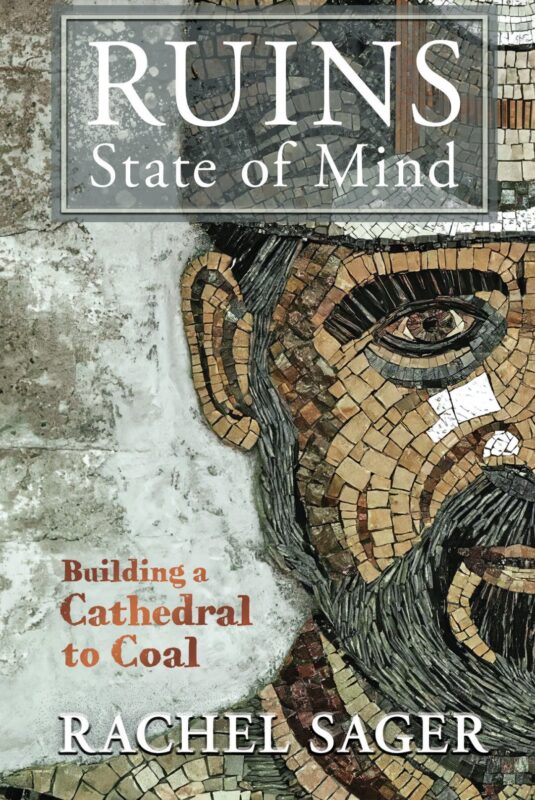
The Ruins was built for the children of coal. This September, I will publish the book that tells its story.
When preorders opened, readers funded the entire first print run in a single day, and the order increased from 300 to 500 copies.
The book opens on a steep hillside in Fayette County.
Three hundred million years ago this steep hillside was a swamp.
A hundred years ago men tunneled into it looking for the Pittsburgh seam.
Coal like this passed through my family before I was born and paid for my college education.
I didn’t know any of this when I got myself here.
I was forty-one years old.
And I accidentally bought a coal mine.
— from the prologue of Ruins State of Mind
Preorder a signed first edition or a special numbered copy of Ruins State of Mind: Building a Cathedral to Coal at Sagermosaics.com.
Sept. 13 — Launch reading and signing at The Ruins, Whitsett, Pa. An intimate gathering of twenty. A few seats remain. Ruins Book signing Event
Oct. 4 — Keynote, Appalachian Literary Arts & Storytelling Festival, Nelsonville, Ohio. [alasfestival.com]
A fall reading at the Pump House with Rivers of Steel will be announced soon.