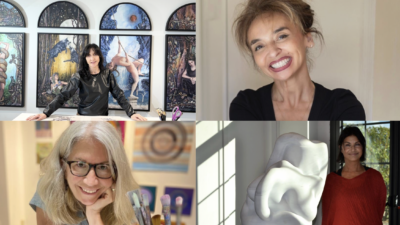
The Pittsburgh-area exhibit “emBodyment” features four artists whose practices converge in a shared exploration of the natural world as both source and mirror of human experience.

Working across varied materials and mediums, each artist transforms elements of landscape, flora, and organic form into images that hover between the familiar and the uncanny.
The works are quietly surreal, where branches become limbs, bodies dissolve into terrain, and the boundaries between person and environment blur.
Nature is not simply depicted but embodied—imbued with gesture, emotion, and presence.
Viewers are invited to consider the relationship between human and natural forms, suggesting a continuum rather than a divide. These artists propose a world that is shaped as much by the external environment as by inner life.
CAROLYN FRISCHLING
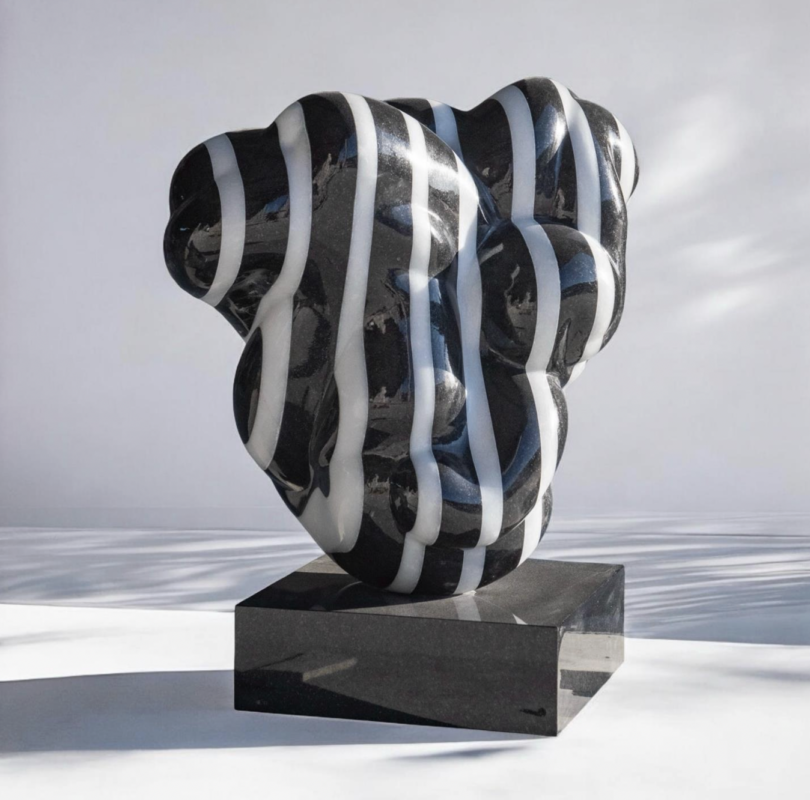
My practice merges traditional craftsmanship with technology to create abstract, biomorphic forms. Using tools such as three-dimensional design software and printing, and a seven-axis robot, I explore complex geometries that were once almost inconceivable to realize.
While technology plays a central role, all of my work is ultimately hand finished, blending precision with the meditative intimacy of traditional techniques. My abstract sculptures draw on natural formations and philosophical inquiry to explore perception, material, and the limits of knowing.
PEGGI HABETS
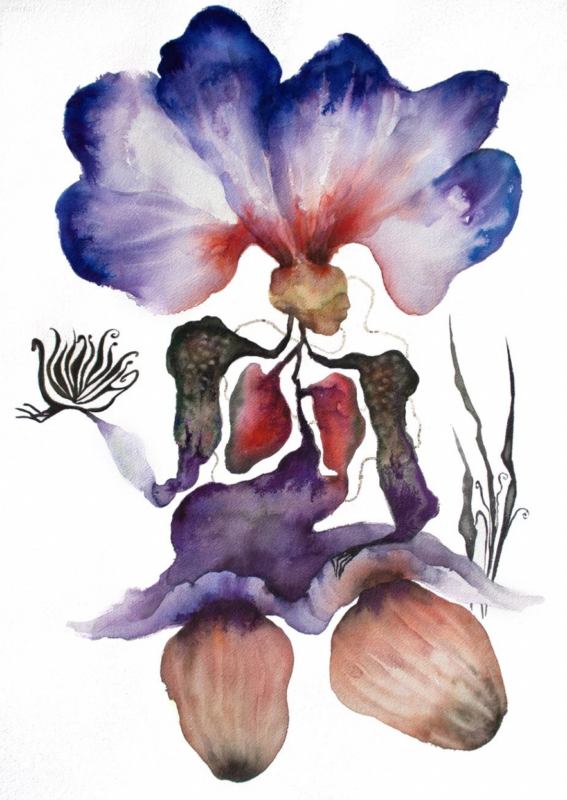
Darling Unbecoming explores the female body as a site of contradiction — simultaneously ornamental and dangerous, cultivated and resistant — a feminine monster of sorts. The figures in these works are built from carnivorous and toxic botanicals: Venus flytraps, pitcher plants, sundews, and poisonous medicinal herbs.
The female form has long been shaped by external forces — trained toward beauty, softness, and passivity. These paintings ask what happens when that form starts growing teeth. The works don’t offer resolution. The figures are neither victims nor predators in any clean sense. They are organisms adapting — developing the tools available to them within the conditions they were given.
LINDA PRICE-SNEDDON
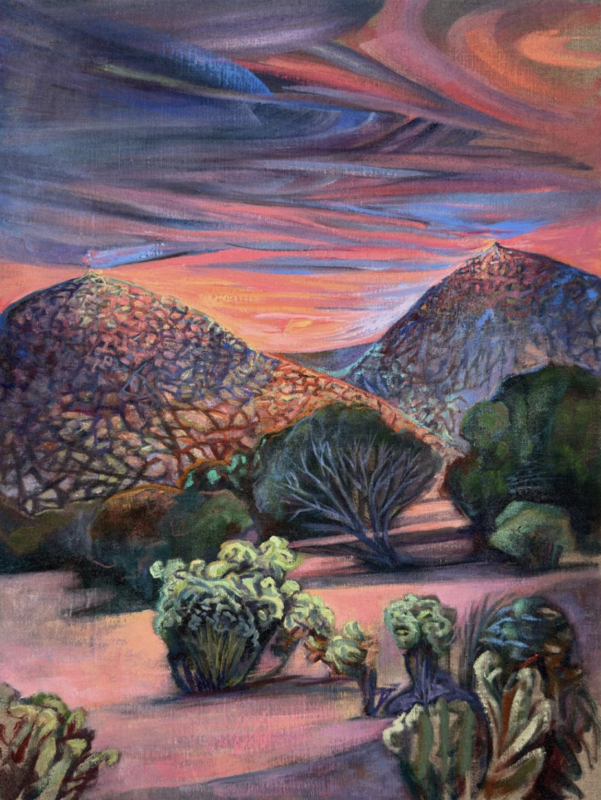
For me, the desert is a sacred place. I’m from the Rust Belt, but I’ve always yearned for an arid open land. Rock, light, and air energize my spirit, and I feel a connection between the fleeting moment of my existence and geologic time.
Surrounded by vastness, gazing upon rocks shaped by the forces of weather and tectonic upheaval, I can sense the incomprehensible span of time between myself and the landscape. I’ve visited Joshua Tree twice, in 2024 and 2025, and returned with photographs that compelled me to paint. What initially seemed improbably complex—the intricate geometries of those ancient rock forms—became fathomable and deeply felt through the act of painting.
There is a vital duality in this landscape: energy at rest and energy in motion. The rock piles, stacks, and towers hold geological time within their mass, yet light constantly moves across them, activating their surfaces. It is this quality—the liveliness of ancient forms meeting changing light—that I have sought to capture in this work.
JANNICK WILDBERG
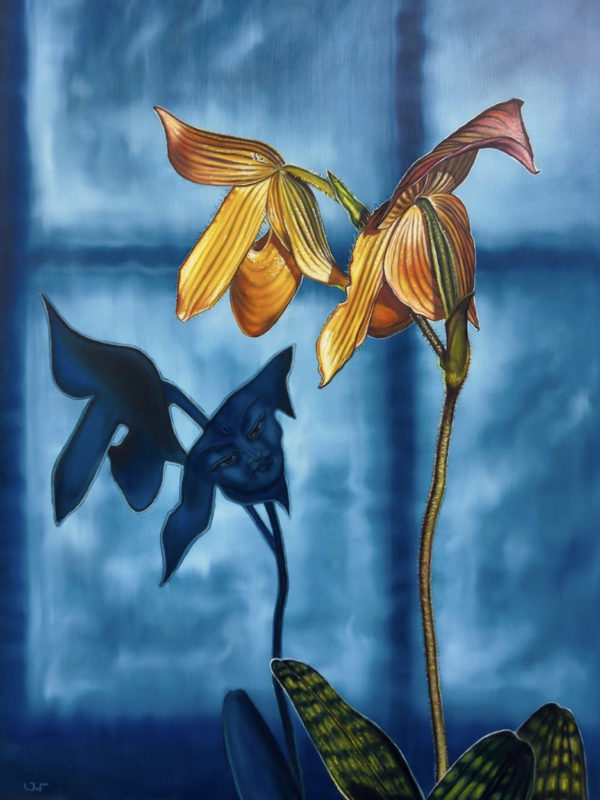
Whether portraits, nests, plants, or abstracts, my paintings attempt to raise awareness of our shared consciousness. I wish to represent life’s radiance and communicate messages of universal interdependence. Plants, with their graceful presence and inner life, are sentient beings.
Recent scientific research suggests as much; our distant ancestors knew it as a fact. They feel, interact, and communicate in their own time and space and are immeasurably more than mere objects of humanity’s dominion.
When we awaken from ‘Self-Absolutism’, we experience the Oneness with everything, become conscious of all sentient beings’ fundamental but fragile interconnectedness, and realize the Preciousness of Life. My new series, “The Shadows Know,” portrays orchids at various life stages to metaphorically illustrate the evanescence of everything.
The realization that Impermanence is our destiny compels us to prioritize Peace and Unity. My “Cradles of Life” series shows nests that have fallen to the ground—avian heartbreaks. While these nests appear realistic from a distance, the close-up reveals a world beyond appearances. Nests, with their profound symbolism, deeply move me.
The “emBodyment” exhibit will be featured at the Zynka Gallery in the Pittsburgh area from April 18 to May 31.