Gettysburg-based artist Sarah Jacobs has a new collection of surreal and bold paintings that prompt us to consider our place in the vastness of space and time.

In my life and art practice, I consider the qualities of separation and oneness. Are we existentially isolated within our separate bodies, are we integral parts of a collective whole that we are only obliquely aware of, or are we simultaneously both?
These deep-spaced paintings were inspired by the Hellenistic philosophy of Plotinus, who believed that all beings are intrinsically important pieces of a larger whole, like how every jigsaw piece is necessary to create a full image.
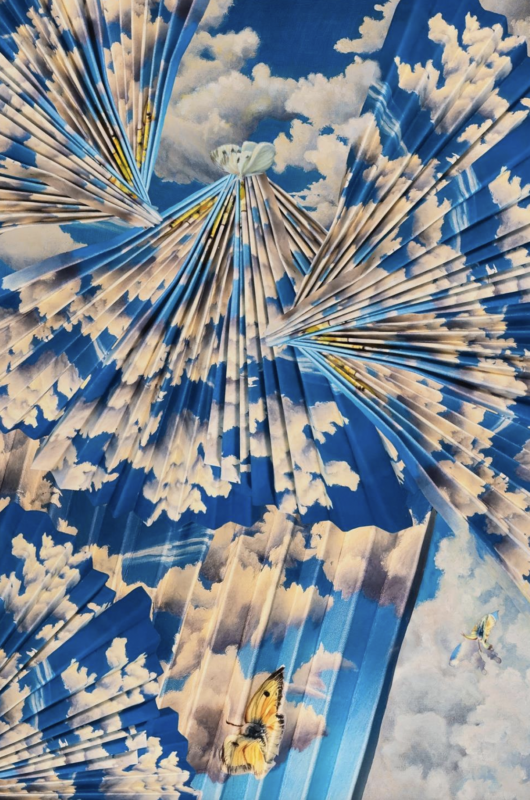
The deep skies, which represent the world beyond us, are paired with specific foreground imagery (birds, butterflies, etc.), which are depicted with more detail and specificity than their environments, suggesting that we relate to them as individuals.
The deep and the near are depicted together in overlapping layers that suggest that, although we are individual actors playing out our lives, we are part of a larger system that we can only partially understand from our limited vantage points. My toenail does not know that it is part of me, nor that the “I” it is part of likes sitcoms, existential philosophy, and dry wine.
We, being so much more than the sum of our body parts, can realize that our understandings of our experiences are limited, and this series plays with the endless possibilities that offers.
My aesthetic visualization of some such possibilities, such as paintings, was inspired by reading about quantum loop theory in Carlo Rovelli’s books, including The Order of Time and this exhibition’s namesake, Reality is Not What it Seems.
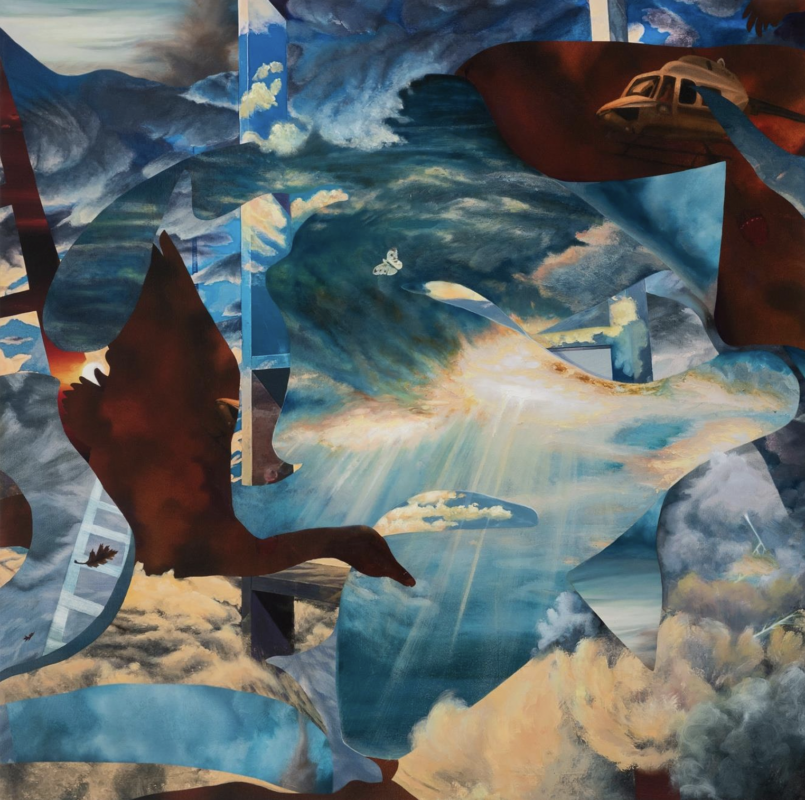
In the series, multiple versions of the same sky or multiple different skies are depicted within one image, suggesting that multiple understandings of reality could be simultaneously valid.
To create the work in this exhibition, I painted several preliminary oil paintings of skies. I had those photographed, and I had the photos of them printed on cotton and paper, which I warped, tore, and then photographed.
I next took the images of the preliminary paintings, the images of them on manipulated paper and fabric, as well as photos of skies I had painted into previous other paintings, and collaged them together digitally in Photoshop.
Next, I had those collages printed on canvas.
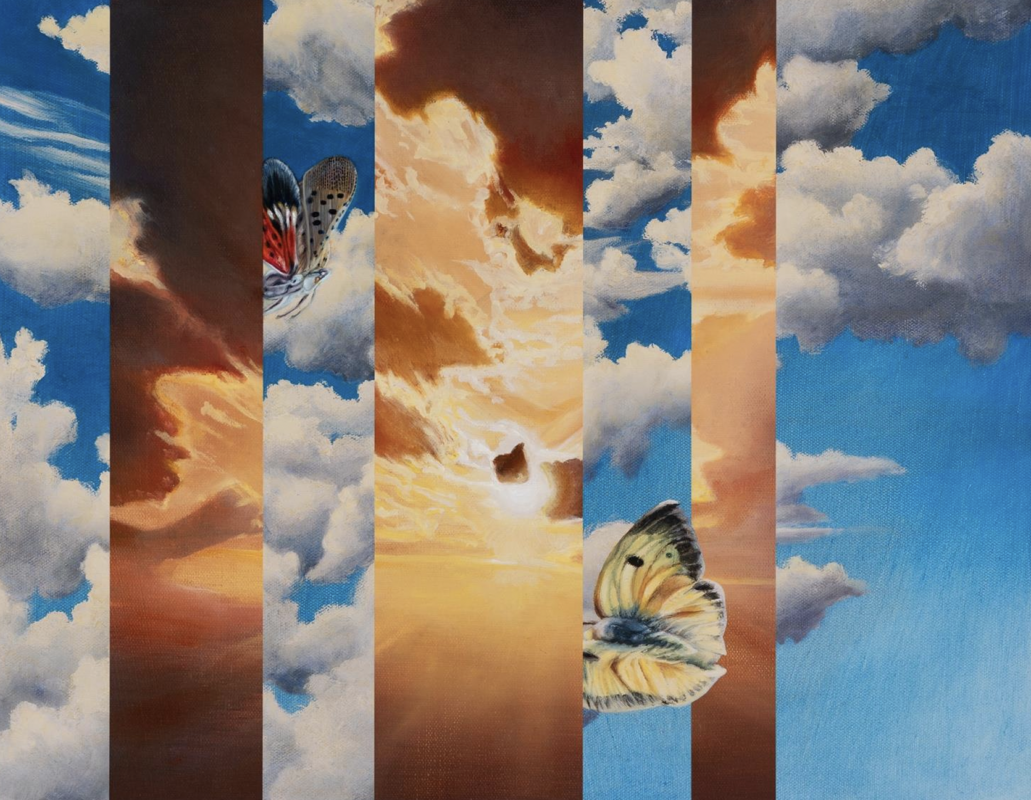
Lastly, I painted more on top of the canvas, primarily with oil paint and, in some cases, acrylic and metal leaf. One exception is Polaroid, which I had printed on paper to suggest that it may be a giant Polaroid photo of a torn Polaroid photo of a supposed moment in time.
The Pittsburgh-area ZYNKA Gallery will present a curated exhibition of Jacobs’s latest work, opening January 10 with a reception from 5-8 pm.
The exhibit will remain on view through February 22.