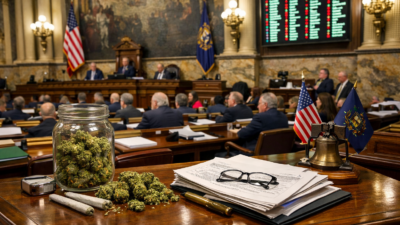
The Pennsylvania House of Representatives has recently passed a significant budget legislation proposed by Gov. Josh Shapiro that hinges on potential revenue from the sale of recreational marijuana, even though such sales have yet to be legalized in the state.

The legislation, totaling $53.2 billion, was approved by a vote of 107-94 earlier this week, largely along party lines.
However, it drew some Republican support, with five GOP lawmakers joining their Democratic colleagues.
Shapiro, a Democrat, included recreational cannabis legalization and the anticipated revenue it would generate in his budget request earlier this year.
Despite this budget plan addressing the financial implications of cannabis sales, it does not contain actual provisions for the legalization of marijuana, Marijuana Moment reported.
Following its approval in the House, the legislation now moves to the Senate, where legislative leaders have expressed skepticism about cannabis legalization and the state’s spending priorities.
“This legislation reflects the proposal put forward by Shapiro in February and builds on the dedicated work we’ve been doing,” said Democratic House Majority Appropriations Chairman Jordan Harris.
“This budget continues our investment in public education, supports law enforcement, and strengthens Pennsylvania’s economy—all while returning money to working families and not raising taxes.”
However, the Senate’s Republican leadership has consistently criticized efforts to legalize cannabis. Republican Senate President Pro Tempore Kim Ward, along with Republican Majority Leader Joe Pittman and Republican Appropriations Committee Chair Scott Martin, released a joint statement expressing ongoing concerns about the budget’s spending levels.
“We will continue to fight for a more fiscally responsible spending plan that better positions our Commonwealth to grow and prosper, without placing unreasonable financial burdens on Pennsylvania families and taxpayers,” they stated.
In contrast, Shapiro asserted that the budget proposal represents a commitment to progress, stating it “builds on the progress we’ve made and continues Pennsylvania’s rise—putting money back in folks’ pockets, investing in schools, expanding our workforce, keeping our communities safe, and growing our economy.”
The governor emphasized the need for urgency, urging the Senate to act swiftly on the budget plan.
The discussion surrounding cannabis legislation coincides with new polling data indicating strong support for legalizing recreational marijuana among Pennsylvanians.
According to a recent poll, nearly 70% of likely voters favor the regulation and taxation of legal cannabis for adults aged 21 and older.
This support spans party lines, with 72% of Democrats in favor, 67% of Republicans, and 64% of independents.
“By legalizing and regulating adult-use cannabis, we’d bring in $1.3 billion in revenue for our Commonwealth over the first five years,” Shapiro stated in a recent social media post, pushing for legislative action. He highlighted the potential for this revenue to be reinvested in essential state programs and services.
In a broader context, the Independent Fiscal Office (IFO) reported in February that legalizing cannabis in Pennsylvania could yield almost half a billion dollars in annual revenue by 2028, well above previous projections from the governor’s office.
The IFO estimates indicated that with a proposed 20% wholesale cannabis excise tax and additional retail sales taxes, the state could see significant tax revenues beginning in the first year of implementation.
Meanwhile, lawmakers continue to explore ways to advance cannabis legislation.
In February, a coalition of drug policy and civil liberties organizations urged Shapiro to take a leadership role in facilitating discussions on cannabis legalization.
And just last month, the Senate Law and Justice Committee approved a bill aimed at creating a Cannabis Control Board to oversee the medical marijuana program and potentially regulate adult-use cannabis if legalized.
As the Pennsylvania legislature navigates these critical fiscal and social issues, the future of recreational marijuana and the associated revenue hangs in the balance, awaiting further deliberation in the Senate.