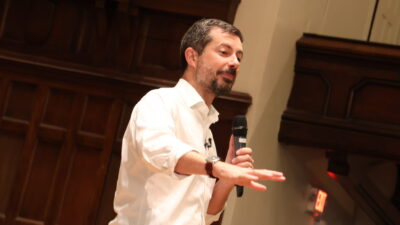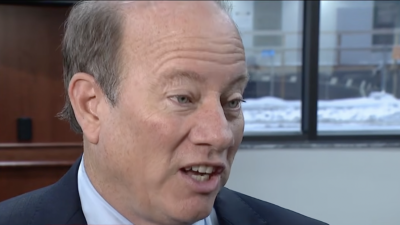
Mike Duggan, the former Democratic mayor of Detroit who launched an independent bid for Michigan governor, announced he is withdrawing from the race, citing a fundraising shortfall and dwindling support.

Duggan’s withdrawal reshapes the contest into a more conventional Republican-versus-Democrat showdown in a state known for its tight political battles.
Duggan, who was the first major figure to declare his candidacy, initially showed promise with strong polling numbers and endorsements.
However, as the November election approached, his campaign faced significant hurdles.
Recent polls, including one from the Detroit Regional Chamber, showed Duggan trailing Democratic Michigan Secretary of State Jocelyn Benson by 11 points in the Democratic primary and trailing Republican Rep. John James by 6 points.
In a letter to supporters, Duggan acknowledged the formidable challenges of running as an independent.
“We knew the independent route was filled with challenge,” he wrote. “Even against those odds, the excitement for real change carried this campaign upward for more than a year.”
Fundraising proved to be a major obstacle for Duggan, who noted that despite the generosity of Michigan donors, his campaign would be significantly outspent by the national Democratic and Republican parties.
This financial disadvantage, coupled with declining poll numbers, led him to step aside.
Duggan’s departure is likely to benefit Benson, who is leading the Democratic field by a significant margin. The Republican primary remains competitive, with John James and businessman Perry Johnson among the frontrunners for the GOP nomination.
Gov.Gretchen Whitmer, a popular Democrat, is unable to seek re-election due to term limits, leaving the race wide open.
Duggan’s tenure as mayor of Detroit, where he garnered bipartisan support for his efforts to revitalize the city post-bankruptcy, had initially positioned him as a formidable candidate.
His administration was credited with stopping decades of population decline and stabilizing Detroit’s finances.
Despite his accomplishments and past affiliation with the Democratic Party, Duggan’s independent bid drew criticism from his former party members.
The Detroit Regional Chamber’s recent poll identified a significant portion of the electorate—about 23% —that favored Duggan, representing a crucial group for the remaining candidates to target.
Jocelyn Benson welcomed Duggan’s supporters, emphasizing a vision for unity beyond partisan division.
Meanwhile, John James acknowledged policy disagreements with Duggan but echoed concerns about Michigan’s direction, urging for change.
Michigan’s status as a swing state, having voted for both Trump and Joe Biden in recent presidential elections, intensifies the stakes of this year’s gubernatorial race.
Some Michigan progressives saw Duggan’s independent bid as a potential spoiler that would have effectively handed the governor’s office to Republicans.
They also accused him of running a “vanity campaign” aimed at whitewashing past controversies, including an ongoing issue over contaminated dirt containing lead and arsenic from demolished building sites.
“Duggan has proven time and time again that he is not fit for the biggest job in the state,” said Justin Mendoza, executive director of Progress Michigan.
“By running this vanity campaign and inviting public scrutiny, Duggan has wrecked his own reputation and forced Michigan voters to reckon with the uglier, more complicated truth of his legacy.”