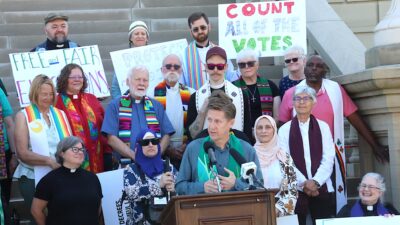
With the Aug. 4 primary less than a month away, religious leaders and practitioners of various faiths gathered at the state Capitol to stand up for voting rights amid growing concerns at both the state and federal levels.

The gathering in Lansing was one of three in the state, as 250 faith leaders in Detroit, Grand Rapids and the capital city spoke up in support of the democratic process in response to yearslong efforts to sow distrust in the election system.
“It is not just the duty of faith leaders, it is the duty of every American citizen to stand against any national or state constitutional amendment, or any legislation that restricts everyone’s right to free and fair elections, to choose our leaders,” said the Rev. Michael Young of Leslie Congregational United Church of Christ.
The news conference followed news that the Department of Justice had sent letters to city clerks in Detroit, Lansing and East Lansing, stating its intent to send election monitors for the Aug. 4 primary.
Department spokesperson Kiersten Pels confirmed the department had notified three Michigan cities of its intent to deploy election monitors, with Pels noting these jurisdictions had received Civil Rights Division monitors in past elections under previous administrations.
Micheal Davis Jr., executive director of Promote the Vote Advocates, which backed two successful ballot initiatives to expand voting rights in Michigan, voiced skepticism of the department’s intentions, noting President Donald Trump’s repeated attempts to discredit the safety and security of U.S. elections following his 2020 loss to former President Joe Biden.
“Given this administration’s repeated use of baseless conspiracy theories to attack voters’ access to the ballot box, we can’t help but conclude that these monitors are simply the latest in a long line of politically motivated attempts to undermine Michigan elections,” Davis said in a statement.
In a joint statement, Michigan Secretary of State Jocelyn Benson and Attorney General Dana Nessel defended the security of Michigan’s elections and the state’s role in administering elections.
“Michigan’s elections are transparent, accurate, accessible, and secure,” Benson said in a statement. “And while the US Department of Justice continues to pursue baseless allegations to confuse voters about those facts, we welcome anyone who wants to — in compliance with the law — observe Michigan’s elections process. When they do, they will see what we already know to be true – Michigan’s professional local clerks are committed to ensuring our elections are safe, accessible, and fair.
Michigan voters could also see a proposal from Americans for Citizen Voting on a ballot in November. Citing concerns with noncitizen voting, the initiative would amend the Michigan Constitution to require voters to present a valid photo ID when casting their ballot. Additionally, the proposal would create additional voter roll verification, requiring the secretary of state to review voter rolls and remove noncitizens.
Opponents of the initiative argue its documentation requirements would disenfranchise more than 700,000 residents, while requiring all Michigan voters to re-register.
Noncitizens are already prohibited from voting in U.S. elections. In a review of Michigan’s motor vehicle records compared to voting records in the state’s Qualified Voter File, Benson found 15 credible cases of noncitizen voting, out of the 5.7 million ballots cast in the 2024 general election, representing 0.00028% of the total vote.
In addition to voting rights concerns within the state, the group of faith leaders pointed to concerns impacting the rest of the nation, from Trump allies suggesting they deploy Immigration and Customs Enforcement agents to polling places, to Trump’s attempts to restrict mail-in voting.
“My faith teaches me that God desires all creation to live in peace with one another and with our creator, and that peace isn’t merely an absence of conflict, though that would be a good place to start,” said the Rev. Leslee Fritz of Grace United Methodist Church in Lansing. “That peace is a sense of well-being, of knowing that you are safe to live fully and freely. In a democracy that includes feeling safe to fully participate in election activities.”
Fritz said that with efforts to restrict voter registration, the FBI’s raid on an Ohio organization supporting voter registration, and concerns that federal agents or military members will be sent to patrol the polls, too many people must now choose between their safety and their participation in the democratic process.
“That not only violates the basic tenets of our democracy, it violates the basic dignity of us all,” Fritz said.
Janine Sinno of the East Lansing Islamic Center warned that restricting mail-in voting could prevent some voters from casting their ballot, noting that her friend, Tanna Skaggs, relies on mail-in voting due to a disability.
She called on other faith leaders to sign on to a national letter from Faith In Us, pledging to uphold democracy and access to the ballot.
For those working to sow doubt in the democratic process, the Rev. Kirk Miller of the First Presbyterian Church of Holt asked them to examine their conscience.
“As spiritual leaders who love this country, we know that we have a lot of history to live up to,” Miller said. “But we have even more hope to live into, and may the truth keep us free.”