As national Republicans eye Michigan as the breeding ground for growing its US Senate majority, the Democratic candidates in the 2026 Michigan race say that confidence is misplaced.

Last week, the National Republican Senatorial Committee said on a donor call that it sees the Great Lakes state as a jumping off point for an expansion of its majority in the upper chamber of Congress. The call was first reported by Axios.
The mention of Michigan on the call was, in a sense, the GOP coping with its lack of a challenger in the Georgia race to take on U.S. Sen. Jon Ossoff, with the National Republican Senatorial Committee looking to Michigan as its best attempt to play offense in 2026.
Brendan Jaspers, the committee’s political director, went so far as to tell Republican donors that those who have said Rogers can’t win in the upcoming race, due to his loss in 2024, were “perpetuating [a] lie” that was out of touch with “the realities of the data.”
Some of that also has to do with the state of the Democratic primary in Michigan, which currently has three contenders: current U.S. Rep. Haley Stevens of Birmingham, state Sen. Mallory McMorrow of Royal Oak and Abdul El-Sayed, the former Wayne County Department of Health, Human and Veterans Services.
Although the race is still in its early phases and the primary won’t commence until August next year, the three candidates are already starting to turn inward and throw jabs at one another. Meanwhile, they’ve also been laser focused on Rogers, who is not the only name in the race but is by far the main contender. Kent Behman, a dentist, Fred Heurtebise, an engineer and welder, and Geneveive Peters Scott are also in the hunt for the Republican nomination, although they each lack major party funding, and perhaps most importantly, the endorsement that President Donald Trump has already bestowed on Rogers.
Rogers’ campaign did not respond to a message from Michigan Advance seeking comment.

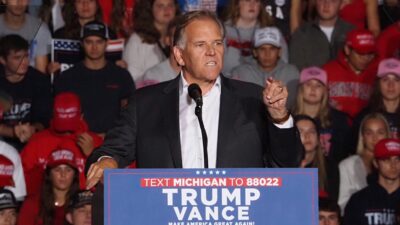
Michigan GOP Senate candidate Mike Rogers (right) speaks at a rally on Saginaw Valley State University campus in Michigan alongside former President Donald Trump (left) on Oct. 3, 2024 ahead of the presidential election (Photo: Anna Liz Nichols)
Those projecting a Rogers victory this early, however, should heed not just the 2024 results – in which Rogers lost to current Democratic U.S. Sen. Elissa Slotkin of Holly – but also the broad electoral history of Michigan’s U.S. Senate races.
Of note, no Republican has won a Senate seat in Michigan for more than three decades. Looking to the last race involving Rogers, he underperformed Trump by over 100,000 votes in a Republican wave year. A straw poll conducted by the Michigan 9th Congressional District also showed Rogers didn’t run away with the survey. Scott was within 10 percentage points from Rogers’ top spot. Rogers garnered 52% out of a little more than 100 delegates voting in the straw poll, to Scott’s 42%.
The 9th Congressional District is located in the state’s blood red Thumb region that covers a wide swath of strong GOP territory, including portions of Huron, Tuscola, Sanilac, Lapeer, St. Clair, Macomb and Oakland counties.
“Even his own base wishes they had a different candidate as he runs on a deeply unpopular agenda that’s spiking costs and threatening to kick hundreds of thousands of Michiganders off their health care,” Michigan Democratic Party spokesperson Joey Hannum told the Advance. “Michiganders know Mike Rogers is an out-of-touch, Florida mansion-dwelling multi-millionaire and they’ll reject him again in 2026.”
McMorrow also told the Advance that “Michiganders rejected Rogers once, and we’ll do it again.”
“Prices are through the roof, families are struggling, and Michiganders aren’t buying what he and Trump are selling,” McMorrow said of Rogers.
Stevens campaign spokesperson Joetta Appiah told the Advance that Rogers will have to answer to voters after making jokes about rising prices spurred by the economic policies of President Donald Trump. Contrast that with the Democrats, and Stevens herself, who are focused on lowering costs for families feeling the pressure.
“The contrast is clear: Mike Rogers is a Florida man looking for a promotion and a platform to rubber-stamp Donald Trump’s chaos agenda,” Appiah said via email.

Democratic Rep. Haley Stevens speaks out against proposed cuts at the Social Security Administration during a rally in Detroit on April 4, 2025. (Kyle Davidson/Michigan Advance)
El-Sayed campaign spokesperson Roxie Richner also said Rogers is a known commodity, but not in a way that’s beneficial to Michigan voters.
“He is a famous flop of a Senate candidate and if given any power he will always choose Big Pharma over the rest of us,” Richner told the Advance.
Christyna Thompson, press secretary for the Democratic Senate Majority PAC, also believed that the overconfidence in Rogers was “wish-casting.”
“Washington Republicans love Rogers because he’ll be a rubber stamp for the very same economic agenda that’s keeping grocery and health care costs high for Michiganders,” Thompson said. “But that doesn’t reflect the reality that he’s a weak general election candidate. He’s already lost the state once, in an election where Donald Trump should have carried him over the top, and he’s trailing every Democrat in the race in fundraising. Strip away the spin, and he’s just another weak candidate riding the fumes.”
That said, the GOP’s supposed prescience on the upcoming potential nastiness of the Democratic primary was clear while reporting this story.
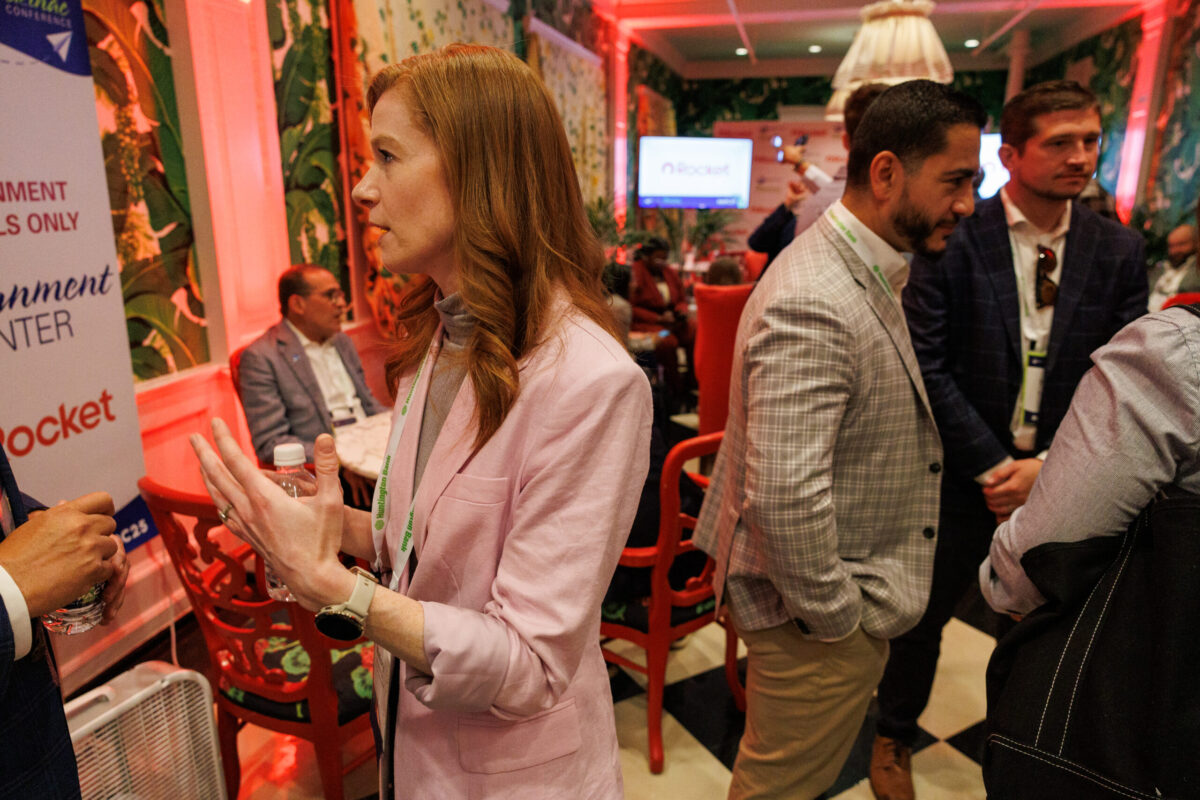
Michigan Democratic State Sen. Mallory McMorrow, left, and Abdul El-Sayed, right, at the Grand Hotel on Mackinac Island, Mich., during the second day of the Mackinac Policy Conference on May 28, 2025. (Photo by Andrew Roth/Michigan Advance)
When asked to comment on the National Republican Senatorial Committee’s projections and whether they thought the race was already won by Rogers, each of the respective Democratic campaigns jockeyed to say why they, over the others, would be the best person to beat Rogers in November.
“Everywhere I go, people tell me the same thing: we need a Senator who works for Michigan, not Trump,” McMorrow said. “That’s why we’ve outraised everyone in this race – and will be the next one to beat him.”
Richner, similarly, used the opportunity to showcase E-Sayed’s credentials against Rogers.
“Meanwhile, Abdul is joining nurses on the picket line, helping Yoopers eliminate medical debt, and building a people-powered movement,” she said. “Abdul beats Mike, both in the November election – and at life, generally.”
Appiah was adamant that Stevens was still “the best Democrat to defeat him,” noting her consistent polling advantage in a head-to-head race with Rogers – the Detroit Regional Chamber’s May poll conducted by Glengariff Group shows that only Stevens beats the Republican candidate in a survey of registered voters, but not by much.