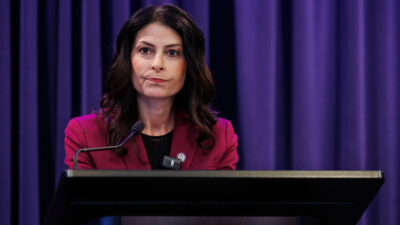
Michigan Attorney General Dana Nessel, alongside a coalition of Democratic state attorneys general, are calling on the U.S. Supreme Court to take up a case surrounding an individual’s right to sue to enforce the federal Voting Rights Act.

In a recent brief , Nessel and 22 other AGs asked the high court to review a lower court’s decision in Turtle Mountain Band of Chippewa Indians v. Howe, which would prevent individuals from suing to enforce the Voting Rights Act.
In their brief, the attorneys general argue in support of the individual right to sue to enforce Section 2 of the Voting Rights Act, which bars state and local governments from enacting racially discriminatory policies, ensuring American citizens would not be denied or restricted from casting their ballot.
While the U.S. Attorney General and private citizens have been able to file lawsuits to enforce this provision for nearly 60 years, a decision from the United States Court of Appeals for the Eighth Circuit has called that practice into question.
The Turtle Mountain Band of Chippewa Indians, Spirit Lake Tribal and three Native American voters filed a lawsuit under Section 2 in 2022, challenging North Dakota’s redistricting plan on the grounds that it diluted Native American votes.
The U.S. District Court for the District of North Dakota held that the map discriminated against Native American voters. However, the Eighth Circuit reversed the decision, ruling that individual voters and organizations cannot sue to enforce Section 2 of the Voting Rights Act.
In their brief, the group of attorneys general argue that private enforcement of the act is essential, and has acted as the primary avenue for enforcing the law since it was enacted. They also argue that exclusively relying on the U.S. Attorney General to enforce the law would be insufficient to protect voters from racial discrimination.
“If individuals are stripped of their ability to enforce the Voting Rights Act, everyday Americans will have little control in protecting their own right to vote,” Nessel said in a statement. “Relying only on the U.S. Attorney General to bring these cases puts communities at the mercy of political officials, and I urge the Supreme Court to review this decision to preserve the fundamental protections of our democracy.”
While private citizens account for 91% of the challenges under Section 2 between 1982 and 2024, the U.S. Attorney General accounts for 7.5% of challenges within that same time frame, the attorneys general wrote.
Alongside Michigan, the brief was joined by attorneys general from Minnesota, Arizona, California, Colorado, Connecticut, Delaware, Hawaii, Illinois, Maine, Maryland, Massachusetts, Nevada, New Jersey, New Mexico, New York, North Carolina, Oregon, Rhode Island, Vermont, Washington,Wisconsin and the District of Columbia.