
It was the biggest applause line of the biggest event in Gov.-elect Keisha Lance Bottoms’ campaign, a rally featuring former President Barack Obama less than a week ahead of the Nov. 3 election.

“I believe in a woman’s right to make decisions –” Bottoms said, then paused for more than 20 seconds of cheers and chants of “Keisha, Keisha.”
“ — a woman’s right to make decisions about her own body and her future,” she continued. “And as governor, I will fight to restore that right.”
Georgia has banned most abortions since a 2022 U.S. Supreme Court decision overturned the federal right to an abortion and left the issue to the states. With some exceptions, Georgia bans abortions once embryonic cardiac activity is detectable, typically around the sixth week of pregnancy. The ban remains in place while a challenge against it moves through court. Before Roe v. Wade was overturned, Georgia allowed abortions up to about 20 weeks of pregnancy.

Gov.-elect Keisha Lance Bottoms speaks at the state Capitol about her transition into office on Nov. 6, 2026. Ross Williams/Georgia Recorder
Bottoms’ health platform included repealing that law and returning to “the Roe-era standard.”
Speaking to reporters at the Capitol the Friday after Election Day, Bottoms appeared to acknowledge obstacles to making that happen.
“If we see a pathway to do something about it this session, then we’re going to take that opportunity,” she said, referring to the annual lawmaking session set to begin in January. “And it may not be this session. If it’s not this session, then we’re going to take it at the first opportunity that we have.”
All pathways run through the Senate
Georgia Democrats outperformed expectations in this year’s midterm election, sweeping all statewide offices on the ballot and narrowly gaining control of the state House. But any pathway for Bottoms to change the abortion law, known as the LIFE Act, would need to run through the state Senate, which is set to remain under slim Republican control.
Republicans will have a two-seat majority in the chamber, which means GOP leadership will likely have final say over which bills are assigned to committee, a required first step toward becoming law.
And once a bill makes it to the full Senate, Democrats will need the support of at least two Senate Republicans to move legislation through the chamber.
Speaking on a recent episode of the Atlanta Journal-Constitution’s “Politically Georgia” podcast, Senate Majority Leader Jason Anavitarte indicated that the Senate’s Republican majority would not have much appetite to shift its priorities on issues like abortion.
“Georgia elected a majority state Senate of Republicans,” the Dallas Republican said. “I mean, those are the electoral results, whether it was 29 or 31 or 32, they elected 29. So we’re going to stand by what we believe is the right thing to do, whether it’s on abortion or gun rights or the economy or taxes or whatever. We’re gonna have a deliberative conversation, and then we’ll make decisions.”
While the Senate will be under a Republican majority, a Democrat is set to preside over it. Sandy Springs Democratic state Sen. Josh McLaurin is set to become the state’s next lieutenant governor in January after winning the majority of votes in the midterm.
McLaurin said a majority is not the same thing as a mandate.
“Those 29 seats are gerrymandered,” he said. “If we had fair maps, Democrats would already have a majority. It’s a testament to the size of voters’ mandate this year that we flipped four Senate seats that were previously considered unwinnable because of gerrymandering. The majority leader should keep that in mind as he performs his moral calculus.”
Room for compromise?
Some Democrats hope a full repeal is possible but believe a compromise is more likely.
“The compromise is going to have to happen in the Senate because that’s where you still have a narrow margin of Republicans,” said state Sen. Sally Harrell, an Atlanta Democrat who previously sought to overturn the abortion ban. “That’s where they have the majority, but there’s so much public support for being able to access abortions and support of reproductive freedom that you might find some Republicans who feel that pressure and who might be willing to enter into a dialogue about making some changes around the edges.”
Harrell said those changes might include reexamining the legal ramifications of fetal personhood, the idea that a fetus ought to be treated as a distinct legal person, or protecting doctors’ right to perform procedures on pregnant women that may harm the fetus.
Georgia’s abortion law seeks to provide these protections, including specifying that doctors are clear to act in cases of “medical emergency,” defined as “a condition in which an abortion is necessary in order to prevent the death of the pregnant woman or the substantial and irreversible physical impairment of a major bodily function of the pregnant woman.”
Some doctors and medical organizations say the language of the law isn’t compatible with the actual practice of medicine.
State Rep. Michelle Au, a Johns Creek Democrat and a physician, said a prime example is the case of Amber Thurman, a 28-year-old medical assistant who died in 2022.
Thurman experienced a rare complication after undergoing a medication abortion. She went to the hospital with a severe infection, but doctors delayed treatment for 20 hours, and by then it was too late to save her life. Georgia’s maternal mortality review committee deemed her death preventable and found the delay largely responsible, ProPublica reported.
Au said all kinds of healthcare providers are regularly tasked with caring for pregnant women, not just obstetricians, and there are no bright lines establishing when a medical emergency exists. She said the law makes treating pregnant women more difficult, even when the consequences are not fatal.
“The law, which is not a clinical mechanism, it’s not a clinical recommendation, interjects itself in a way that does not harmonize with the way medicine is practiced, and it interferes with the way that medicine is practiced,” she said. “And that’s what we’re seeing, not just in these cases with catastrophic outcomes, but across the spectrum. Anytime that you are tasked with taking the best care of a patient the way you were trained to do and you hesitate because you’re like, ‘I’m not sure if I can do this now because of this legal regime,’ that impedes patient care.
“That makes patient care worse,” she added. “It creates worse outcomes, even if the patient doesn’t ultimately end up dying.”
Au said lawmakers will be hearing from doctors and medical organizations about what changes they would like to see.
“The most important thing moving forward is we cannot have a law, we cannot have it written into statute that healthcare providers are criminalized for providing what we have been taught to be the best standard of care for certain clinical situations,” she said.
Elizabeth Edmonds, executive director of the Georgia Life Alliance, a nonprofit that advocates against abortion, said she thinks the law protects doctors as-is, but legislation to spell that out more clearly could be more palatable for conservative senators than an outright repeal.
“I don’t think it’s out of the question to maybe put together a piece of legislation that just spells that out but doesn’t touch any of the restrictions or other things established in the LIFE Act,” she said.
Other states have passed similar legislation. In Texas, it was called the “Life of the Mother Act.”
“They called it a ‘cleanup bill,’ even though it wasn’t really cleaning anything up, it was really more of a public education thing, letting people know doctors are allowed to provide these services and treatments, that a woman doesn’t have to be on the doorstep of death to receive life-saving care and things like that,” Edmonds said. “So I don’t think that that would be out of the question, and we would certainly work with anybody on either side if it helps to clear up that public confusion.”
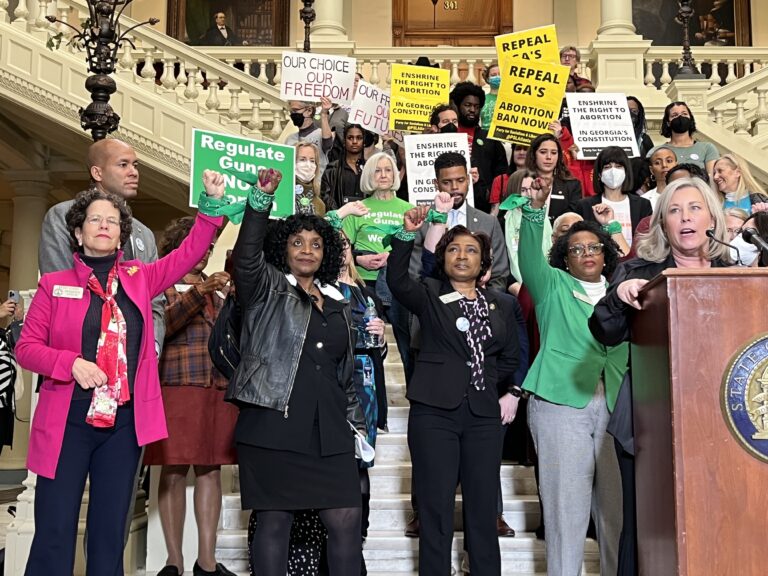
Democrats and abortion rights advocates held a press conference in 2023 to unveil a proposal to repeal Georgia’s six-week abortion ban and protect access to the procedure. Jill Nolin/Georgia Recorder
Pressure from both sides
If Georgia’s new Democratic leadership decides that kind of compromise will be a goal for next year’s session, they can expect resistance.
Cole Muzio is founder and president of Frontline Policy Action, an influential rightwing evangelical lobbying group that has successfully pushed for culturally conservative legislation, including Georgia’s abortion law.
Muzio said the current law provides protections for doctors and he would resist changes to it.
“I don’t see a problem with the language of the law,” he said. “I think we’ve just got political narratives that have been pushed, and it would take a lot of convincing for me to see anything beyond the politics aiming to increase abortion.”
Muzio said he is hopeful Democrats will not exceed what he views as a narrow mandate from voters and that his organization is ready to work with them on legislation focused on bipartisan issues like boosting support for special education and children in foster care.
But he said Frontline is ready to defend outgoing Gov. Brian Kemp’s legacy, including the abortion ban.
“Our voters will not look kindly on any senator that participates actively in undoing what the governor achieved,” Muzio said. “I don’t believe or expect that will happen, but the unity of the caucus and a unified front behind caucus leadership will serve these individual members well as they go back to their districts.”
But legislators are likely to receive pushback not only from the anti-abortion side.
Kwajelyn Jackson, executive director of the Feminist Center for Reproductive Liberation, a health clinic in Atlanta providing abortions within the current law, said reproductive rights advocates will be lobbying for change as well.
“We will ensure that, whether or not there is waffling or hesitation, that it is made clear to everyone who is holding public office that we are demanding real change and that we are not willing to wait and see, that we actually want to see action being taken as quickly and as definitively as possible,” she said.