“We want to do everything we can to make sure our children have full bellies,” said Felisha Hartwell, executive director of Reachh — Family Resource Center in Hinton, West Virginia.

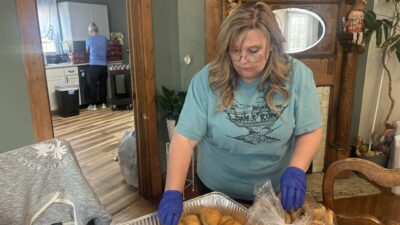
In Hinton, West Virginia, women with the town’s Reachh — Family Resource Center spent a recent afternoon boxing up beanie weenies, mashed potatoes, corn and rolls.
They put the food in white styrofoam containers so kids who’d eat the food later that evening wouldn’t know it came from a free food program.
The organization started a meal train to provide hot dinners for families in the area after the federal government shutdown delayed Supplemental Nutrition Assistance Program benefits for thousands of West Virginians.
“I’ve always been someone who really cares about children and how they feel, and it dawned on me that some of these middle school and high school kids aren’t going to want to be seen by their peers at a free meal provided by the community,” said Felisha Hartwell, executive director of Reachh. “So, we decided to make grab and go meals for everybody to make sure people still have their dignity.”
The group has accepted donations from local churches, community members and more to pay for hot meals on week nights and to fill up the group’s food pantry.
In Summers County, one in five kids rely on SNAP to eat, Hartwell said.
“We want to do everything we can to make sure our children have full bellies,” she said. “We can’t continue to do this long term because it’s a huge undertaking.”
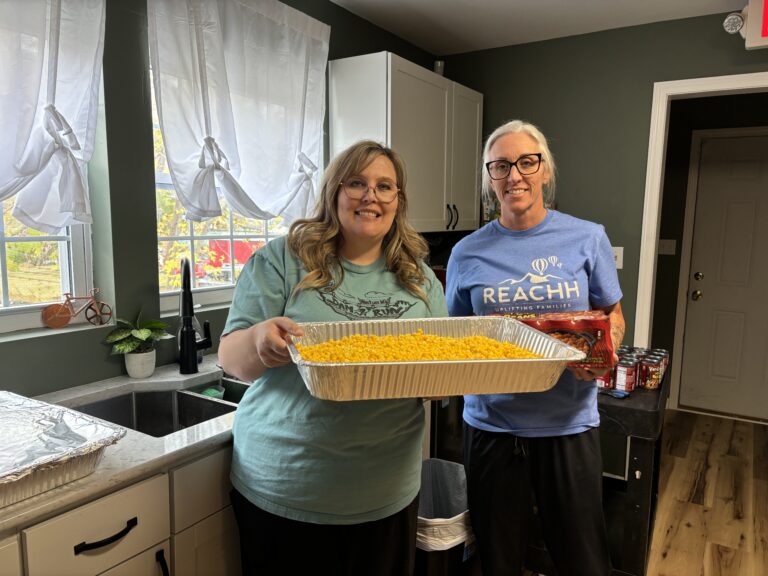
Reachh — Family Resource Center Executive Director Felisha Hartwell and Assistant Director Jennifer Meadows prepared free grab-and-go meals for families in Hinton, West Virginia, on Nov. 3, 2025. (Photo by Amelia Ferrell Knisely/West Virginia Watch)
Child hunger is a problem in West Virginia: roughly one in five kids don’t have enough food. Nearly every county offers free breakfast and lunch to children because of the state’s high poverty rate.
Around 40% of SNAP recipients in the state are children, whose benefits didn’t show up Nov. 1.
Janna Estep, a mother of three young kids in Oak Hill, uses SNAP to buy milk, bread, eggs, cheese and more. She just used her remaining SNAP benefits to buy what she could at the grocery store and plans to go to a local pantry soon.
“My deep freezer is about to be empty,” she said.
The Trump administration said it will use contingency funds to pay reduced SNAP benefits but that could take months.
West Virginia will have to calculate the new benefit amount for roughly 275,000 residents who use SNAP, and Gov. Patrick Morrisey said Tuesday that he would press the state’s outside SNAP vendor to process benefits as quickly as possible. It may take an estimated four to seven days for the state’s vendor to get the system operational again, the governor said.
Morrisey so far has declined to directly fund SNAP to provide the full benefits amount, saying the state’s vendor that processes the benefits can’t accept a direct cash infusion. He sent around $8 million to food banks so far to meet a growing need and expects to transfer another $2.5 million to food banks this week.
“We had a lot of first time families that have never needed us before,” said Amanda Bolyard, chair of the In-School Pantry Program in Monongalia County that stocks school pantries for students. She also volunteers with Pantry Plus More, which works to eliminate child hunger in the area.
“There’s a big misunderstanding and stigma around poverty. There are a lot of working poor people who are working and cannot make ends meet,” she said. “We have been making sure those in school pantries are well stocked … We definitely don’t want hungry kids.”
Jim McKay, state coordinator for Prevent Child Abuse West Virginia, said his partners are very concerned about the delayed SNAP benefits’ negative impacts on child welfare.
“Research shows that when there’s an economic shock on a family, that can be particularly problematic in increasing the risk of child maltreatment,” McKay said. “ … All of these things just add more stress to the families. And ultimately, child abuse prevention is about reducing stress on families.”
An effort to stock school pantries for children
Raleigh County United for Prevention Director Kellie Gunnoe said that Morrisey’s food funding was necessary as they’ve seen a 50% increase in need due to the delayed SNAP benefits and unpaid federal workers. Her organization is stocking school food pantries across the county with items kids can take home to eat.
“We get meals that can be microwaved like Easy Mac. They have something they can make by themselves,” she said.
Families without cars can’t make it to pantries, Gunnoe said, so her organization is working with school counselors to make sure kids have food for after school.
“In those rural places that are outside of Beckley, they’re just without,” she said. “We’re just having to be creative on how we get things from point A to B.”
Pantry Plus More is hosting mobile food pantries in Monongalia County for families who are referred through the local school system. The group held a food giveaway in Westover last weekend where they gave away food boxes and meat.
“We were expecting to serve 225 families, and we ended up serving 340 families. Volunteers were packing boxes on the fly to make sure these families were fed,” Bolyard said.
In Elkins, local restaurants have teamed up to offer a free meal to kids every night of the week for the month of November. The initiative was the brainchild of Emily Watson, who owns Clementine’s Cantina with her husband.
“I was worried about how some children would eat in our area … I think they’re the most vulnerable group they can’t really provide for themselves. I easily found plenty of people to cover the days,” she said, adding that restaurants are covering the cost of meals out of their own budgets, which can be a strain.
“It is very much needed apparently because Saturday one of the restaurants fed 80 kids, Sunday we fed 67. Last night, we fed 120,” Watson said.
Morrisey said Tuesday that the state can’t continue to fund food banks long term as a solution to the delayed and partial SNAP benefits. But he may call in the state lawmakers for a special legislative session to allocate more money for food distribution.
With so many unknowns, Claudia McKay said the Ohio County Family Resource Network is continuing to meet as many needs as they can. They’re getting calls every day for food needs.
“We have not let up,” McKay said. “We’re getting the highly increased volume and calls for food, but we’re working on providing gift cards to families just trying to meet the gap.”
“At the heart of the community, you have these organizations with these volunteers, and we’re able to mobilize quickly, meet people where they are. That said, it is such a stressor for communities, for our parents, but also for our organizations, both financially, emotionally, and physically. This has far reaching impacts on all of us,” she said.