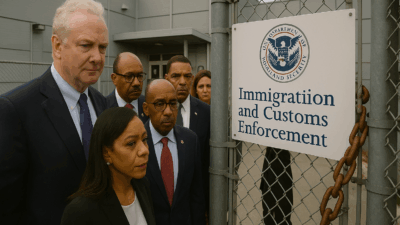
A bipartisan delegation of Maryland congressional leaders was denied entry this week into the George H. Fallon Federal Building in downtown Baltimore, where U.S. Immigration and Customs Enforcement operates a temporary holding room.

It is a move advocates say violates their federal oversight authority and raises red flags over alleged detainee mistreatment.
Members of the group, which included U.S. Sens. Chris Van Hollen and Angela Alsobrooks, as well as Reps. Kweisi Mfume, Glenn Ivey, Johnny Olszewski Jr., and Sarah Elfreth, attempted an unannounced inspection of the ICE facility.
They were allowed into the federal building but blocked at the threshold of the holding rooms. A director allegedly informed them she had received “direction not to allow anyone” inside the facility.
Rep. Mfume, a senior member of the House oversight committees, condemned the action.
“We were told to sit in front of the door,” he said, arguing the denial contradicts public law granting members of Congress the authority to visit detention facilities, CBS News reports.
ICE detention under fire
Their attempt comes amid intensifying scrutiny over conditions within the compact holding rooms, which are the subject of a high-profile class-action lawsuit.
Filed by the Amica Center for Immigrant Rights and the National Immigration Project, the suit alleges that detainees, some of whom were held for days, have endured overcrowding, been denied access to essentials like food, water, and medication, and substandard sanitary environments inconsistent with even the facility’s temporary status.
Immigrant advocates and legal observers emphasize that congressional access is not only legal—it is essential to ensure governmental transparency and accountability in places where basic human dignity may be imperiled.
It is also becoming more common: The episode echoes a similar denial of access to lawmakers at an ICE facility near Chicago.
Both Van Hollen and Alsobrooks previously pressed federal officials in April, after staff visits revealed holding times exceeding ICE’s 12-hour policy, up to 54 detainees in cells designed for far fewer occupants, and reports of makeshift bedding arrangements without food service or medical staff on-site.
ICE stated in a press release that it maintains the facility operates in compliance with applicable federal laws and agency policies, noting that the hold rooms are not regulated under standard detention rules and that its Health Service Corps remains available for medical care.
It stated that the facility’s cramped conditions reflect broader constraints tied to the limited local detention infrastructure in Maryland.
Legal experts warn that refusing entry to sitting members of Congress oversteps the law. Similar denials at other ICE sites have sparked lawsuits and public rebuke, with courts reinforcing that advance notice is not required for congressional inspections.
Activists speak out
Public advocates, including CASA Baltimore and the Amica Center, have organized protests and information campaigns since early spring, describing the holding facilities as unfit and unsafe for extended stays.
Reports include detainees kept for days without access to showers, denied required medications for chronic conditions, and forced to sleep on floors lit 24 hours a day.
In response to sustained pressure, a federal judge issued a temporary injunction in May, blocking the deportation of two plaintiffs detained under these alleged conditions. The judge ruled that their continued detention would impede the legal case and potentially cause irreversible harm.
The Maryland lawmakers’ blocked visit underscores longstanding tensions between ICE’s operational discretion and legislative oversight, highlighting public concerns that conditions inside federal holding facilities remain opaque and unaccountable.