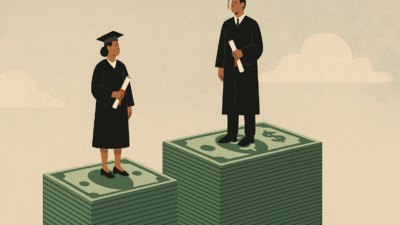
A new report from the Illinois Workforce and Education Research Collaborative (IWERC) reveals that while higher education pays off in Illinois, students from low-income backgrounds continue to earn significantly less than their wealthier peers—even when they achieve similar levels of education.

Titled Precarious Prospects, the study follows more than 340,000 Illinois high school seniors from the graduating classes of 2008 to 2012. Using a unique dataset that links high school, college, and employment records, researchers tracked students for nearly a decade after graduation.
Their findings show that higher levels of education correlate strongly with higher earnings—but family income, race, and gender remain powerful determinants of economic outcomes.
“The research shows that the best path to attain economic mobility is still a college degree,” State Superintendent of Education Tony Sanders said.
Students from high-income households (top income quintile) earned an average of $46,433 annually by their mid-to-late twenties, while those from low-income households (bottom quintile) earned just $31,407—a 48% gap. The study also found stark racial disparities: Black and Latino students from high-income households often earned less than white or Asian peers from lower-income families.
Even among students with the same degree, earnings varied by background. For example, white men from high-income families consistently earned more than Black or Latino women from low-income backgrounds, even with identical degrees in the same fields.
The report also highlighted geographic disparities. Rural students were less likely to earn high wages than urban counterparts, although the cost of living partially offsets the difference.
Moreover, students from downstate counties with high poverty rates—especially in southern Illinois—faced the most significant earnings gaps.
Low-income students were also more likely to attend community colleges or for-profit institutions, which often led to lower-paying jobs.
Among those who did complete a degree, many found employment in industries such as food service, retail, and transportation, where wages remain low and advancement opportunities are limited.
However, the study did identify outliers—low-income students who earned advanced degrees and achieved high salaries—suggesting that opportunity does exist, even if unevenly distributed.
IWERC plans to release a follow-up report this fall, examining the successful pathways taken by high-achieving students from low-income families.
The full report is available online at dpi.uillinois.edu.