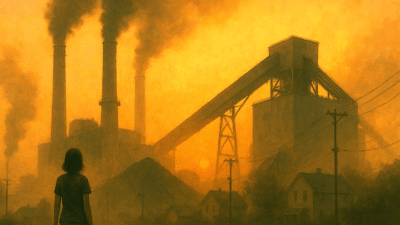
A recent Johns Hopkins Bloomberg School of Public Health study has compiled data showing that operations at the CSX coal terminal in Curtis Bay, Maryland, substantially increase air pollution levels in the area.

The findings sharpen the focus on environmental justice and public health implications for an industrial-adjacent residential area, in a community that has long linked the coal terminal to local health issues.
Researchers led by Dr. Christopher Heaney monitored air quality in Curtis Bay from July 2022 to July 2023.
They observed spikes in delicate particulate matter and black carbon, both microscopic pollutants linked to respiratory and cardiovascular diseases, whenever wind patterns directed emissions from the coal terminal toward homes and schools, particularly during active bulldozer operations at the site.
The coal terminal, part of the Port of Baltimore complex and dating back to the 1880s, handles substantial volumes of coal, accounting for roughly a third of U.S. coal exports.
It sits uncomfortably close to dense residential blocks, playgrounds, and community infrastructure.
Although CSX maintains that its coal-handling procedures exceed regulatory standards, and officials state they use dust suppression systems, study results indicate that these measures are insufficient.
Heaney confirmed pollution increases during simultaneous conditions of active equipment and prevailing winds from the terminal.
Longtime residents and environmental justice advocates see this as scientific vindication.
The analysis builds on a similar November 2024 study that detected coal particles settling on neighborhood surfaces, including schools, houses, and yards as far as three-quarters of a mile from the terminal.
This project utilized electron microscopy to trace elemental signatures specific to coal, confirming the persistent deposition of coal dust following exposure.
These results were obtained during Maryland’s review of CSX’s terminal permit, which was renewed last fall by the Department of the Environment.
Although state regulators have instituted stricter oversight, residents say everyday living conditions have changed little.
Critics argue that minor, incremental improvements to dust control are inadequate. Instead, they propose covering coal piles, enclosing transfer operations, and mandating continuous fence-line air-monitoring to protect those living at the facility’s doorstep.
Curtis Bay is neither unique nor anomalous.
Its situation mirrors environmental justice pockets nationwide, including communities situated near industrial sites that face heightened exposure without regulatory safeguards. As Heaney and colleagues pointed out, their methodology provides a replicable model for assessing the impacts of coal dust in similar locales.
Health risks associated with coal dust are well-documented. It is linked to asthma, cardiovascular problems, neurological disorders, and more. Long-term exposure, particularly in low-income areas, may reduce lifespans and exacerbate health disparities.
Moving forward, community advocates are calling for permit reforms that require real-time emissions monitoring and a reevaluation of whether the coal terminal’s location is compatible with residential proximity.
For many residents, the question isn’t just what data reveals, but how quickly policymakers and industry will act to clear the air.