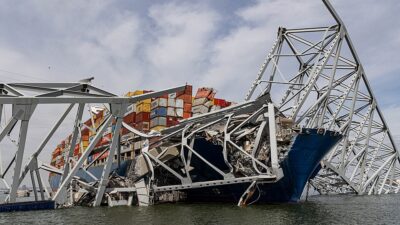
Maryland officials conducted an on-site tour of the Francis Scott Key Bridge demolition operations this week, in a visible sign that reconstruction efforts remain on track following the 2024 collapse that claimed six construction workers and disrupted regional transportation.

Crews have mobilized a fleet of heavy machinery, including concrete saws, cranes, backhoes, and barges, to dismantle the remaining sections of the 1.6‑mile steel span systematically.
Workers will cut the deck into six‑foot sections for removal and recycling, completing the demolition over roughly nine months, the Associated Press reports.
Governor Wes Moore, who toured the site with federal partners and state transportation officials, praised the pace and precision of the effort, saying the state is keeping the effort “on time and on budget.”
He said he honored the memory of the six workers killed in March 2024 and called the incident “a national crisis demanding a national response.”
Progress on replacing the iconic structure is moving ahead.
The forthcoming design marks Maryland’s first cable-stayed bridge, which will rise approximately 45 feet higher than the previous structure and expand the shipping channel to a full 1,000 feet to accommodate larger vessels.
Construction of critical foundations is slated to begin in fall 2025, contingent on federal permitting by the U.S. Coast Guard.
The rebuild is estimated at $1.7 billion to $1.9 billion, fully funded by federal disaster relief provisions passed by Congress in December 2024. The new span is expected to open by late 2028.
Local businesses and motorists have expressed relief at seeing visible progress toward restoring connectivity between Baltimore County and city neighborhoods.
Experts say the site tour reinforces the state’s commitment to transparency as public concerns about timeline delays and cost overruns remain.
The delivery of the new bridge comes amid broader concerns about aging infrastructure and vulnerability to maritime accidents. It also raises expectations for increased safety standards and improved resilience to future risks, including tighter design protocols to protect against ship collisions.