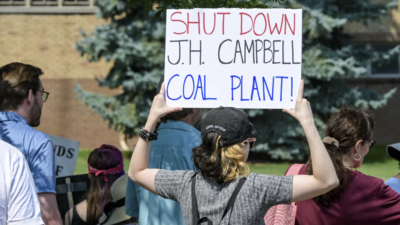
Michigan’s Department of Attorney General and several environmental justice groups presented oral arguments before a panel of the U.S. Court of Appeals for the District of Columbia, arguing that emergency orders that kept the J.H. Campbell coal plant from retiring were illegal applications of federal law.

A team of lawyers from Michigan Attorney General Dana Nessel’s office, Earth Justice and the Sierra Club each argued that the U.S. Department of Energy’s declared energy emergency in May 2025 forced the Michigan plant, located in West Olive, to remain open past its scheduled retirement. That order has been renewed four times since being issued last year.
The administration contends that keeping the coal plants operational is necessary to protect the stability of the grid while demand for electricity is increasing due to artificial intelligence data centers and manufacturing growth.
Nessel’s team argued that the initial order disregarded the prior planning and regulatory approvals of Consumers Energy, which operates that plant. Nessel’s team called it another example of the Trump administration arbitrarily issuing false emergencies as a pretext to advance its energy policies outside of its authority.
“Never before this point did the DOE delay the retirement of a power plant absent a request from the operating utility or local governmental body, and only ever in response to concrete, particularized emergencies, and subject to limitations to ensure that the order extends no further than necessary to address the emergency at hand,” the department said in a news release.
Nessel, in a statement, said that by employing false emergency declarations, the administration was “forcing Michigan residents to foot the bill for an aging, expensive coal plant that was slated for responsible, cost-saving retirement.”
This administration came in with a fixation to funnel Americans’ money to the coal industry without regard for our health or our future.
– Michael Lenoff, senior attorney with Earth Justice, who said the Trump administration had invoked emergency powers in a blatantly unlawful and unprecedented manner.
“I am relieved my office is finally before the court to expose this political theater for what it is: an illegal power grab that loots the pockets of ratepayers,” Nessel added.
Nessel plans to hold a press conference and rally near the plant next week, along with community leaders and concerned residents.
The Campbell plant was built in the 1960s and was on track to be replaced with the production of more cost-effective and environmentally friendly energy resources. The retirement of the plant was also set to save Michigan ratepayers nearly $600 million. With the plant still open via the Trump administration’s actions, Consumers Energy has reported at least $18 million in costs to keep it up and running, all while burning coal, which produces significant greenhouse gas emissions.
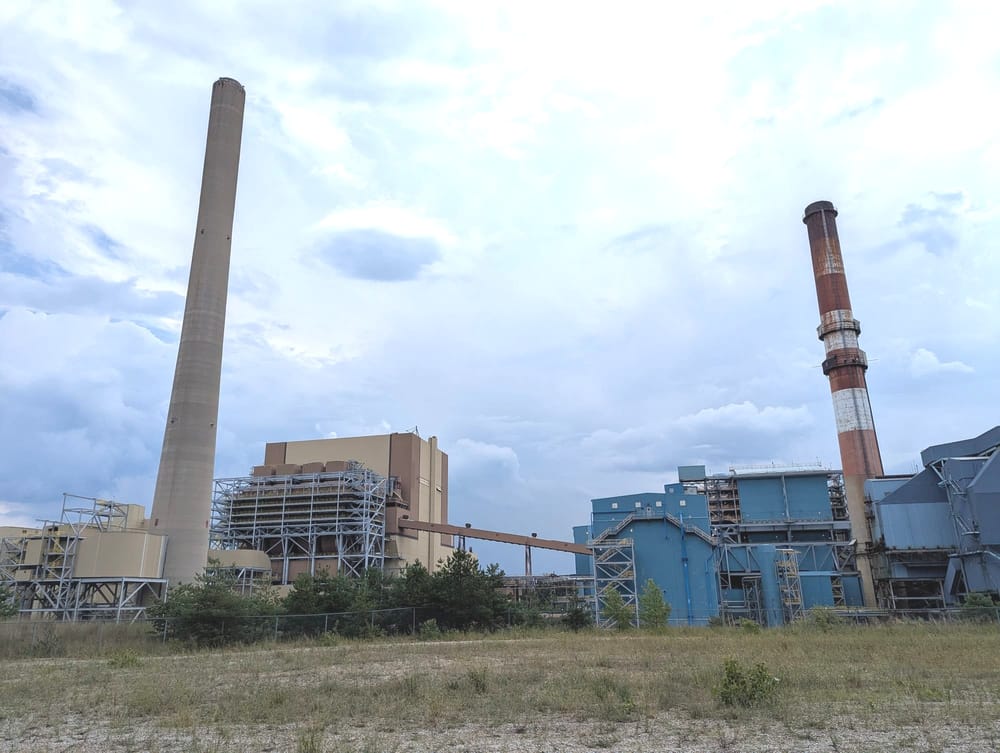
The J.H. Campbell plant in Port Sheldon Township, operating since 1962, was scheduled to close partially in 2030 and wholly in 2040. Consumers Energy, however, announced in 2021 it was moving the plan up by 15 years for May 31, 2025. [ONN photo/Sarah Leach]
Legal representatives for Earth Justice and the Sierra Club also presented arguments. The groups noted that a recent energy capacity auction through the Midcontinent Independent System Operator, which serves the central United States, showed an increase in capacity completely independent of the Trump administration’s actions at the Campbell plant. The groups said that shows that there is no energy emergency for the region, and that the federal energy regulator has no justification to keep it open through what they termed as “illegal” extension orders.
In a press call following the hearing, Greg Wannier, senior attorney for the Sierra Club, said the legal authority used by the Trump administration to initiate and extend the order is usually reserved for direct crises that threaten local facilities that ultimately may affect the national power grid. Previous administrations used the authority sparingly, Wannier added, and in situations where winter storms, hurricanes or other large-scale disruptions were the culprits.
“What we’ve seen over the past year is the Trump administration twisting the use of this emergency authority beyond all recognition,” Wannier said. “For this reason, one of the key themes of the oral argument that was held today was how broad that authority is, which is to say: ‘How do you define an emergency that allows DOE to act?’”
Jan O’Connell, a senior energy organizer with the Michigan branch of Sierra Club, said the organization has been sounding the alarm bell on the Campbell plant’s continued operation, which includes concerns for the health and safety and the wallets of Michigan residents.
“Michigan has the highest electricity rates in the Midwest, and the DOE order isn’t helping matters,” O’Connell said. “The … sham illegal order has made rates even higher.”
Michael Lenoff, senior attorney with Earth Justice, said the administration had invoked emergency powers in a blatantly unlawful and unprecedented manner.
“This administration came in with a fixation to funnel Americans’ money to the coal industry without regard for our health or our future,” Lenoff said. “From trying to lease public lands for mining, to gutting environmental regulations, this administration is letting coal companies pollute the air we breathe and the water that we drink, and then charge us the bill.”