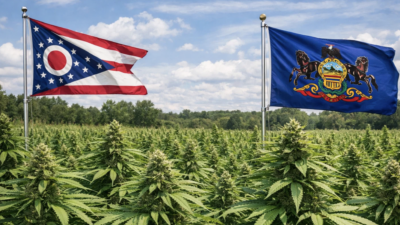
Both Pennsylvania and Ohio are dealing with legislative issues regarding cannabis; the former’s governor is still grappling with opponents to recreational use, while Ohio lawmakers are placing new limitations on their legal weed industry.

Pennsylvania’s Democratic Gov. Josh Shapiro has once again elevated legalization as a budget and legislative priority, urging lawmakers to act this session to regulate recreational marijuana and capture tax revenue flowing across the state line.
In his latest budget request — the third consecutive one to include legalization language — Shapiro framed the issue as one of competitiveness and public safety, arguing that an unregulated market fuels criminal activity while neighboring New Jersey siphons off Pennsylvania consumers.
“If they show up for work, there’s no reason why they can’t do it,” Shapiro told WPVI-TV Philadelphia, pressing lawmakers to negotiate a framework that would legalize adult recreational use.
The governor pointed to data suggesting that a majority of people buying legally in New Jersey come from Pennsylvania and emphasized the state’s lost tax revenue and unchecked illicit market.
House Democrats have echoed the governor’s call, imploring the GOP-controlled Senate to enter talks and advance a legalization bill before the legislative session ends.
By contrast, in Ohio, Republican lawmakers have moved to rein in the nascent legal market, enacting restrictions that roll back parts of last year’s voter-approved legalization.
In December, the legislature passed — and Republican Gov. Mike DeWine signed — Senate Bill 56, a sweeping package that tightens rules on dispensaries and bans “intoxicating” hemp products. These measures, advocates say, undercut the intent of Issue 2, which voters approved last November.
The law’s critics warn it would have far-reaching consequences beyond tighter commercial regulations.
Advocates point to statutory language removed by the bill that previously protected lawful cannabis users from certain forms of discrimination — protections that had been cited in disputes over child custody, access to organ transplants, and professional licensing.
Opponents also note that the new statute recriminalizes possession of cannabis acquired outside of Ohio’s licensed system or grown outside limited homegrow allowances, meaning consumers could face criminal exposure for products legally purchased in neighboring states such as Michigan.
DeWine, however, has been dismissive of opponents’ efforts. Asked about calls to overturn the legislature’s changes, the governor told News 5 Cleveland that supporters of legalization should accept their initial victory rather than “whining” about subsequent legislative choices. He suggested the rollbacks align with voter sentiment and defended the legislature’s authority to refine the policy.
The divergent approaches in Pennsylvania and Ohio highlight broader tensions playing out nationally: whether legalization should be implemented quickly to capture tax revenue and reduce illicit markets, or carefully constrained to address perceived public health, regulatory, and social concerns.
In Pennsylvania, momentum hinges on whether the governor and legislative leaders can bridge partisan divides.
While in Ohio, activists are preparing a direct democratic test of those legislative revisions — a contest that could determine the practical scope of legalization at the ballot box or in the courts.
As both states proceed, residents and businesses will be watching closely: the decisions made in Harrisburg and Columbus will not only affect local markets and communities but also shape the regional balance of legal cannabis commerce.