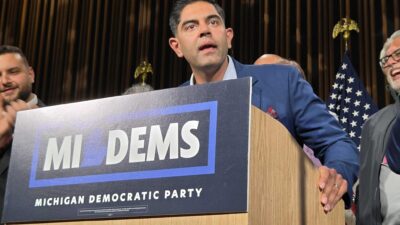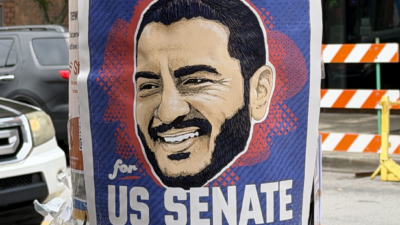
The conventional wisdom is that Michigan Senate-elect Abdul El-Sayed’s midterms victory was unremarkable given that he “only” won by 7 points in a purple state, while Democrats won by 14 points nationwide, and “underperformed” Governor-elect Jocelyn Benson by 2 points.

To the contrary, I believe that El-Sayed’s victory was both remarkable and historic given the unprecedented obstacles that he had to overcome to become the first Muslim ever elected to the U.S. Senate.
El-Sayed had to survive a months-long, vile and dishonest, smear campaign orchestrated by a sitting president and echoed by his sycophants. President Trump sneeringly called Abdul a “communist,” a “terrorist sympathizer,” and/or “a jihadist lunatic who hates our country” in practically every speech and social media post over the last two months of the campaign. It was the most brutal and bigoted presidential assault on a political candidate in modern American history.
His Republican opponent, Mike Rogers, never disavowed the naked bigotry, and claimed that El-Sayed “believes America deserved 9-11.” He repeatedly fabricated allegations about the Muslim Brotherhood, Hamas, and Hezbollah, and, at their last debate, showed how low he would go by asking “are you for America, or are you for these terrorists groups?”
To my knowledge, not a single national or Michigan Republican had the basic human decency to call for an end to the shameful lies and smears.
El-Sayed also had to overcome an obscene amount of outside PAC spending by right-wing billionaires. In the August Democratic primary, AIPAC and corporate PACs spent over $60 million to defeat Abdul and support his primary opponent, Haley Stevens. This obliterated the all-time record for the most PAC money in a Democratic congressional primary. El-Sayed refuses corporate PAC money, and was outspent by about 10-to-1 in the primary despite outraising Stevens among individual donors. The PAC dollars were exclusively devoted to deceptive ads designed to impugn Abdul’s character. Tellingly, no major Democratic leaders objected to this attempt by right-wing PACs to buy a Democratic primary.
In the general election, Rogers was supported by over $170 million of PAC spending (most from Elon Musk, AIPAC, and the MAGA PAC), about twice the outside spending for El-Sayed (all of which came from the Senate Democratic PAC and issue-oriented groups). Again, El-Sayed outraised Rogers from small donors, but was outspent by about 2-to-1.
Another major challenge was that El-Sayed faced a state Democratic Party that was almost universally united behind his primary opponent, Haley Stevens. Governor Gretchen Whitmer, retiring Senator Gary Peters, Attorney General Dana Nessel, and ex-Senator Debbie Stabenow all endorsed Stevens, along with many other state and local party officials. To their credit, Senator Elissa Slotkin, Congresswoman Debbie Dingell, and Secretary of State Jocelyn Benson chose to stay neutral and let voters decide.
The weekend before General Election Day, Haley Stevens reneged on her earlier endorsement of El-Sayed and endorsed Mike Rogers. This backfired by finally coalescing the state party establishment behind Abdul.
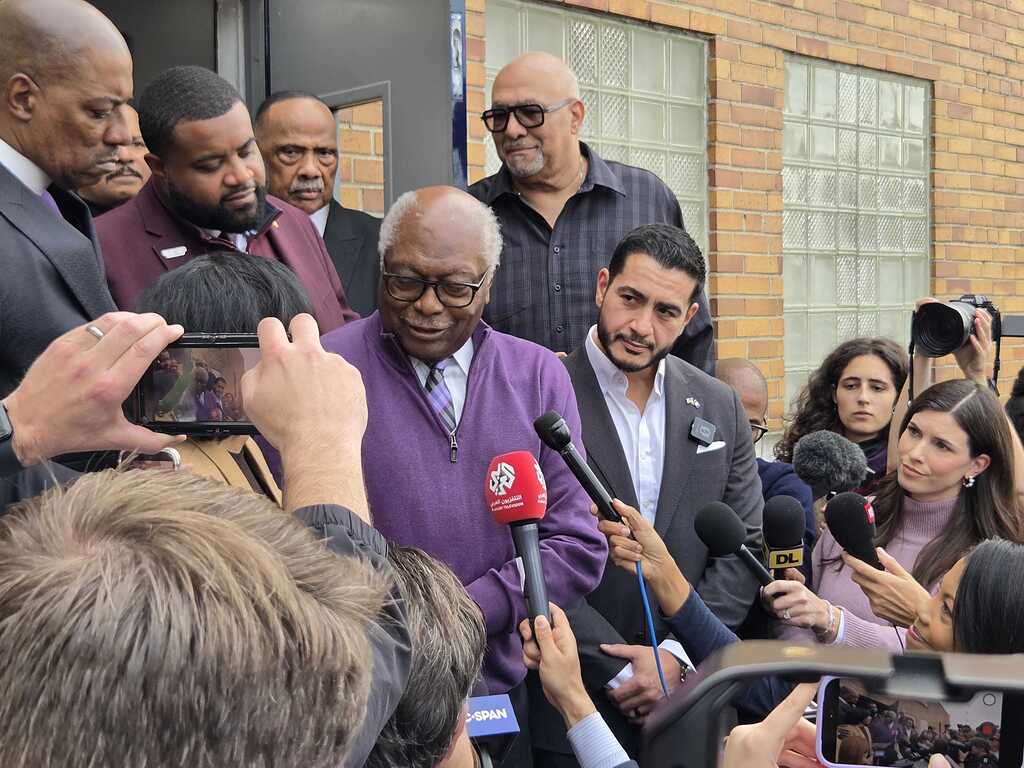
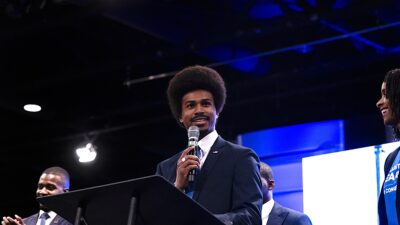
U.S. Rep. Jim Clyburn (D-South Carolina), center left, speaks during a press conference supporting U.S. Senate nominee Abdul El-Sayed, center right, on Sunday, Nov. 1, 2026 at North End Church of God in Christ in Detroit, Mich. (Photo by Ben Solis/Michigan Advance)
Finally, there was a double standard in mainstream media coverage of the Michigan Senate campaign. The media scrutinized and parsed not only every phrase that El-Sayed uttered over the last 20 years, but also statements by distant relatives with whom he never lived and twitch streamers who generate attention by being provocative. But the media did not apply the same level of scrutiny in pressing Mike Rogers to explain how he and his wife made millions of dollars after leaving Congress, why he flip-flopped to support election denialism, or why he employed a white supremacist as a campus organizer.
The media obsessively parroted the Rogers’ campaign talking points that El-Sayed was struggling with both Jewish voters statewide and Black voters in Detroit. The debate within the Michigan Jewish community was in fact real and newsworthy, but the electoral relevance was greatly exaggerated given that Jews represent only about 1.5 percent of Michigan voters. While there are many more Black voters, the “concerns” turned out to be wishful thinking by the Rogers campaign as El-Sayed captured over 90 percent of the Black vote in Detroit. Yet the media barely reported on the incredible success of the El-Sayed campaign in shifting large numbers of young, unaffiliated, and Arab-American voters to his side which led to his comfortable victory margin.
The simplistic claim that Abdul El-Sayed’s victory was much more expected than Democratic victories in, say, Mississippi or Texas, falls apart in view of the massive challenges that dwarfed those faced by any other Senator-elect in the country. He and his grassroots campaign met the moment, as did the decent people of Michigan, who rejected the presidential smears, the big money PACs, a hostile state party bureaucracy, and a biased mainstream media, to deliver one of the greatest political stories in Michigan, and American, history.