Pennsylvania Democrats have all the momentum at their backs as they hope for a Blue Wave to sweep the November 3rd midterm elections.

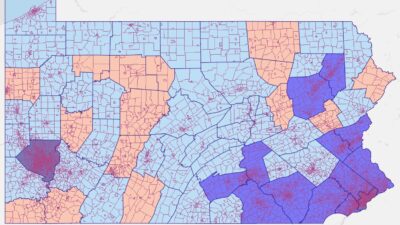
Since 2015, I’ve examined the voter registration trends in the Keystone State across dozens of articles over the last decade-plus. In that time, I’ve never created a map as blue as the one above. For the most part, Pennsylvania Republicans have consistently gained ground on their Democratic counterparts in the Trump Era.
To illustrate, a month before Trump descended the escalator to run for president, Democrats held a registration advantage in the state of 999,427. By the end of 2024, in the wake of Trump’s second Presidential victory, that lead had dwindled to only 170,975.
In October 2025, however, the tide began to turn as Trump’s approval ratings dropped and there was new leadership in the statewide Democratic Party. By last May, thanks to gains in the southeast and south central portions of the commonwealth, Dems were able to improve their margin to 188,381.
Over the course of the summer, Democrats experienced strong growth throughout the state, to the point that their statewide margin now stands at 247,724. These numbers will likely buoy Gov. Josh Shapiro, who is aiming to win re-election with enough coattails to flip four U.S House seats. The governor’s also looking to become the first Democratic incumbent to sweep in elected majorities in the state House and Senate since Milton Shapp did so during the 1974 Watergate midterms.
Beyond our borders, political observers are always eagerly watching a swing state like Pennsylvania to get a sense of the national mood. So let’s take a deeper dive into these numbers to see what they can tell us about the upcoming midterms!
A quick note: I explore our changing voter trends by tracking the gains one party accumulated in registrations over the other party. For example, R+500 means that the Republican Party gained a net 500 more registered voters in that county than the Democratic Party did over this period, while D+500 indicates the opposite.
Central
- Blair: D+291
- Bradford: R+48
- Cameron: R+6
- Centre: D+809
- Clearfield: R+47
- Clinton: D+101
- Columbia: R+12
- Elk: R+36
- Huntingdon: D+74
- Juniata: D+4
- Lycoming: D+367
- McKean: D+29
- Mifflin: D+12
- Montour: D+41
- Northumberland: D+73
- Potter: D+42
- Snyder: D+74
- Sullivan: R+24
- Tioga: D+40
- Union: D+235
One of the most-debated topics of the 2026 campaign is whether Trump’s tariff and Iran policies are hurting him with his rural voters. Well, in largely rural central Pa., we’re seeing Democratic gains in core GOP counties. Moreover, the influx of new students to Penn State flipped Centre County from a Republican plurality to a Democratic plurality, reversing a GOP accomplishment from 2024.
Northeast
- Carbon: R+17
- Lackawanna: D+1,290
- Luzerne: D+3,026
- Monroe: D+675
- Pike: R+80
- Schuylkill: D+92
- Susquehanna: D+202
- Wayne: D+29
- Wyoming: D+112
Among the quartet of competitive Congressional contests in our commonwealth is the match-up between freshman Rep. Rob Bresnahan and Democratic challenger Paige Cognetti in the Northeast’s 8th Congressional District. Over the past decade, Donald Trump converted thousands of ancestral Democrats in the Scranton/Wilkes-Barre corridor, to the point that Bresnahan was elected off Trump’s coattails in 2024.
In 2026, however, it looks like some of those voters are returning to the Democratic fold, as the party posted four-digit gains in both Lackawanna and Luzerne counties. The Luzerne numbers in particular must be especially worrying for the Bresnahan campaign, as his eight point margin there was pivotal to his 2024 victory.
Northwest
- Clarion: D+86
- Crawford: D+101
- Erie: D+511
- Forest: R+23
- Jefferson: D+22
- Mercer: R+22
- Venango: D+5
- Warren: D+42
Here again we see a region that is traditionally red, yet one that still experienced a blue summer. I always keep an eye on bellwether Erie County, which has supported the statewide winner in 19 of the last 20 Presidential elections. If Democrats bounce back there it could be a sign that they’re likely to perform well throughout the Midwestern United States.
Southcentral
- Adams: D+126
- Bedford: R+14
- Cumberland: D+1,720
- Dauphin: D+2,414
- Franklin: D+436
- Fulton: D+1
- Lancaster: D+2,294
- Lebanon: D+355
- Perry: D+86
- York: D+1,524
The southcentral region is home to another critical U.S. Houe race, the rematch between Republican incumbent Scott Perry and his Democratic opponent Janelle Stelson in PA-10. Perry can’t be happy with these numbers, as not only did blue Dauphin and purple Cumberland move left, but Dems also gained ground in York, traditionally the Big Red Machine of Pa.counties. Furthermore, the shift in Lancaster suggests Josh Shapiro could become the first Democratic gubernatorial nominee to win that county since Bob Casey Sr’s landslide back in 1990.
Southeast
- Berks: D+931
- Bucks: D+2,424
- Chester: D+3,135
- Delaware: D+3,966
- Lehigh: D+2,717
- Montgomery: D+4,568
- Northampton: D+1,962
- Philadelphia: D+15,170
SEPA is home to the other two key U.S. House races: Incumbent GOP Rep. Brian Fitzpatrick vs Democrat Bob Harvie in PA-1, and Democrat Bob Brooks vs incumbent GOP Rep. Ryan Mackenzie in PA-7. The 1st District mostly consists of Bucks County, where Democrats are trying to build on their 2025 victories to finally upset the Fitzpatrick dynasty there. Meanwhile, Dem gains in Lehigh and Northampton Counties are a strong sign for Brooks’ hopes of flipping the bellwether 7th District.
Even further down the ballot, there are several state Senate and state House races in this area that Gov. Shapiro is targeting. For instance, the Montgomery County native is aiming to flip the Southeast trio of SD-6, SD-16 and SD-24 in his quest to earn that aforementioned Pa. Senate majority. Recent polling from State Navigate suggests Shapiro’s coattails may indeed be strong enough to win these crucial legislative races.
Southwest
- Allegheny: D+7,291
- Armstrong: R+120
- Beaver: D+31
- Butler: D+391
- Cambria: R+74
- Fayette: R+189
- Greene: R+183
- Indiana: D+12
- Lawrence: D+14
- Somerset: D+32
- Washington: D+61
- Westmoreland: D+192
Since 2016, Donald Trump has depended upon the voters in the Appalachian southwest to power his statewide efforts in Pennsylvania. Yet even here, the PA GOP is seeing erosion. While it’s not a surprise to see Democrats gain in Allegheny County, the degree of their improvement is nonetheless notable. What might most worry Republicans, however, is the poor performance in Allegheny’s neighboring counties, where they’ve gotten used to posting terrific margins on Election Nights.
Why these trends mnatter
All historical and contemporary indicators suggest Democrats will enjoy plenty of victories on November 3rd. Of course, ever since Donald Trump shocked the world and defeated Hillary Clinton in the 2016 presidential contest, any positive poll results have elicited the same reaction from shell-shocked Dems: Are these numbers actually for real?
While anything could still happen, it’s worth going over how the Pennsylvania voter registration trends have generally been predictive of future results. Republicans initially saw gains throughout Trump’s rise in 2015 and 2016; and they only began to lose momentum midway through 2017 and on into the 2018 midterms, when Dems won the House. GOP growth then resumed in the run-up to the 2020 election, foreshadowing Trump’s surprising performance in that contest (despite losing in 2020, Trump out-performed his polls the most that year).
During the summer and fall of 2022, Republican registration gains noticeably slowed, an indication that those midterms would ultimately disappoint them, as Democrats held up well for a party with an incumbent president. Yet the PA GOP resumed their strong growth in 2023 and 2024, a sign that Trump would soon return to power.
Given all this context, these past two years have unfolded as you might expect. Coming out of 2024, Pennsylvania Republicans continued to make gains through 2025, only for the tide to begin to turn that fall. Since then, state PA Dems have gained exponentially more strength over the course of 2026, suggesting they’ll do quite well in these upcoming midterms.