Rural voters want their politicians to be authentic, to recognize the primary importance of defense and agriculture, and to respect the rural ethos, its farmers, shopkeepers, and labor.

Elissa Slotkin modeled this type of candidate. She was authentic and never apologized for who she is, nor did she downplay her family’s prior success. She spoke at length about both defense and agriculture – as well as how food security is national security. She visited rural communities and townships.
The two debates between Michigan’s Democratic Senate candidates Abdul El-Sayed and Haley Stevens reveal the failure of both campaigns to follow the playbook modeled by Slotkin.
El-Sayed, while smooth, articulate, and arguably the better candidate, made several fatal errors that will preclude rural voters (which were 29% of the Michigan vote in 2024) from voting for him.
Those voters generally will not be voting in the Democratic primary – opening a lane for El-Sayed to win that race.
Authenticity
El-Sayed opened the second debate with a falsehood – he immediately said he was a doctor. He is not in the context of medicine. He never did a residency and never took his boards.
Curiously, there was no reason for him to do this. It is just as powerful to say that he received a degree in medicine.
My neighbors are already aware of this disconnect.
Stevens didn’t fare much better. Touting that she is not a millionaire is not only irrelevant – many rural voters like a certain – it also implies that she isn’t smart enough or capable enough to become one. She should drop this.
Defense
Defense is El-Sayed’s first failure point. He doesn’t understand how it works. He repeatedly says that the US is sending taxpayer money to Israel to use as they please. Not true. The US sends weapons to Israel. US dollars are sent to US weapons suppliers and are spent in the United States. Even if what is purchased is determined by the Israelis. It boosts our economy. Actual cash is being reduced to 0.
Rural understands this – this is where the majority have a military outlook. This exact topic comes up in conversation from time to time.
Defense and ICE
El-Sayed wants to abolish ICE, specifically saying that the entire agency as it exists should go away. He doesn’t understand what ICE does – rural understands very well.
Ninety percent of ICE’s activities are the following: 1) Human Trafficking & Smuggling; 2) Financial Crimes & Money Laundering; 3) Cybercrime & Child Exploitation; 4) Narcotics & Weapons Smuggling; 5) Intellectual Property Theft & Trade Fraud; 6) Counterterrorism; and 7) Targeting War Criminals.
Is El-Sayed really throwing all of this out the window? He says he is.
My neighbors bring this up—many of us have worked in law enforcement, even me. I have been the Chief Security Officer of a bank and the head of Bank Secrecy and Anti-Money Laundering. Throughout my career, I worked with ICE agents on these financial crimes.
The problem is that a vast majority of ICE’s activities relate to core national defense (even though the current spend rate is heavily on deportations).
It doesn’t help that El-Sayed believes that everyone should be given a pathway to citizenship unless they have committed a “heinous” crime.
This throws up two red flags: 1) Anyone in law enforcement knows our highest and best use is to catch criminals before they commit a crime; and 2) Heinous?
Agriculture
Stevens failed on this issue – one of her three policy proposals is the elimination of tariffs on food. To the detriment of the farmer?
She can’t possibly know what to put in a bill. Farmers currently have working groups dedicated to teasing out where tariffs are needed and where they aren’t. She is shooting from the hip, and it shows.
El-Sayed recognizes that tariffs are a tool and need to be thought through.
El-Sayed has a fairly nice farm statement on his website. With one glaring error – he wants to give guest workers on H-2A visas a pathway to citizenship. He clearly doesn’t understand how this works.
Most guest workers are not looking for citizenship. They want to make money and then return to their home country and buy a farm there.
This is also true for many people working here illegally.
It also would be devastating for farms. Once a migrant receives a green card, someone poaches them from the farm. They simply are excellent workers in any field.
Virtually every H-2A visa holder I have spoken to says what they really want is a semi-permanent, portable, 10-year agricultural visa that allows them to work whenever they want and to travel freely back and forth to their home country.
Why not give them what they want?
El-Sayed’s plan, on the other hand, would gut farm labor.
Money out of Politics
It is here where El-Sayed throws himself under the bus. He repeatedly encourages voters not to vote for anyone who takes money from special interest groups – namely corporations.
He seems unaware that 65% of workers work for a corporation.
Yet he actively solicits funds from unions and lobbyists in the form of advocates and special interest groups. This is one side of the equation, and it shows. He implies repeatedly that he is “bought” by those groups. This is no better and no worse than being bought by corporations.
And unions today, all of which are now run by millionaires, are just a different form of corporation.
I don’t know any rural voters, other than perhaps some of the party faithful, who would vote for a candidate who has only union endorsements and money but none from business. This is lopsided.
Rural Labor
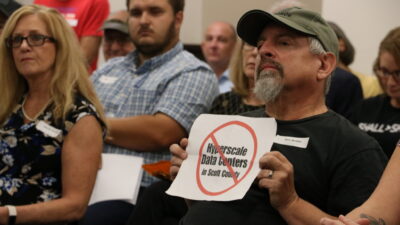
El-Sayed’s union capture was on full display when he stated that rural contractors would not be allowed to participate in the construction of data centers. Rural Michigan north of 10 generally doesn’t have unionized shops – many are family owned.
El-Sayed would, by legislation, require all data centers to be built by imported union labor, to the exclusion of rural labor.
In El-Sayed’s economy, the only way for a rural contractor to participate in the construction of a data center in a rural area is to sell out to a larger organization, often owned by a Trump supporter, so long as those employees then join a union.
El-Sayed’s point about reducing monopolies resonates with rural voters. He then contradicts himself by implying that the only labor he likes is labor that has been concentrated in large firms.
This makes no sense, unless of course you have been “bought” by the unions.
This does not sell in rural areas.
He also repeatedly stated that he visits only cities in Michigan. Never a township or village.
Stevens didn’t fall into either of these traps.
El-Sayed’s dislike of companies hinders his understanding of business
When asked how he would keep auto manufacturers in Michigan, he said he would talk to the UAW. Not the people running the businesses? He also said the innovation in the auto industry came from the unions. Rural isn’t buying that.
He wants AI companies to be “spun off” (he clearly doesn’t understand what a spin-off is) and run by a majority publicly elected board. This is absurd – China and Russia already tried this. It doesn’t work.
El-Sayed makes a point of not talking to business executives. He is less effective because of that. At the end of the day, a US Senator needs to represent the entire state. Not just a preferred minority of unions and special interest groups.
Moderator questions were disconnected from voter issues
Most of the moderators’ questions were geared toward the chattering class. Inflation is not the #1 issue facing Michigan. Rural voters don’t talk about Gaza, who is paying for ads, how much candidates get from PACs, the animosity between the candidates, AIPAC, or endorsements, unless they are lopsided.
The issues are China and defense, being able to grow fruits and vegetables, managing the out-of-control deer population, grid reliability, teaching children to read, preserving small and family-owned businesses, keeping the border secure, and creating a robust pipeline to learn a trade – which you might then practice in a shop that you own.
The general election in November will be out of reach for anyone who doesn’t understand rural.