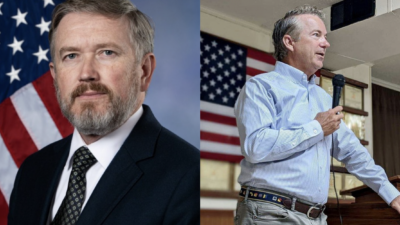
Two prominent Kentucky Republicans — Sen. Rand Paul and Rep. Thomas Massie — have publicly opposed U.S. military action against Iran, arguing that Congress must authorize any new war and that unilateral executive action risks repeating costly mistakes in the Middle East.

In speeches and social media posts this week, both lawmakers invoked constitutional limits on presidential war-making and voiced sympathy for the Iranian people while opposing military escalation.
Their statements echo an older tradition of American restraint: Massie quoted John Quincy Adams to argue that “America… goes not abroad, in search of monsters to destroy,” and described his opposition as rooted in an oath to the Constitution.
“As with all war, my first and purest instinct is wish Americans soldiers safety and success in their mission,” Massie wrote. “But my oath of office is to the Constitution, so with studied care, I must oppose another Presidential war.” He criticized the recent attack on Iran as “an act of war that Congress did not authorize,” calling the action inconsistent with an “America First” agenda.
Massie said he plans to again work with Democratic California Rep. Ro Khanna to force a congressional vote authorizing any sustained military campaign against Iran.
He highlighted the domestic cost of protracted foreign interventions, noting that the United States has spent “trillions of taxpayer dollars in the Middle East” — money he said could have transformed infrastructure at home.
“Picture how great our country could be if we’d spent that [money] here,” Massie wrote.
Massie’s stance is consistent with his previous votes opposing unauthorized operations abroad. Last December, he was among a small number of Republicans who supported a war powers resolution following U.S. strikes tied to alleged drug-smuggling vessels and subsequent limited operations related to Venezuela.
Sen. Rand Paul, a frequent critic of broad executive military authority, likewise urged restraint and congressional oversight. Paul has long argued that the Constitution vests the power to declare war in Congress, a structural safeguard intended “to make war less likely,” citing James Madison’s warning that the executive branch is the “branch most prone to war.”
Both lawmakers emphasized that Congress has mechanisms designed to check unilateral military action. While formal declarations of war have been rare — only five in U.S. history, the last in 1941 after Pearl Harbor — Congress created the War Powers Resolution as a tool to restrain presidents who undertake military operations without legislative approval.
This week, both chambers have prepared war powers resolutions for floor votes, moves that could force lawmakers to publicly record their positions.
“Your Representative needs to be on record as opposing or supporting this war,” Massie wrote online, urging constituents to press lawmakers for clarity.
The Kentucky duo’s opposition underscores an unusual bipartisan and intra-party pairing in the debate over Iran: fiscal conservatism and constitutionalist skepticism of foreign entanglements converging with progressive demands for legislative oversight.
As House and Senate members move to consider war powers measures, Massie and Paul are positioning themselves as leading voices for congressional authority and caution amid heightened tension in the Middle East.