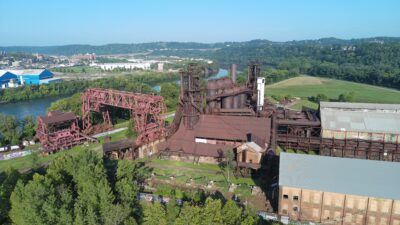
While Pittsburgh is sometimes held up as a successful example of urban reinvention in the Postindustrial Era, (think “eds and meds”), its transition away from steel has in fact been uneven and contested.

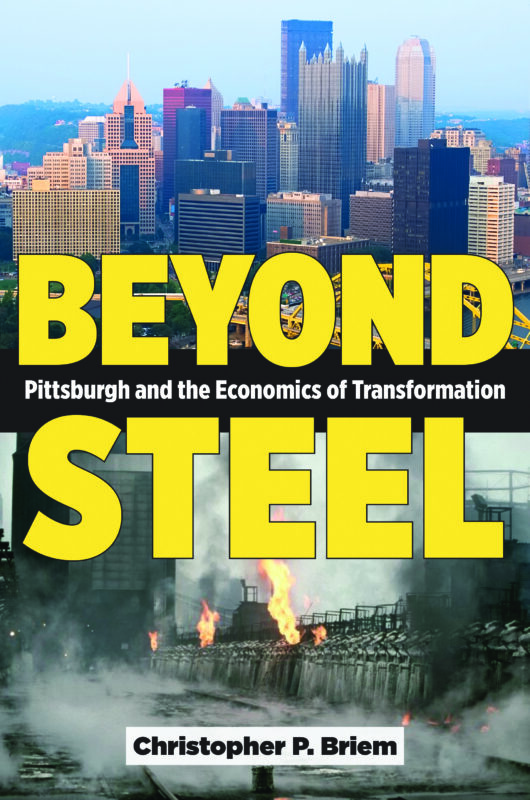
[Editor’s Note: University of Pittsburgh Economist Christopher Briem’s new book, Beyond Steel: Pittsburgh and the Economics of Transformation, is available for pre-order and is scheduled for release Feb. 3 2026.]
Beyond Steel is a collection of the author’s encyclopedic knowledge of Pittsburgh during and after its steelmaking heyday.
After growing up in the city’s working-class neighborhoods, Briem became an economist with the University of Pittsburgh’s program in Urban and Regional Analysis where he devotes his research to documenting decades of economic change, for better and worse.
Briem’s book tells stories about the boundary between resilience and obstinacy, particularly as manifested in the ultimately unsuccessful pursuit of economic development through smokestack chasing.
“Long before the 1980s arrived,” he writes, “future prospects for Greater Pittsburgh had decoupled from the prospects of the American steel industry, a reality that to this day remains difficult to accept for a region so long identified with the seemingly monolithic industry.”
At once optimistic and cautious, Beyond Steel informs debates about how communities across the Rust Belt navigate issues of dynamism, heritage, and deindustrialization.
Early buzz about the book from experts on Postindustrial Communities sings its praises.
Renowned Postindustrial Communities scholar Richard Florida writes:
Pittsburgh stands as the base case for economic revival and reinvention. In this deeply researched and compellingly told work, Christopher P. Briem takes us inside the forces that shaped the city’s rise as an industrial powerhouse, its devastating decline, and its captivating ongoing comeback. A must-read for all who care about the future of the Rust Belt, America, and postindustrial regions around the world.