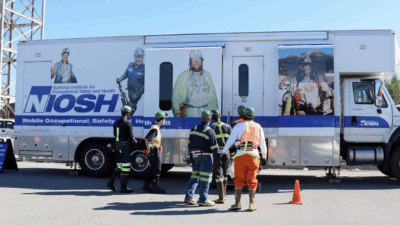
A mobile unit that provides free black lung screenings to coal miners is up and running again this month after federal cuts led to the service’s pause earlier this year, according to a news release from the Centers for Disease Control and Prevention.

The mobile testing unit — run by the National Institute for Occupational Safety and Health (NIOSH) — will be offering screenings in Morgantown and Marion County on Aug. 5. An additional screening event will be held in nearby Maryland on Aug. 27.
Details for the visits are as follows:
- 8 a.m. – 4:30 p.m. from Tuesday, July 29 to Thursday, July 31 at the National Mine Rescue Association’s Post 5 Mine Rescue Contest at Mylan Park (500 Mylan Park Lane, Morgantown, WV 26501)
- 8 a.m. – 3:30 p.m. on Tuesday, Aug. 5 at the Price Cutter in Mannington (1 Rainbow Plaza, Mannington, WV 26582)
- 8 a.m. – 3:30 p.m. on Aug. 27 at the Grantsville (Maryland) Volunteer Fire Department (178 Springs Road, Grantsville, MD 21536)
While appointments are recommended, they’re not required.
All coal miners — current and former, and from any part of a mine — are encouraged to take advantage of the free health assessments, which include a black lung screening as well as tests to analyze general lung health. All reports and screenings are confidential.
Assessments will take about 30 minutes per a person and include a work history and respiratory questionnaire, a chest X-ray, a blood pressure screening and a spirometry breathing test.
Those who participate in the screenings should receive results in eight to 10 weeks, per the release.
These screenings are crucial to helping with the early detection of black lung disease. Earlier detection of black lung allows miners to practice better mitigation, which can help slow the disease from progressing into more complicated and debilitating forms.
There is no cure for black lung. Experts say the best treatment is minimizing exposure to dangerous silica dust.
If miners receive a black lung diagnosis — either from the NIOSH mobile unit or another health care provider — they may qualify to apply for a Part 90 transfer through the federal Coal Mine and Safety Act of 1969. Part 90 transfers allow miners to relocate to a less dusty part of a mine without facing negative consequences like a cut in hours, pay or other retribution from mine operators.
NIOSH is the only entity qualified to certify X-ray results that are submitted as part of a Part 90 transfer request.
Earlier this year, the federal government made NIOSH a target for cuts through the new Department of Government Efficiency. All employees within the agency’s Coal Workers’ Health Surveillance Program — which oversees the mobile unit as well as the certification of black lung X-rays — were put on administrative leave in April with permanent firings initially scheduled for June and July.
In late April, a class action lawsuit was filed on behalf of a West Virginia coal miner against the federal Department of Health and Human Services. Harry Wiley, the lead plaintiff on the suit, had been diagnosed with black lung in November 2024. Because of the federal cuts, Wiley was unable to receive a response to his Part 90 transfer request or have his X-ray results certified by NIOSH, leaving him further exposed to silica dust that is known to worsen his condition.
In May, attorneys successfully argued that the federal government’s cuts were in violation of congressionally mandated rights afforded to Wiley and other coal miners in similar situations.
On May 13, U.S. District Judge Irene Berger issued a preliminary injunction in the class action case that ordered the “full restoration” of services at NIOSH’s Respiratory Health Division, which houses the CWHSP.
The federal government issued a certification to the federal court on June 2 testifying that employees were back at NIOSH in both the RHD and the CWHSP. At that time, however, more work remained to get the mobile unit back on the road. This month’s screening dates are the first to occur since the federal cuts took place.